NASA testing found that a natural gold-colored Kevlar(R) and PBI webbing met flammability criteria in a high-oxygen environment, though complete softgoods assemblies still require configuration and wear testing
Future lunar and Martian missions may use an atmosphere containing more oxygen at a lower pressure than Earth's sea-level environment. That combination could shorten the time astronauts must spend breathing oxygen before spacewalks, but it also makes ordinary textile materials easier to ignite. A NASA technical briefing reports that one commercial webbing made from 60% Kevlar(R) and 40% polybenzimidazole, or PBI, passed a required flammability test under those conditions.
Testing the webbing
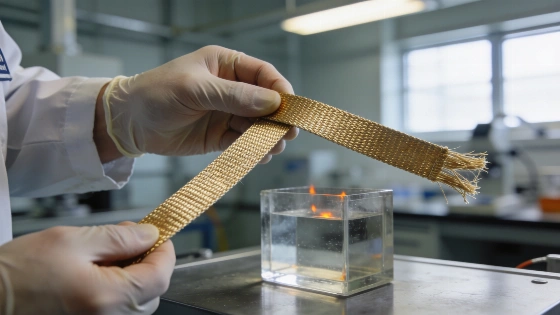
The work focused on narrow woven fabrics, commonly called webbing or woven tape. These materials appear in softgoods such as crew mobility aids, restraint nets and handles for storage bags. Standard meta-aramid and nylon webbings are not sufficient for the planned elevated-oxygen environment, so NASA's evaluation began with commercial-off-the-shelf candidates that could potentially be incorporated into flight hardware.
Tests were conducted at White Sands Test Facility using NASA-STD-6001B Test 1. The setup used an unshielded J configuration: an igniter contacted the front surface of the material rather than the cut edge, while the tested area included the webbing's lateral free edge. This arrangement matters because ignition behavior can change when a material is exposed from a different direction or when neighboring components alter heat flow.
At a fixed pressure of 8.2 psia, the test measured the maximum oxygen concentration, or MOC, at which at least five samples met the NASA criteria. One-inch-wide natural and black versions of the 60% Kevlar(R)/40% PBI webbing were examined. The natural webbing reached an MOC of 37% oxygen, while the black version reached 35%. The natural material therefore passed at the 37% oxygen and 8.2 psia condition being evaluated for future exploration environments.
What the results show
The result is a material-level flammability finding, not a certification of a completed spacecraft component. The natural webbing is gold colored, and the briefing also reports offgassing testing for that version under NASA-STD-6001B procedures. Offgassing measurements help identify volatile substances released by a material, which can affect crew health, contamination-sensitive equipment or optical surfaces in a spacecraft.
The distinction between a measured property and a broader engineering conclusion is important across space science. For example, spacecraft data used to estimate subsurface heating on Io require careful separation of observation from interpretation, a principle also reflected in Juno's measurements of Io's internal heat. Here, the direct evidence is narrower: samples behaved acceptably in a specified ignition test at a specified pressure and oxygen concentration.
Those measurements do not show that every version of the webbing will perform identically. The manufacturer offers widths from one-quarter inch to 8 inches, but the reported tests used one-inch-wide samples. Differences in width, weave, yarn size, density, surface treatment, color, fiber blend or edge finishing could alter how heat and flame move through the textile.
The assembly still matters
NASA did not assess the webbing after wear and tear in this testing. Abrasion, cuts, bending, contamination and repeated loading can change a textile's surface and expose fibers in ways that are not represented by unused laboratory samples. The study therefore cannot establish how the material would behave after service in a restraint, handle or mobility aid.
Nor can a favorable textile test predict the final flammability of a softgood by itself. Stitching, seams, fasteners, coatings, adjacent fabrics and the shape of the finished item can change ignition and flame spread. A webbing that passes as an isolated sample must be tested again in the complete configuration, using the dimensions and construction intended for flight.
The same caution applies to variants that appear visually similar. A black version of the webbing produced a lower MOC than the natural version in the reported tests, indicating that color or associated processing may affect performance. That difference does not by itself identify the cause, but it is enough to justify testing each proposed formulation rather than treating the fiber blend as the only relevant variable.
Why it matters for exploration
NASA's elevated-oxygen materials strategy is intended to make compliant textiles available as building blocks for future softgoods. The effort is being implemented by the Mars Campaign Office and Johnson Space Center with support from the NASA Engineering and Safety Center. Its first phase concentrates on commercially available textiles with a strong prospect of meeting the flammability requirements before they are incorporated into more complex hardware.
The natural Kevlar(R)/PBI webbing is useful in that process because it combines an available commercial product with a result at the target oxygen concentration and pressure. That makes it a candidate for additional design and qualification work, not a finished mission-ready solution. Engineers will still need to examine mechanical strength, flexibility, long-term wear, contamination, manufacturing consistency and behavior when the webbing is combined with the other materials in a softgood.
Elevated oxygen increases the proportion of oxygen molecules available to support combustion, while reduced pressure changes how heat, gases and flame propagate. A material can therefore behave differently from the way it would in ordinary room air. NASA-STD-6001B provides a controlled basis for comparing candidates, but the test represents one ignition geometry and one set of environmental conditions rather than every situation an astronaut's equipment could encounter.
A maximum oxygen concentration is not a universal safety threshold for an entire vehicle. It is the highest concentration at which the tested samples met the specified criteria at the chosen pressure and under the chosen procedure. Engineers must combine that evidence with configuration testing and durability data before deciding whether a webbing is appropriate for a particular lunar or Martian application.