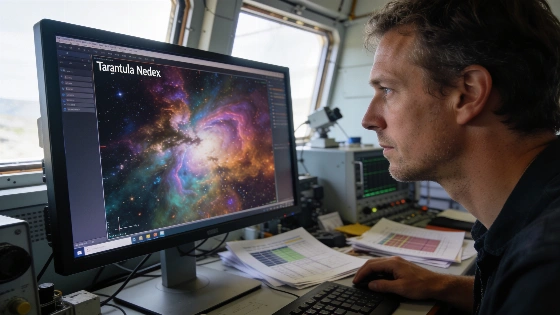
A composite image from Chandra, Webb, and Hubble reveals how the Tarantula Nebula in the Large Magellanic Cloud is shaped by young stars and energetic gas, offering new insight into star formation and nebular evolution
A new composite image of the Tarantula Nebula, also known as 30 Doradus, combines data from NASA's Chandra X-ray Observatory, James Webb Space Telescope, and Hubble Space Telescope to reveal the complex interplay of gas, dust, and young stars in one of the most active star-forming regions in the local universe. The nebula, located in the Large Magellanic Cloud about 160,000 light-years from Earth, is a key laboratory for understanding how massive stars influence their environment.
Multiwavelength Observations
The latest image integrates X-ray, infrared, and optical data to highlight different physical processes within the nebula. Chandra's X-ray observations trace hot gas heated to millions of degrees by shock waves from stellar winds and supernova remnants. Webb's infrared data penetrate dust clouds, revealing thousands of young stars and regions rich in cool dust that may eventually form new stars and planets. Hubble's optical imaging captures warmer hydrogen gas and resolves individual stars embedded in the nebula's intricate structure.
This multiwavelength approach allows astronomers to disentangle the contributions of various stellar populations and energetic processes. By comparing the spatial distribution of hot gas, dust, and ionized hydrogen, researchers can better understand how feedback from massive stars sculpts the surrounding material and regulates further star formation.
Energy Loss and Nebular Evolution
Analysis of the combined datasets suggests that the Tarantula Nebula is losing energy through several mechanisms, including the escape of hot gas from the region. The outflow of this gas, driven by the collective winds of young, massive stars, may help disperse the nebula's material and limit the efficiency of star formation over time. The findings are consistent with previous studies that have identified similar feedback-driven processes in other star-forming regions, but the scale and detail available in 30 Doradus provide a unique opportunity to test theoretical models.
Researchers also incorporated archival data from the retired Spitzer Space Telescope to extend the wavelength coverage and improve constraints on dust properties. The combination of these observatories enables a more complete census of the nebula's stellar content and the physical conditions shaping its evolution.
Implications for Star Formation
The Tarantula Nebula's proximity and richness in young, massive stars make it an ideal target for studying the interplay between stellar feedback and the interstellar medium. The observed energy loss mechanisms may influence the nebula's lifetime and the eventual dispersal of its gas and dust, affecting the formation of subsequent generations of stars and planets. These insights are relevant not only for understanding local star-forming regions but also for interpreting observations of more distant galaxies where similar processes operate on larger scales.
As astronomers continue to analyze data from advanced space telescopes, they are refining models of how massive stars shape their environments. This work complements ongoing efforts to monitor the lunar surface for seismic activity, such as the deployment of the Lunar Environment Monitoring Station by Artemis astronauts, as described in recent mission updates.
Understanding the feedback processes in regions like the Tarantula Nebula is essential for building a comprehensive picture of galactic evolution and the conditions that lead to planet formation.
To interpret images like the new Tarantula Nebula composite, it is important to recognize how astronomers use multiwavelength data. Each telescope observes a different part of the electromagnetic spectrum, revealing distinct physical processes: X-rays trace extremely hot gas, infrared penetrates dust to uncover hidden stars, and optical light highlights ionized gas and stellar populations. By combining these datasets, researchers can reconstruct a more complete and physically accurate view of complex astronomical objects, while also identifying the limitations and uncertainties inherent in each observational method.