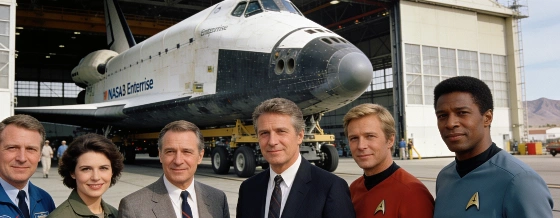
On September 17, 1976, NASA introduced its first space shuttle orbiter, OV-101. Named Enterprise after a wave of public support, the vehicle played a central role in early shuttle flight tests and set the stage for the program's future.
NASA unveiled its first space shuttle orbiter, OV-101, on September 17, 1976. The rollout in Palmdale, California, marked a new approach to testing reusable spacecraft. Although Enterprise was never meant to fly in space, its introduction changed how NASA prepared for operational shuttle missions. In 2026, NASA marked the 50th anniversary of the event, noting Enterprise as the first shuttle shown to the public and recalling the significance of its debut.
How the public named the shuttle
OV-101 was almost called Constitution, in honor of the U.S. bicentennial and Constitution Day. That changed after nearly 100,000 Star Trek fans wrote to the White House, asking that the shuttle be named Enterprise after the fictional starship. President Gerald Ford approved the new name, making it one of the few times public input directly shaped a major NASA decision. NASA's own historical review documents the episode, which is often cited in studies of science communication and public engagement, including work by the Max Planck Society and journals like Nature.
The rollout ceremony at Rockwell's Palmdale plant drew hundreds of guests, including Star Trek creator Gene Roddenberry and several original cast members. Their presence, alongside NASA officials, highlighted the mix of scientific ambition and popular culture that defined the shuttle era. This moment is often referenced in discussions about how public perception can influence large-scale research programs.
Enterprise's role in shuttle testing
Enterprise never flew in space, but it was essential to the shuttle program's early development. NASA used the orbiter for atmospheric test flights, gathering data on aerodynamics, landing, and systems integration. These tests, carried out by NASA engineers and detailed in technical reports, laid the groundwork for the shuttle program, which launched its first space missions in 1981. The Approach and Landing Tests (ALT) included both uncrewed drop tests and piloted free flights, allowing engineers to analyze flight control and landing performance in real conditions.
Enterprise's flights were limited to Earth's atmosphere, but the lessons learned shaped the design and operation of later orbiters. Today, Enterprise is on display at the Intrepid Sea, Air & Space Museum in New York City, as confirmed by a 2026 Space.com review. Its story is often used in educational materials from places like MIT and Stanford to show the importance of step-by-step engineering validation in aerospace projects.
Context and impact
Enterprise debuted at a time when NASA was rethinking crewed spaceflight. The shuttle program aimed to create reusable vehicles that could both launch and return, a major shift from earlier expendable designs. The public's involvement in naming the shuttle reflected a wider cultural interest in space exploration, similar to other moments in NASA history, such as earlier missions that tested new ideas. The timing of the rollout, on Constitution Day during the bicentennial, gave the event a clear historical context, as noted in NASA's 50th anniversary materials.
Enterprise's atmospheric tests did not produce dramatic images of spaceflight, but they gave engineers the confidence to move forward with orbital missions. Using a dedicated test vehicle set a model for future programs that need to balance innovation with safety. This approach has since been studied by research teams at CERN and in aerospace engineering departments worldwide, showing the value of thorough ground and flight testing before sending people into space.
Enterprise's story shows how public enthusiasm and technical needs can come together in the development of space technology. Its legacy is not about distance traveled, but about the foundation it provided for the shuttle fleet. The decision to involve the public in naming the orbiter, and its use in key flight tests, highlight the connection between culture and engineering in space history. For more technical details on the shuttle's test program, see the official NASA briefing on the Approach and Landing Tests.
Understanding the role of test vehicles like Enterprise means looking at how spacecraft are validated. Before a new crewed vehicle can fly in space, engineers run a series of ground and flight tests to check aerodynamics, control systems, and landing performance. These steps are crucial for finding design limits and making sure crews are safe. Enterprise's flights provided real-world data that simulations and wind tunnels could not fully match, making it a key part of the transition from concept to operational shuttle missions.