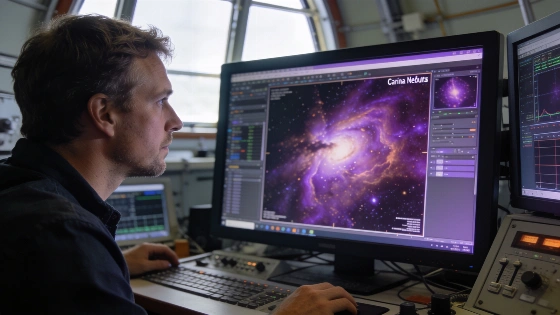
A new image from the James Webb Space Telescope's NIRCam instrument captures a dense cluster of young stars in the Carina Nebula, offering fresh insight into stellar formation and the evolution of massive star groups
The James Webb Space Telescope (JWST) has delivered a detailed new view of the Carina Nebula, one of the Milky Way's most active star-forming regions. Using its Near-Infrared Camera (NIRCam), JWST imaged a feature known as the "Treasure Chest," a compact cluster of young stars embedded within dense clouds of gas and dust. This observation provides astronomers with a sharper look at the early stages of stellar evolution in a region previously imaged by other telescopes, but never with this level of infrared detail.
Imaging the Treasure Chest
The Carina Nebula lies approximately 7,500 light-years from Earth in the southern constellation Carina. The "Treasure Chest" is a nickname for a cluster of about 70 young stars, many still partially enshrouded by the nebula's gas and dust. JWST's NIRCam, sensitive to infrared wavelengths, can penetrate these obscuring materials, revealing stars that are otherwise hidden in visible light. The most massive star in the cluster is estimated to be around 19 times the mass of the Sun, highlighting the diversity of stellar types forming in this environment.
Infrared imaging is crucial for studying star formation because it allows astronomers to observe objects embedded within thick interstellar clouds. The new JWST image shows not only the stars themselves but also the complex structure of the surrounding nebula, including filaments and cavities shaped by stellar winds and radiation.
Revising the Cluster's Age
One of the key scientific questions addressed by this observation is the age of the Treasure Chest cluster. Earlier estimates, based on less sensitive data, suggested the stars could be as young as 100,000 years. However, the latest analysis using JWST data indicates an age closer to 1.3 million years. This revision has significant implications for understanding how quickly massive stars form and how their energy output influences the surrounding nebula.
Determining the age of young star clusters is challenging due to uncertainties in stellar evolution models and the effects of dust obscuration. The improved resolution and sensitivity of JWST's instruments help reduce these uncertainties, but some ambiguity remains, especially for the most deeply embedded objects.
Scientific Implications and Future Observations
The Carina Nebula has long been a target for astronomers studying the life cycles of stars. Each new observation with advanced instruments like JWST can reveal previously unseen features and prompt revisions to established models. The ability to resolve individual stars within dense clusters is essential for testing theories of star formation and feedback processes.
As the Treasure Chest cluster continues to evolve, its most massive stars will become even more luminous, potentially illuminating additional regions of the nebula and exposing further details. These observations also complement studies of other stellar explosions and remnants, such as the rare Type Ic supernova recently observed by China's Einstein Probe, which was discussed in a recent Science Report article on the earliest moments of massive star death.
Continued monitoring of the Carina Nebula with JWST and other observatories will help clarify the timescales and physical processes that govern the birth and evolution of stars in extreme environments.
Understanding how astronomers interpret images like those from JWST requires some background in infrared astronomy. Unlike visible-light telescopes, infrared instruments can detect heat emitted by objects that are otherwise hidden by dust. This capability is especially important in star-forming regions, where thick clouds block most optical light. By analyzing the intensity and color of infrared emission, scientists can estimate the temperature, mass, and age of young stars, as well as map the structure of the surrounding nebula. However, these measurements depend on accurate calibration and careful modeling to separate the effects of dust, gas, and stellar light.