Mitsubishi Motors and Highlanders plan to mass-produce AI-enabled humanoid robots for industrial automation at a repurposed Kyoto facility, targeting up to 1,000 units per month by early 2027, with initial deployment on engine assembly lines
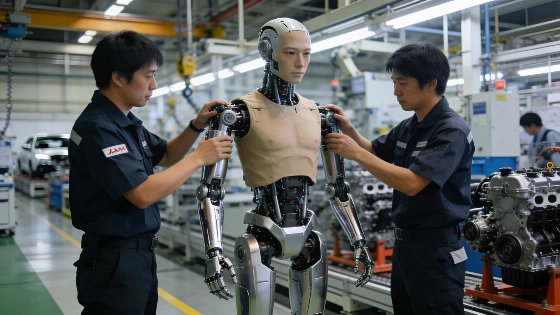
Mitsubishi Motors has announced a partnership with Tokyo-based robotics startup Highlanders to begin mass production of AI-enabled humanoid robots at its Kyoto plant, with manufacturing scheduled to start in early 2027. The project will convert an unused engine production line into a dedicated robot assembly area, aiming for a reported output of up to 1,000 units per month. The robots, developed by Highlanders, are intended for industrial automation and will first be deployed on Mitsubishi's own engine manufacturing lines to perform factory tasks and generate operational data for further refinement.
The initial deployment phase will focus on integrating the robots into existing production environments, where they will be tasked with repetitive or ergonomically challenging operations. Mitsubishi and Highlanders state that the robots will use a combination of AI-powered perception, motion planning, and natural-language interaction to perform assigned tasks. The first robots will be evaluated in controlled factory settings, with performance data collected to improve reliability and safety before broader commercial rollout. After this internal validation, the companies plan to offer the robots to other manufacturers and businesses facing labor shortages.
Highlanders, a University of Tokyo spin-off founded in 2023, specializes in general-purpose humanoid and quadruped robots designed for manufacturing, logistics, infrastructure inspection, and disaster response. The company's flagship humanoid platform, HL Human, was first demonstrated in 2025 and features a 19-degree-of-freedom body with high-output electric actuators for human-like movement. According to developer specifications, the robot is designed to autonomously execute complex industrial tasks, with future versions planned to include dexterous five-finger hands capable of grasping objects up to 3 kilograms. The company is also developing a physical AI framework to enable robots to interpret instructions, perceive their environment, and act with minimal human intervention.
Mitsubishi's investment in Highlanders is intended to combine the startup's robotics technology with the automaker's established manufacturing processes and quality control systems. By leveraging idle factory capacity and existing production expertise, Mitsubishi aims to scale up robot manufacturing while maintaining reliability standards typical of automotive assembly. The company has not disclosed detailed technical documentation or independent evaluation results for the robots' performance in real-world industrial settings. As with other recent efforts to automate factory work using humanoid robots, such as those by Tesla and Google DeepMind, the transition from prototype to reliable deployment remains a significant engineering challenge. For context, Google DeepMind recently expanded its Gemini Robotics model to full-body humanoid control, enabling walking and object manipulation across different robot platforms (see coverage of Gemini Robotics expansion).
According to company statements, the HL Human prototype is equipped with AI-driven perception and motion planning, but the extent of its autonomy and safety in unsupervised environments has not been independently verified. The robots are expected to operate under human supervision during initial deployment, with Mitsubishi collecting operational data to identify failure modes and refine control algorithms. The companies have not released information on the robots' safety certification, compliance with industrial robotics standards, or the frequency of human intervention required during testing. The broader vision includes simulation software to accelerate robot training and deployment, but the effectiveness of these tools in reducing real-world integration risks remains to be demonstrated.
Highlanders' approach reflects a growing trend among robotics developers to combine physical AI with scalable manufacturing, but the gap between laboratory demonstration and dependable factory operation is substantial. The companies have not specified which industrial tasks will be fully automated, nor have they detailed the limits of robot dexterity, speed, or error recovery in complex environments. As with other humanoid-robot initiatives, the reliability, safety, and cost-effectiveness of large-scale deployment will depend on rigorous evaluation, transparent reporting, and ongoing human oversight.
Humanoid robots are designed to mimic human form and movement, enabling them to operate in environments built for people and use existing tools and infrastructure. However, achieving reliable autonomy in unstructured industrial settings remains a major technical challenge. Most current systems rely on a combination of pre-programmed routines, AI-based perception, and human supervision to ensure safety and task completion. The transition from controlled demonstrations to routine factory use requires extensive testing, safety certification, and adaptation to unpredictable real-world conditions. As the field advances, the distinction between automation and true autonomy-and the role of meaningful human control-remains central to both engineering and regulatory oversight.