Venus reaches its widest evening separation from the Sun on Aug. 15, while Mercury and Jupiter pass within 0.6 degrees before dawn in a difficult but rewarding conjunction
August offers a split planetary display: Venus remains the dominant object after sunset, while Mercury and Jupiter gather low in the eastern sky before sunrise. The most unusual pairing comes on the morning of Aug. 15, when the smallest and largest planets appear less than 0.6 degrees apart. Their proximity will not make them easy to see; from mid-northern latitudes, both will be submerged in brightening twilight and only about 65 minutes above the horizon before sunrise.
Venus Turns South
Venus reaches greatest elongation on the evening of Aug. 15, appearing 46 degrees east of the Sun. That geometry normally suggests a strong evening apparition, but elongation alone does not determine how high a planet will stand. Venus's declination carries it well south of the Sun, so its apparent track meets the western horizon at a shallow angle during late summer.
As a result, Venus sets progressively lower toward the west-southwest as August advances. At greatest elongation, it reaches the horizon around the end of evening twilight rather than remaining in a fully dark sky. During the second half of the month and into September, the planet will set in increasingly bright twilight, even though it remains exceptionally luminous.
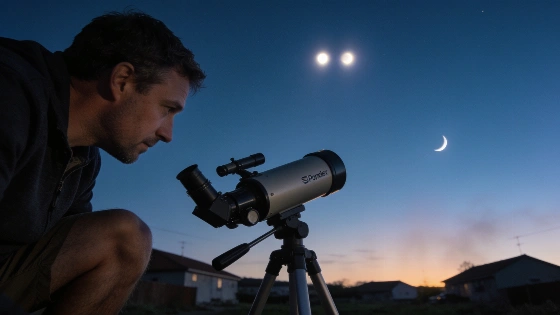
Venus brightens from magnitude -4.2 to -4.5 during the month and shows a phase close to half illuminated when viewed through a telescope. On Aug. 15, a crescent Moon will sit to the lower right of the planet. The changing appearance reflects orbital geometry: as Venus moves around the Sun, the visible fraction of its sunlit hemisphere changes in much the same way that the Moon's phases do.
Mercury Meets Jupiter
Mercury provides the first morning target. On Aug. 2, it reaches a greatest elongation of 19 degrees and should appear as a point of roughly magnitude +0.2 low in the east-northeast about 50 minutes before sunrise. It then drops closer to the horizon each morning while brightening rapidly, reaching magnitude -0.7 on Aug. 9 and -1.3 by Aug. 16.
On Aug. 9, the stars Castor and Pollux in Gemini offer a useful visual guide. Extending the line between them downward toward the east-northeast leads toward Mercury. The following morning, Aug. 11, an extremely thin crescent Moon will lie about 2 degrees above Mercury; the Moon will be only 2% illuminated and roughly 32 hours from new.
Jupiter was in conjunction with the Sun on July 29 and remains too close to the Sun for unaided viewing on Aug. 5. It rises into visibility by moving about two-thirds of a degree higher each morning. Around Aug. 12, it should appear about 5 degrees to the lower left of Mercury shortly before sunrise. From Aug. 13 through Aug. 17, the planets remain less than 4 degrees apart, with the closest approach on Aug. 15.
The conjunction will be difficult because the planets will lie only about 12 degrees west of the Sun and roughly 10 degrees above the east-northeastern horizon at sunrise. Jupiter, at magnitude -1.8, will be about twice as bright as Mercury, but both will be competing with the sky's rapidly increasing background light. Binoculars may help locate them, provided the Sun is still safely below the horizon and the observer has an unobstructed view.
Mars Before Dawn
Mars rises around 2 a.m. local daylight time and stands about 20 degrees above the east-northeast horizon when dawn begins roughly two hours later. It continues to brighten as Earth approaches it, but the improvement will be gradual rather than dramatic. Even at the end of August, Mars will remain about 277.1 million kilometers away.
That distance is an inferred orbital separation rather than a direct measurement made by a telescope during each observing session. Planetary positions are calculated from well-tested orbital models, while the planet's apparent brightness depends on distance, illumination and the surface and atmospheric properties that determine how much sunlight it reflects.
On Aug. 9, Mars will appear about 4.5 degrees to the right of a waning crescent Moon. For observers comparing this view with the Moon's July appearance, the contrast is useful: the earlier Buck Moon's changing visibility was shaped by lunar phase and local atmospheric conditions, whereas Mars's slow brightening is primarily governed by orbital geometry and reflected sunlight.
Saturn Through Telescopes
Saturn is the month's best-placed telescopic planet. It rises a few hours after sunset near the border between Cetus and Pisces, then climbs into a commanding position in the south-southeast by dawn. Its rings are still tilted enough to provide a clear view through a telescope, although their apparent opening will narrow somewhat in the months ahead.
Saturn's position makes it less dependent on the brief viewing windows that limit Mercury and Jupiter. Observers can find it late in the evening, when the sky is fully dark, and continue following it toward morning. On the night of Aug. 3, it will appear to the lower right of a gibbous Moon, providing a convenient nearby reference point.
Angular distances in the sky can be estimated without specialized equipment. A clenched fist held at arm's length spans about 10 degrees, three adjacent fingers cover roughly 5 degrees, and a single finger is close to 1 degree. These estimates are sufficient for locating the wider planetary arrangements, but the Aug. 15 Mercury-Jupiter pairing is too tight for the fist method and requires careful scanning with binoculars or a telescope.
The apparent separation between two sky objects is an angle measured from Earth, not a physical distance between the objects. Mercury and Jupiter will look close because their lines of sight nearly overlap from our viewpoint, while the planets remain separated by vast distances in the Solar System. Similarly, greatest elongation describes an object's angular distance from the Sun in our sky; it does not mean the planet has reached its greatest physical distance from the Sun.