Analysis of NASA spacecraft data suggests Mars's southern mantle is hundreds of degrees warmer than the north, challenging assumptions about the planet's internal symmetry and geological history
New research using decades of NASA orbital data has revealed a striking thermal asymmetry deep within Mars, with the planet's southern hemisphere exhibiting mantle temperatures hundreds of degrees higher than those beneath the north. The finding, published in Nature, challenges the long-standing assumption that Mars's interior is largely spherically symmetric and raises new questions about the planet's geological evolution and potential for past habitability.
Evidence from Orbital Dynamics
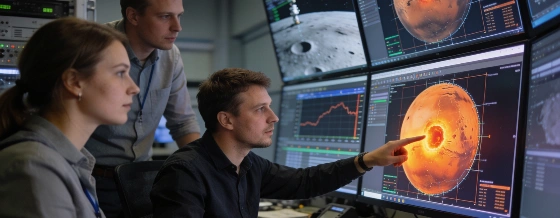
The study team, led by Alexander Berne, analyzed archival tracking data from three NASA orbiters-Mars Global Surveyor, Mars Odyssey, and Mars Reconnaissance Orbiter. By examining subtle changes in the spacecrafts' orbital velocities, the researchers inferred variations in Mars's gravitational field. These variations, when modeled using a technique called tidal tomography, allowed the team to estimate differences in internal structure and temperature between the hemispheres.
The analysis indicated that the mantle beneath Mars's southern hemisphere is between 200 and 400 degrees Celsius (390-750 degrees Fahrenheit) warmer than the mantle beneath the northern hemisphere. This temperature difference is significant enough that parts of the southern mantle may remain partially molten, a condition that could have influenced the duration of volcanic activity and the planet's thermal evolution.
Surface Dichotomy and Internal Structure
Mars's surface is already known for its pronounced north-south dichotomy: the northern hemisphere is dominated by low-lying plains, while the southern hemisphere features thicker, heavily cratered highlands. The crust in the south averages about 25 kilometers thicker than in the north. This asymmetry has long been recognized, but the new evidence suggests that the internal temperature structure is even more extreme than previously thought.
The hotter southern mantle may help explain several puzzling observations. For example, seismic data from NASA's InSight lander showed that seismic waves dissipate more rapidly in the south, consistent with higher temperatures. Magnetic anomalies detected in iron-bearing minerals in the southern crust also align with the idea that past heating exceeded the Curie temperature, erasing and then re-inducing magnetic signatures after Mars's global magnetic field faded over four billion years ago.
Possible Origins and Alternative Explanations
The origin of Mars's hemispheric differences remains uncertain. One leading hypothesis is that a giant impact early in Mars's history excavated the northern lowlands, creating a thinner crust and allowing the northern mantle to cool more rapidly. Alternatively, the thicker southern crust may have acted as an insulating lid, trapping heat and slowing cooling in the south. Both scenarios are consistent with the observed gravitational and thermal data, but distinguishing between them will require higher-resolution gravity measurements and further modeling.
These findings add to a growing body of evidence that planetary interiors can be far more complex than simple models suggest. Similar asymmetries have been observed in other solar system bodies, as highlighted by the discovery of double-lobed structures in solar ejections tracked by multiple spacecraft (see related coverage), underscoring the importance of multi-instrument, multi-mission datasets in planetary science.
Implications for Mars Exploration
The presence of a warmer, potentially partially molten southern mantle could have influenced Mars's volcanic and tectonic history, as well as the persistence of subsurface heat sources relevant to past habitability. The tidal tomography method demonstrated in this study may also be applicable to other planets and moons, offering a new tool for probing internal structures where direct seismic data are unavailable.
Future missions equipped with more sensitive gravity and seismic instruments could help resolve the outstanding questions about Mars's internal evolution. For now, the evidence points to a planet whose interior is as divided as its surface, with implications for understanding planetary formation and the diversity of terrestrial worlds.
To interpret these results, it is essential to understand how gravity field measurements can reveal internal planetary structure. As a spacecraft orbits a planet, tiny changes in its velocity-caused by variations in the planet's mass distribution-can be detected through precise tracking. By modeling these changes and accounting for external influences such as solar tides, scientists can infer differences in density and temperature deep below the surface. While this approach cannot directly image the interior, it provides critical constraints on models of planetary evolution and helps identify regions where further investigation may yield the greatest scientific return.