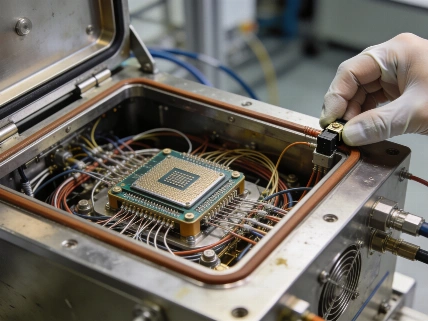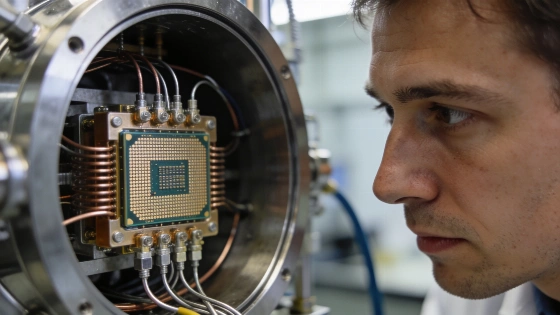
LTM says its AI-QEM circuit function is available through IBM Quantum for eligible plan users, with reported benchmarks on circuits running across as many as 100 qubits
Expectation values from quantum circuits can shift when gate errors and environmental decoherence alter a processor's output. LTM says its AI-QEM software addresses that problem with classical inference. On November 12, 2026, the company announced that the function was available in the IBM Quantum Functions Catalog, describing itself as the first global systems integrator to publish a function there. IBM Quantum had outlined the catalog's beta launch the previous day in a developer update.
What the Function Does
The circuit function is designed to integrate with Qiskit Estimator workflows. It decomposes observables into Pauli operators, then uses a trained neural network to rescale each noisy expectation value: ⟨Pi⟩mitigated = ⟨Pi⟩noisy / ζi. The model predicts per-Pauli correction factors from circuit structure. Backend topology and qubit calibrations also inform its predictions.
LTM describes the architecture as a Graph Convolutional Network (GCN)-Transformer. The approach uses classical deep-learning inference to adjust results without extra QPU runtime, additional circuit repetitions or ancilla qubits. That is a distinct route from methods that gather more quantum samples to estimate how noise affects an answer. In its launch announcement, LTM said the models learn and correct device-specific error patterns through classical post-processing.
Reported Benchmarks
LTM reports 95.06% accuracy on 100-qubit Clifford circuits at depth 45. On 96-qubit 2D Ising runs, it reports 90.29% accuracy. The company also gives a mean absolute error (MAE) of 0.343 across validation suites spanning 80 to 150 qubits, and says the model outperformed random-forest mitigation baselines. LTM says it validated AI-QEM on IBM Quantum computers across circuit sizes and complexities, including experiments involving more than 100 qubits.
For tests on ibm_kingston, LTM reports that the function matched native IBM EstimatorV2 QPU times: 12 seconds for commuting workloads and 23 seconds for non-commuting workloads. These are reported platform benchmarks, with the accuracy figures and timings attributed to the company.
Noise Without Sampling
Zero-noise extrapolation (ZNE) and probabilistic error cancellation (PEC) compensate for noise by running ensembles of modified circuits. Those extra executions can create substantial sampling overhead. AI-QEM instead applies learned correction factors to noisy expectation values, avoiding additional quantum sampling according to LTM.
The function's stated scope is the IBM Heron processor family. It is applied when |⟨O⟩noisy| ≥ 0.1, targeting expectation values away from zero because the method can amplify noise near zero. That threshold is an operating limit, not evidence that the method corrects every noisy output.
Scope of the Claim
LTM calls itself the first global systems integrator to publish a circuit function on the platform. AI-QEM is listed for eligible IBM Quantum access plans, including Premium, Flex and On-Prem users, and is intended for use in Qiskit workflows. IBM describes Quantum Functions as a beta catalog of ecosystem tools that users can add to an IBM Quantum Platform instance. Its November 11 developer update listed AI-QEM alongside Quantum Elements' Orbit function among new circuit functions for error management.
The launch is accompanied by an IBM Quantum tutorial on Trotterized time evolution of the 2D tilted-field Ising model. IBM Quantum Adoption and Business Development Vice President Scott Crowder said the AI-QEM listing reflected the growing role of ecosystem partners in expanding tools for the quantum community. A separate QCi project report describes a planned comparison of a room-temperature photonic optimizer with classical methods, illustrating a different stage of evidence from a published circuit function with reported hardware benchmarks.