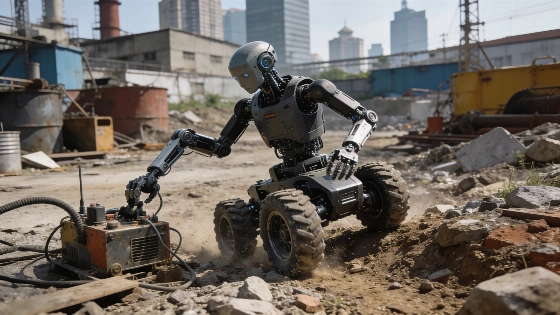
Run Robotics has demonstrated a wheel-leg hybrid robot at WAIC 2026, combining rapid wheeled movement with robotic arms for inspection, firefighting, and emergency response in complex environments. Most components are domestically sourced
Shanghai-based Run Robotics has presented a new wheel-leg hybrid robot at the 2026 World Artificial Intelligence Conference (WAIC 2026), aiming to address industrial inspection and emergency response in environments that challenge conventional mobile robots. The system, described by the company as a "centaur" robot, integrates a four-wheel all-terrain chassis with a human-like upper body equipped with robotic arms. This configuration is intended to combine the speed and efficiency of wheeled locomotion with the manipulation capabilities of articulated arms, targeting tasks that require both mobility and physical interaction in hazardous or irregular settings.
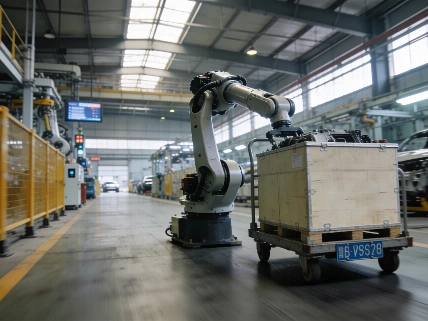
The robot's lower body uses four wheels to traverse uneven ground and hazardous sites, while the upper body is designed for manipulation tasks such as clearing debris, operating equipment, and supporting rescue operations. According to Run Robotics, the platform can be configured with dual arms, dexterous hands, and multidimensional force sensors, depending on operational requirements. The company reports that the robot can carry a typical payload of 100-120 kilograms and support a maximum static load of 210 kilograms. The system is engineered to meet explosion-proof standards and is intended to remain lightweight for deployment in industrial and emergency scenarios.
Perception and Autonomy
The robot is equipped with a proprietary perception system that fuses lidar, binocular vision, and depth cameras. This sensor suite is designed to identify pipelines, valves, gauges, obstacles, and people, estimate their positions, and assess operational status. Run Robotics states that the robot can autonomously plan routes, avoid obstacles, and locate targets for manipulation, creating a closed loop from perception to action. However, the company has not disclosed the extent of human supervision required during operation, nor has it provided independent evaluation of the robot's autonomy in unstructured or dynamic environments.
While the robot is described as suitable for autonomous inspection, firefighting, emergency rescue, mining, oilfield inspection, and industrial maintenance, the evidence for reliable performance in these settings is currently limited to company demonstrations. The robot's modular design allows for adaptation to different tasks, but no systematic field trials or third-party safety assessments have been reported. According to Run Robotics, more than 95 percent of the robot's core components are manufactured in China, reflecting a focus on domestic supply chains and local engineering capability.
Deployment Status and Commercial Claims
Run Robotics has established its research and production base in Shanghai's Zhangjiang Science City, citing access to engineering talent and industrial infrastructure as factors supporting development. The company reports that it has secured commercial orders for the robot and plans to complete an automated assembly line by the fourth quarter of 2026. The robot's unveiling was highlighted at WAIC 2026, an event featuring over 1,000 companies and 3,000 exhibits, with the "centaur" robot named among the top ten exhibits by China's state broadcaster. However, no independent verification of commercial deployment or operational reliability has been made public.
According to a report from Global Times, the robot's design is intended to overcome limitations of conventional humanoid and wheeled robots, particularly in environments where bipedal walking is unreliable or where manipulation tasks exceed the capabilities of traditional inspection robots. The company positions the system as a response to longstanding challenges in adaptability, operational range, and large-scale deployment. Nonetheless, the absence of published field data, peer-reviewed evaluation, or systematic safety testing means that the robot's real-world effectiveness and risk profile remain uncertain.
Technical and Sector Context
Measured specifications provided by Run Robotics include a typical payload capacity of 100-120 kilograms, a maximum static load of 210 kilograms, and a modular upper body that can be equipped with various manipulation tools. The perception system integrates lidar, stereo vision, and depth cameras, but the company has not disclosed sensor resolution, processing latency, or failure rates. The robot is reported to meet explosion-proof requirements, but no certification details or compliance with international safety standards have been published. The company claims that the robot's core components are over 95 percent domestically produced, aligning with broader trends in China's robotics sector, which, according to the Ministry of Industry and Information Technology, now accounts for more than half of global humanoid robot models and nearly 70 percent of quadruped robot sales.
At present, the robot's status is that of a demonstrated prototype with announced commercial interest, but without independent field validation or regulatory approval for deployment in safety-critical environments. The system's autonomy, manipulation reliability, and safety under real-world conditions have not been independently tested or certified. As with many advanced robotics demonstrations, the gap between laboratory or exhibition performance and routine operational deployment remains significant, particularly in environments where human safety and infrastructure integrity are at stake.
Understanding the distinction between automation and autonomy is central to interpreting robotics demonstrations. Automation refers to the execution of predefined tasks with minimal human intervention, often in structured environments. Autonomy, by contrast, requires the system to perceive, decide, and act in dynamic, unpredictable settings, adapting to novel situations without direct human control. Many robots described as autonomous in marketing materials still depend on human supervision, remote intervention, or pre-mapped environments. Reliable autonomy in complex, safety-critical domains remains a major engineering and regulatory challenge, and claims of autonomous operation should be evaluated in light of the evidence for independent, repeatable performance under real-world conditions.