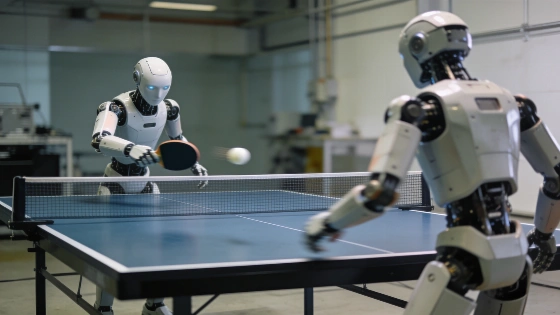
Two Unitree G1 humanoids kept a table-tennis rally going for more than 10 alternating strikes. PingpongDuo also raised simulated ball-return success by 13.2 percent over a baseline, but its real-world test remains a narrow demonstration.
More than 10 alternating strikes: that was the longest reported real-world rally by two Unitree G1 humanoids using PingpongDuo. In a preprint posted on October 14, 2026, the nine authors describe how the system coordinates movement around a shared table-tennis task. The result demonstrates paired control, not reliable play across different venues or the full range of conditions in competitive doubles.
Doubles demands more coordination than simply hitting a ball. The robots share limited space on one side of the table, taking turns to strike while clearing the central hitting area after each shot. PingpongDuo is a hierarchical control structure built to manage those demands and reduce the risk of collisions between teammates. The team-level planner sets positioning targets for both robots, while individual controllers handle footwork and racket actions.
A learned risk estimator checks proposed movements for possible contact involving a robot's hands or feet, along with collisions between the robots' bodies. A safety filter adjusts risky plans and gives priority to the robot preparing to strike. The planner so coordinates positioning and clearance of the shared workspace; it does more than assign the next shot.
Each robot also uses separate learned policies for footwork and racket control. Researchers trained the movement policy on human doubles footage and built a library of about 200 footwork sequences for different travel distances. The skills draw on body positions and movements generated by other skills, allowing transitions between striking and making space, followed by recovery or waiting, without first returning to a standard stance.
That design is relevant to other coordinated robotics work, including a robot-team study focused on construction tasks. The environments and goals differ: PingpongDuo must respond to a moving ball as two machines share a confined area.
A separate racket-arm policy adjusts seven joints based on the robot's current state and estimates of the ball's position and velocity. To train it, the researchers calibrated a physics simulator against real measurements, including ball flight, table bounces and racket contact. In simulation, the system increased successful ball returns by 13.2 percent compared with the baseline method.
The evaluation also measured positioning during clearance, with an error of about 2 centimeters. In a separate physical test, one robot completed a 2.15-meter clearance-and-recovery cycle in 2.4 seconds and reached a peak speed of 2.23 meters per second. In real-world experiments, the pair sustained more than 10 consecutive strikes in strict alternation. These figures come from distinct tests: the return-rate improvement came from simulation, while researchers demonstrated the rally and movement cycle on hardware.
The researchers report that the setup relies on external motion-capture equipment and does not account for ball spin. The demonstration covers coordinated control in a particular test setup; it does not show performance without motion capture or play across varied tables and conditions. These results remain a research demonstration, not evidence of a commercial table-tennis system or competitive-level performance.
PingpongDuo's findings appear in the PingpongDuo preprint, authored by Haoran Jiang, Yichao Zhong, Kai Zhang, Cheng Liu, Yixuan Pan, Zhenjie Yang, Jingbo Wang, Tianyu Li and Li Chen. Its hierarchy separates team positioning decisions from each robot's movement and racket control, using learned risk estimates to screen proposed trajectories.