Samsung Electronics is developing a humanoid robot that leverages motor technology from its home-appliance division, aiming to reduce actuator costs and compete with domestic robotics firms. The project remains internal and separate from its public robotics subsidiaries.
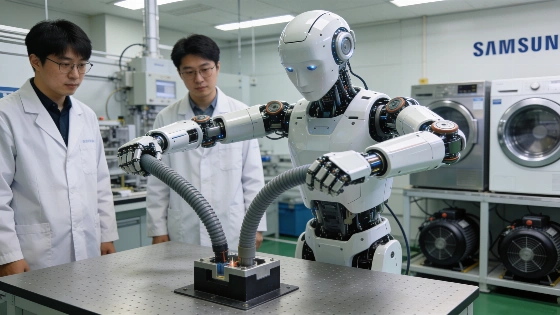
Samsung Electronics is advancing an internal humanoid robot project, information from reports from South Korea. Unlike its publicly announced Robotics eXperience (RX) division and its investment in Rainbow Robotics, this effort is described as a confidential initiative drawing on Samsung’s large-scale manufacturing expertise. The project reportedly adapts brushless DC (BLDC) motor technology used in home appliances such as washing machines and refrigerators to produce robotic actuators, which can account for a large share of humanoid production costs. Using established manufacturing infrastructure could reduce the cost and time needed to produce these parts, potentially giving Samsung a cost advantage over domestic competitors.
Industry sources describe the in-house humanoid as being at an advanced development stage, with laboratory performance reportedly ahead of several domestic prototypes. Its actuators are designed to support complex movements and the degrees of freedom needed for dexterity and coordination. Internal reports cited in coverage describe a system with 22 degrees of freedom across its arms and hands and a 95 percent success rate on precision tasks such as inserting a water hose during factory testing. Those figures reflect reported internal testing, not a publicly documented independent evaluation.
Samsung’s publicly announced robotics strategy provides a separate, established structure for the company’s work in the field. On December 31, 2024, it said it would exercise a call option to raise its stake in Rainbow Robotics from 14.7 percent to 35 percent, making the robotics company a Samsung subsidiary and the group’s largest shareholder. The earlier investment was reported at KRW 86.8 billion. In its December 2024 announcement, Samsung said the expanded relationship would combine Rainbow Robotics’ robot platforms with Samsung’s AI, software, manufacturing expertise and global sales network. Samsung also established a Future Robotics Office reporting directly to the chief executive. Led by Rainbow Robotics founding member Oh Jun-ho, the office will pursue future robots, including humanoids.
Rainbow Robotics was founded in 2011 by researchers associated with the Korea Advanced Institute of Science and Technology’s Humanoid Robot Research Center. Its history includes Hubo, described in the supplied reporting as Korea’s first bipedal robot. The company’s RB-Y1, but, is a wheeled mobile dual-arm research platform, not a bipedal humanoid. It comes with a software development kit, ROS 2 support and simulation models for developing AI and control software. Reported cumulative sales exceeded 130 units by the end of 2025, including about 25 supplied to Toyota. The platform has also been tested at a Coupang logistics center.
Samsung’s robotics work also encompasses artificial intelligence. The article’s account describes Gauss as a foundation for robotics AI and identifies Shallow-π, a vision-language-action (VLA) model introduced by Samsung Research, as combining visual perception, language understanding and movement. Company data cited in that account says Shallow-π uses one-third the computational resources of conventional VLA systems and enables up to 17 decisions per second. Samsung is also developing a World Model to predict the physical consequences of robot actions before they happen. Plans for a Robot Data Factory at the Gumi campus would use data from robots on semiconductor, smartphone and appliance production lines to train and refine AI systems.
The reported in-house humanoid project is described as operating independently from Rainbow Robotics, while the RX division, established in July 2026, oversees broader robotics strategy, technology development and international research coordination. The distinction matters: Rainbow Robotics’ publicly described portfolio includes collaborative robots, mobile manipulators and autonomous mobile systems for manufacturing and logistics. The appliance-motor approach and performance figures attributed to the internal humanoid concern a separate reported development effort.
Samsung’s efforts are part of a wider industry trend, as established manufacturers look to use their production capabilities to accelerate humanoid development. DOBOT’s LUMO robot, for example, has been demonstrated with all-terrain mobility and interaction combining computer vision, voice interaction and motion control. (See coverage of DOBOT's LUMO robot demonstration.)
Laboratory results alone do not establish how a robot will perform in varied operational settings. Reports on the Samsung project do not say whether it operates autonomously or under human supervision. They also give no details on its safety mechanisms, failure rates beyond controlled tests or commercial deployment schedule. Those factors are basic to assessing reliability in environments where conditions can change and human intervention may be needed.
Robotics testing often relies on controlled conditions, selected tasks and curated environments. Sensor noise, mechanical wear, unexpected obstacles and recovery from failures can pose different challenges on factory floors or in other unstructured settings. Bridging the gap between simulation and real-world operation, the sim-to-real gap, requires extensive validation, safety engineering and clear protocols for human oversight and intervention.