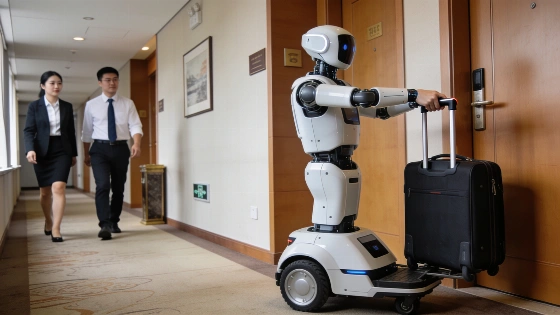
China's World Humanoid Robot Games evaluated robots on hotel service, household chores, and library shelving, testing their ability to operate autonomously and adapt to unpredictable real-world environments
China's second World Humanoid Robot Games (WHRG) has shifted the focus of robotics evaluation from controlled arenas to real-world environments, challenging humanoid robots with tasks in hotels, libraries, and simulated homes. The event, held at the Beijing Continental Grand Hotel, required robots to perform practical work such as delivering luggage, replenishing guest supplies, making beds, and handling laundry-tasks that demand both physical dexterity and adaptive decision-making in unstructured spaces.
Household Tasks Put Robot Autonomy to the Test
Robots were assessed on three core household tasks: tidying a living room, folding clothes in a bedroom, and washing and hanging laundry in a bathroom and on a balcony. Each task was scored out of 300 points, with deductions for collisions, dropped objects, and crossing boundaries. An additional test introduced an unexpected parcel delivery, requiring robots to respond to a voice command, retrieve a package, and then resume their previous activity. If human intervention occurred, the run was classified as remote-controlled and the score was halved, highlighting the distinction between autonomous and teleoperated performance.
Among the competitors, TianYi 2.0-a wheeled humanoid robot developed by Beijing-based X-Humanoid-was featured in scenario-based events. According to company information, TianYi 2.0 can adjust its torso height between 130 and 165 centimeters and operate for over two hours per charge. The robot uses the Huisi Kaiwu operation platform, with the company emphasizing a shift from traditional "higher and faster" competitions to scenario events that prioritize practical work capability. However, the event's real-world settings exposed persistent challenges for current-generation robots, including navigating narrow hotel corridors, manipulating deformable objects like linens, and maintaining stability while transporting loaded trolleys.
Library Shelving and Dexterous-Hand Challenges
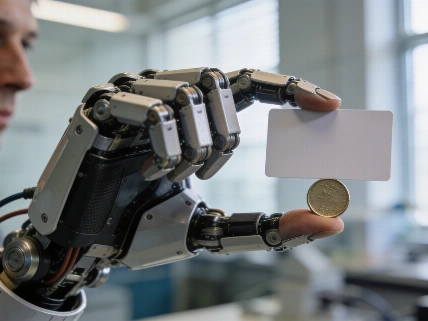
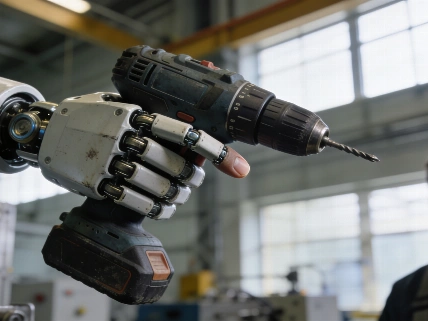
The WHRG also included a library-shelving competition, where robots had 30 minutes to collect returned books, shelve them, and correct misplaced volumes in an active library environment. This task tested the robots' visual recognition, precision, and reasoning under operational conditions. In addition to scenario-based events, the games featured six real-world tasks and eight dexterous-hand "micro-manipulation" contests, such as picking up beans and driving screws. AGILINK, a company spun off from AgiBot, stated that success in dexterous-hand events signals a product's readiness for demonstration-grade real-world use, though independent verification of these claims was not reported.
Scoring Rewards Independence From Human Operators
Measured performance data from the event included a 30-minute time limit for both hotel and library tasks, with robots required to complete multi-step sequences without direct human assistance to achieve full scoring. The competition attracted 666 teams and 2,056 robots from 16 countries, according to the WHRG, and coincided with the opening of the World Robot Conference in Beijing. The scoring system penalized errors that would be significant in real deployments, and the weighting of autonomous operation over teleoperation reflects ongoing industry efforts to reduce human oversight in service robotics.
Real-World Settings Expose Current Limitations
Experts in robotics and automation note that moving robots from standardized test courses into real-world environments exposes the limitations of current mechanical design, perception algorithms, and adaptive planning. While scenario-based competitions provide valuable benchmarks for progress, they also reveal the persistent need for human supervision and intervention, especially when robots encounter unexpected obstacles or ambiguous instructions. This mirrors findings from other research efforts, such as the development of robots designed to collaborate with humans in physically demanding tasks, as seen in recent studies on ergonomic humanoid robots for shared lifting.
Fully Autonomous Service Robots Remain a Work in Progress
Autonomy remains a central challenge for service robots intended for deployment in homes, hotels, and public spaces. While the WHRG scenario events demonstrate incremental progress, the evidence from this year's competition suggests that fully autonomous operation in complex, dynamic environments is not yet routine. The distinction between remote-controlled and autonomous runs, and the significant scoring penalties for human intervention, underscore the technical and operational barriers that remain before humanoid robots can reliably perform unsupervised work in real-world settings.
Automation and Autonomy Are Not the Same
Understanding the difference between automation and autonomy is essential in robotics. Automation refers to the execution of predefined tasks with minimal variation, often in controlled environments. Autonomy, by contrast, requires a system to perceive its environment, make context-sensitive decisions, and recover from unexpected events without direct human input. In practice, most current service robots operate somewhere between these extremes, relying on a combination of programmed routines, sensor feedback, and occasional human intervention. The WHRG's evaluation framework highlights the importance of measuring not just task completion, but also the degree of independence and adaptability demonstrated by each system.