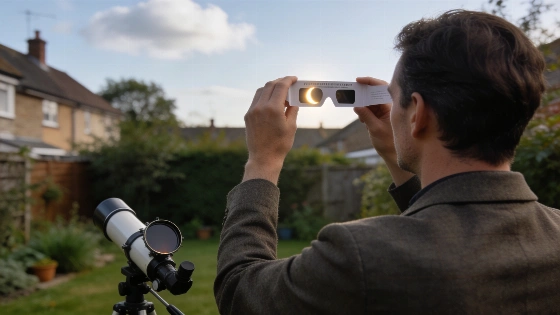
The August 12, 2026, eclipse will cover about 90% of the Sun in parts of the UK. Here is how to choose certified eye protection and compare viewing options without risking permanent damage
A partial solar eclipse will cross the UK on August 12, 2026, when the Moon passes between Earth and the Sun and hides much of the solar disk. In some parts of the country, around 90% of the Sun may be obscured, but the remaining crescent will still be bright enough to injure the eyes if viewed without proper protection. The event is not total in the UK; the path of totality will pass across Greenland, Iceland and northern Spain.
Why eye protection matters
The danger during a partial eclipse is easy to underestimate. The visible sunlight becomes less intense as the Moon covers the Sun, yet the uncovered portion still emits enough radiation to damage light-sensitive tissue at the back of the eye. That injury can be permanent, and it may not be immediately painful because the retina has no pain receptors.
Ordinary sunglasses, even very dark ones, are not designed for solar observation. Homemade filters, photographic film, smoked glass and other improvised materials are also unsafe. Anyone watching the eclipse directly should use purpose-built solar viewers that meet ISO 12312-2:2015, the international safety standard for solar viewing products. The standard number should be clearly marked on the glasses or viewer.
Children should be supervised, and viewers should be inspected before use. Scratched, punctured, torn or otherwise damaged filters should be discarded. Solar glasses are intended for looking at the Sun itself, not for general use, and they should be put on before facing the Sun and removed only after looking away.
Choosing eclipse glasses
For a family or small group, the Celestron EclipSmart Solar Eclipse Glasses cost £12.99 at Amazon. The four-pack uses cardboard frames and includes a compact information booklet. Celestron is an established optics company, but the important safety consideration remains the ISO 12312-2:2015 marking rather than the brand alone.
The Celestron EclipSmart 3 Piece Solar Eclipse Observing & Imaging Kit costs £29.99 at Amazon. It combines a solar filter for a mobile phone, the Celestron information booklet and one pair of eclipse glasses. Its plastic frames may be more durable than cardboard designs, particularly for viewers who want to store them for another eclipse.
The Soluna 2-piece Solar Eclipse glasses are listed at £2.99 at Amazon, reduced from £4.99. The lower price makes them a budget option, although reported concerns about the strength of the cardboard frames mean they should be handled carefully. Their suitability still depends on the required safety standard being present and the filters remaining undamaged.
Options for eyeglass wearers
People who wear prescription glasses do not need to remove them to observe the eclipse. The Absolute Eclipse Solar Eclipse Fit-Over Glasses, priced at £25.85 at Amazon, are designed to fit over existing spectacles. Their larger shape can make positioning easier, but users should still check that the solar filters cover the entire viewing area and sit securely.
For a magnified view, the Celestron EclipSmart 10x42 Porro Solar Binoculars cost £99 at Amazon. Their built-in, non-removable solar filters are intended to keep the binoculars protected whenever they are used for solar viewing. The 10x magnification can reveal larger solar features such as sunspots, although binoculars must never be used to view the Sun unless their front-mounted solar filters are specifically designed for that purpose.
Magnification does not make solar viewing safer by itself. In fact, binoculars and telescopes collect more sunlight than the unaided eye, concentrating it into a smaller area. Filters placed only at the eyepiece can fail or overheat, so solar filters must be installed at the front of the optical instrument and designed for that model.
Planning the observation
Weather and local eclipse geometry will determine how much of the event is visible from a particular location. A site with a clear, unobstructed view of the southern sky can help, while checking a reliable forecast close to August 12 will be more useful than relying on long-range predictions. The best UK locations for the partial eclipse will depend on the local timing and obscuration, so observers should check updated astronomical forecasts before traveling.
The eclipse can also be viewed indirectly by projecting sunlight through a pinhole onto a shaded surface, avoiding any need to look at the Sun. This method produces a small image and should not be confused with looking through an unfiltered camera, phone, binocular or telescope. Photographers need equipment-specific solar filters and should follow the camera manufacturer's guidance.
The July 2026 Buck Moon was photographed through smoke and haze in several regions, as documented in global reports of the Moon rising through atmospheric haze. The comparison is useful because it highlights a different observing limit: atmospheric conditions can reduce contrast and visibility, but they do not make direct solar viewing safe.
Solar eclipse glasses do not make it safe to stare continuously at the Sun for longer than necessary, and they should not be used with unfiltered optical equipment. The central fact for the August 12 event is simple: a partial eclipse never removes enough sunlight to create the natural safety window associated with totality. Certified, undamaged solar viewers are therefore essential throughout the partial phase.
ISO 12312-2:2015 is a product-safety standard, not a measurement of how much of the Sun an eclipse will cover. Solar viewers made to the standard reduce the intensity of visible and infrared radiation reaching the eye to safer levels when used correctly. The standard does not protect against misuse, damaged filters or unsafe combinations with binoculars and telescopes, so the filter's placement and condition remain part of the safety check.