Astronomers explain why the August 12, 2026, total solar eclipse appears to reverse direction on flat maps as it crosses the Arctic, despite the Moon's shadow always moving from west to east across Earth
The total solar eclipse scheduled for August 12, 2026, will trace a path across the high northern latitudes, offering a rare opportunity for observers in parts of Europe and the Arctic. Yet, many eclipse maps seem to show the Moon's shadow moving in an unexpected direction-apparently reversing course as it crosses the Arctic. This visual contradiction is not a physical anomaly, but a geometric effect created by projecting a curved path onto a flat surface.
Shadow Motion and Earth's Rotation
Every total solar eclipse on Earth is governed by the combined motions of the Moon and our planet. Both bodies move eastward: Earth rotates eastward once every 24 hours, while the Moon orbits eastward around Earth. The Moon's shadow, specifically the umbra where totality occurs, sweeps across the surface faster than Earth's rotation, always moving from west to east. This consistent direction is a direct result of orbital mechanics and is confirmed by both observation and modeling.
For the 2026 event, the path of totality will begin in northern Siberia, pass near the North Pole, and then arc toward Greenland, Iceland, and northern Spain. On a globe, this path forms a smooth curve. However, when mapped onto a flat surface using standard projections, the track appears to bend back on itself, creating the illusion that the shadow reverses direction as it crosses the Arctic.
Map Projections and Visual Illusions
The apparent reversal is a consequence of how cartographers translate the three-dimensional surface of Earth onto two-dimensional maps. Near the poles, common projections such as Mercator or equirectangular greatly distort distances and angles. As the eclipse path approaches the North Pole, the shortest route between two points-known as a great circle-can appear to double back or curve sharply on a flat map, even though the shadow's motion remains continuous and unidirectional on the globe.
This geometric distortion is especially pronounced for eclipses that pass close to the poles. Animations based on spherical models, such as those produced by eclipse specialists, show that the Moon's shadow never actually reverses course. Instead, the path simply follows the curvature of Earth, sweeping over the top of the planet in a broad arc. The illusion is a byproduct of flattening a spherical trajectory.
Physical Parameters and Viewing Safety
The Moon's shadow consists of two main regions: the narrow umbra, where observers experience totality, and the broader penumbra, where only a partial eclipse is visible. The width of the umbra during the 2026 eclipse will depend on the Moon's distance from Earth at the time, while the speed of the shadow is determined by the relative motions of the Moon and Earth. For this event, the umbra will move at several thousand kilometers per hour, with totality lasting up to two minutes in some locations.
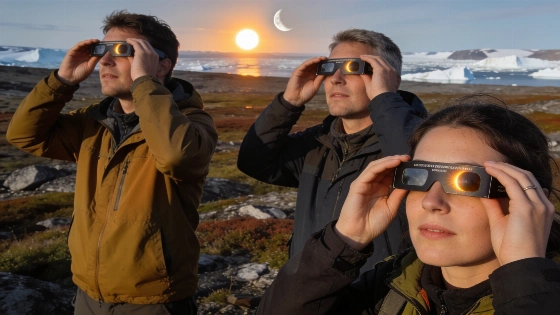
Observers in the penumbral region should use certified solar eclipse glasses or solar filters to protect their eyes during the partial phases. Direct viewing of the Sun without proper protection can cause permanent eye damage, except during the brief period of totality when the Sun is completely covered. For those in the UK, a detailed guide to safe viewing equipment is available in this Science Report article on eclipse safety.
Upcoming Celestial Events
While the path of totality for the August 2026 eclipse is limited to specific regions, millions more will witness a partial eclipse across Europe, the North Atlantic, and parts of North America. Just two weeks after the solar eclipse, a near-total lunar eclipse will be visible over much of North America, providing another opportunity for skywatchers. The summer of 2026 will also feature several other notable astronomical events, including planetary conjunctions and meteor showers.
Understanding the geometry behind eclipse paths helps clarify why map projections can create misleading impressions. The underlying physics remains consistent: the Moon's shadow always moves from west to east, regardless of how it appears on a flat map.
To interpret eclipse maps accurately, it is essential to understand how map projections work. A map projection is a mathematical method for representing the curved surface of a sphere on a flat plane. All projections introduce some distortion, especially near the poles, affecting the apparent shape and direction of features like eclipse paths. Recognizing these limitations allows astronomers and the public to distinguish between visual artifacts and the true motion of celestial events.