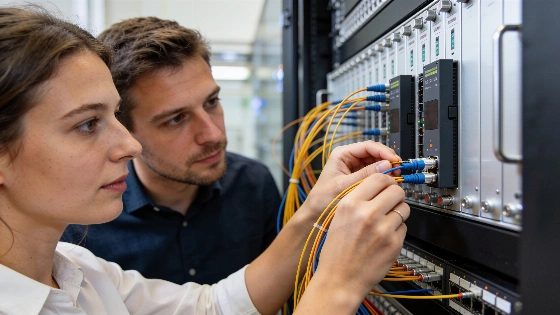
A new partnership between GÉANT and the Quantum Internet Alliance aims to connect quantum communication testbeds to Europe's research fiber backbone, advancing field trials for quantum key distribution and distributed quantum computing.
Europe's efforts in quantum networking are moving out of the lab and into the real world. On September 8, 2026, GÉANT and the Quantum Internet Alliance (QIA) signed an agreement to connect quantum communication prototypes to the continent's research fiber backbone. This partnership will allow field trials that test quantum networking under actual operating conditions, not just in controlled environments. The Qubit Report and other industry sources have confirmed this step, which follows a pattern seen in other large research collaborations, such as those at CERN and MIT.
The agreement, signed in Amsterdam by GÉANT CEO Lise Fuhr and QIA Director Stephanie Wehner, sets up both technical and organizational plans for linking quantum network nodes to GÉANT's optical backbone. This backbone already connects 40 national research and education networks (NRENs) across Europe, supporting high-speed data transfer between universities and research centers. The QIA, led by TU Delft and made up of more than 50 institutions, brings expertise in quantum node hardware, quantum memory, and entanglement distribution protocols. Its members include universities, telecom operators, system integrators, and startups from 12 European countries, following a collaborative model similar to those used by the Max Planck Society and Stanford University.
Earlier quantum communication experiments were limited to single labs or short fiber runs. This new collaboration aims to test quantum key distribution (QKD) and blind quantum computing protocols over operational, multi-country routes. GÉANT will provide dark fiber, manage cross-border routing, and work with the SIG-Quantum group to make sure quantum and classical network layers can run side by side without interfering with each other. This setup matches the need for robust, scalable infrastructure described in recent research on quantum network architectures.
The partnership's technical work focuses on three areas: field trials and testbeds, network architecture and standards, and ecosystem deployment. Field trials will use GÉANT's dark fiber and optical routes to connect QIA's quantum network prototypes, allowing real-world tests of entanglement distribution and QKD over distances and network conditions found in actual research networks. Work on architecture and standards will define how NRENs can interoperate, develop network telemetry, and set operational rules for mixing quantum and classical traffic.
QIA's Technology Forum will work directly with GÉANT's technical teams and NREN community groups to align hardware and software standards and avoid network fragmentation. The collaboration supports building a European-made quantum internet prototype, with the longer-term goal of linking future quantum processing units (QPUs) into distributed computing networks. This approach reflects the need for scalable, repeatable integration highlighted in recent reports on quantum hardware manufacturing.
Taking quantum networking from the lab to operational field trials brings new engineering challenges. Quantum signals are sensitive to loss, noise, and environmental changes, especially over long fiber routes that cross borders and network domains. Keeping entanglement fidelity and secret-key rates stable in the presence of classical traffic, varying fiber quality, and complex routing is a major technical problem. The focus on network telemetry and operational standards shows the need for constant monitoring and quick fault detection-issues that are less visible in lab settings. These challenges are similar to those faced in early deep-space communication work, where signal integrity and error correction were critical.
The agreement does not promise immediate commercial quantum services, but both organizations have committed to clear milestones. These include setting up testbeds for QKD and blind quantum computing, validating interoperability protocols, and integrating quantum network control with existing federated identity systems. The partnership's progress will be measured by its ability to show stable, repeatable quantum communication across the GÉANT backbone, using metrics like entanglement distribution rate, QKD key rate, and error rates.
The partnership is also about European technological independence. By focusing on European-made hardware and open standards, GÉANT and QIA aim to reduce reliance on non-European vendors and proprietary systems. This is meant to ensure that future quantum networks can be trusted for sensitive research and public-sector use, and to help develop a skilled quantum workforce in Europe.
Still, moving from prototypes to operational infrastructure is complex. Integrating quantum and classical systems at scale, building robust error correction, and keeping networks secure and reliable across different environments are all unresolved problems. The real test will be whether the partnership can deliver reproducible, independently verified quantum networking performance outside the lab, laying the groundwork for distributed quantum computing in Europe. Until then, the focus will remain on solving the engineering problems needed to make quantum networking a practical tool.
Quantum key distribution (QKD) is a cryptographic method that uses quantum states-usually single photons-to create shared secret keys between distant parties. Its security comes from the fact that quantum measurements disturb the state, making eavesdropping detectable. In practice, QKD systems must deal with photon loss, detector noise, and imperfect devices, which can lower key rates and create vulnerabilities. Integrating QKD into real fiber networks requires careful engineering to balance quantum and classical traffic, manage loss, and authenticate endpoints, making field trials on real infrastructure a necessary step toward secure quantum communication.