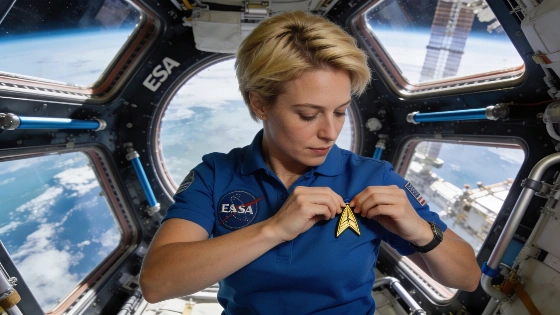
ESA astronaut Sophie Adenot marked Star Trek's 60th anniversary by wearing a Starfleet badge on the International Space Station, highlighting the show's influence on real-world space exploration and international scientific cooperation
When European Space Agency astronaut Sophie Adenot appeared on video from the International Space Station wearing a Starfleet badge, the gesture was more than symbolic. It marked a rare moment where science fiction's vision of exploration intersected with the realities of orbital science, as the ISS crew acknowledged Star Trek's 60th anniversary from low Earth orbit.
Symbolic Actions in Orbit
Adenot's decision to wear the gold Starfleet insignia-specifically the badge of Captain Pike from Star Trek: Strange New Worlds-was not a casual nod to pop culture. The badge, delivered as part of her mission supplies, was featured floating in the station's Cupola module, a location chosen for its panoramic view of Earth and space. The European Space Agency used the occasion to draw a direct line between the fictional crews of the USS Enterprise and the multinational teams aboard the ISS, emphasizing a shared ethos of discovery and collaboration.
In a video released by ESA and Star Trek, Adenot attached the badge to her ESA uniform while working in the Columbus laboratory module. She described exploration and science as fundamentally collective efforts, grounded in curiosity and the willingness to learn from new discoveries. The visual of the badge in microgravity, set against the backdrop of the station's observation windows, underscored the continuity between imagined futures and the operational realities of spaceflight.
Mission Context and Crew Operations
Adenot launched to the ISS on 13 February 2026 as part of NASA's Crew-12 mission, traveling aboard a SpaceX Dragon capsule. Serving as a flight engineer for Expedition 75, she joined an international team conducting research and maintaining station systems. Her mission was scheduled to conclude with the arrival of Crew-13, expected within weeks of the anniversary event.
The ISS, orbiting at approximately 400 kilometers above Earth, operates as a platform for scientific research across disciplines, from microgravity biology to materials science. Adenot's participation in the tribute coincided with routine operations, but the timing highlighted the station's role as a living example of international cooperation-an ideal long championed by Star Trek's creators. The badge itself, a small metallic object, was selected for its symbolic resonance rather than any technical function.
Star Trek's Influence on Space Exploration
Since its debut in 1966, Star Trek has shaped public perceptions of space exploration, often foregrounding themes of diversity, cooperation, and ethical inquiry. The show's creator, Gene Roddenberry, envisioned a future where humanity's maturity would be measured by its embrace of difference and its capacity for collective achievement. This philosophy has found echoes in the operational culture of the ISS, where astronauts from multiple nations work together under shared protocols and scientific objectives.
ESA's public messaging around the anniversary made explicit reference to this lineage, stating that while the tools and technologies have changed, the mission-explore, discover, do it together-remains constant. The agency's framing positioned science fiction not as escapism, but as a source of inspiration for real-world scientific and engineering progress. This interplay between imagined futures and practical achievement is not unique to the ISS; as reported earlier, NASA's own milestones have often drawn on cultural narratives to frame technical advances.
Limits and Legacy of Symbolic Gestures
While the Starfleet badge carried no operational significance, its presence aboard the ISS served as a reminder of the cultural forces that shape scientific ambition. The gesture did not alter mission protocols or research outcomes, but it did highlight the permeability of boundaries between science and culture. For the ISS crew, the act of honoring Star Trek's anniversary was a way to acknowledge the broader context in which space exploration unfolds-a context shaped by public imagination as much as by technical capability.
Such symbolic acts have limits. They cannot substitute for the rigorous engineering, international agreements, and sustained funding that make missions possible. Yet they can reinforce the values that underpin scientific collaboration, especially in an era where geopolitical tensions threaten to erode the foundations of joint space activity. The ISS remains one of the few operational arenas where these ideals are tested daily, and gestures like Adenot's badge-wearing serve as visible affirmations of that ongoing experiment.
Understanding the significance of this event requires some context about the ISS itself. The International Space Station is a modular orbital laboratory assembled through decades of multinational cooperation. Its modules, contributed by agencies including NASA, ESA, Roscosmos, and JAXA, are interconnected both physically and through shared operational protocols. Crew rotations, scientific priorities, and even symbolic gestures are negotiated within this framework, making the ISS a unique testbed for both technical and cultural integration in space.