Astronomers use optical and X-ray observations to study Deneb, the Cygnus Loop supernova remnant, and the black hole Cygnus X-1, revealing the complex structure of the Cygnus constellation and its hidden extremes
High in the northern summer sky, the constellation Cygnus stands out for its distinctive swan-like shape and its role as a gateway to some of the Milky Way's most studied stellar phenomena. Marked by the bright star Deneb, Cygnus is not only a visual anchor for stargazers but also a region rich in objects that reveal the life cycles of stars, from young clusters to the remnants of supernovae and the presence of a confirmed black hole.
Locating Deneb and the Cygnus Pattern
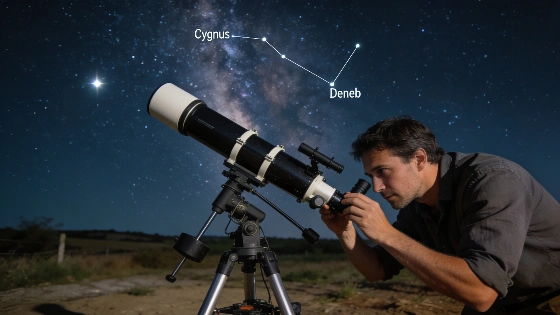
Deneb, whose name derives from the Arabic for "tail," forms the northeastern point of the Summer Triangle, a prominent asterism visible throughout the summer months. Although Deneb is the dimmest of the Triangle's three stars, its position helps observers trace the outline of Cygnus. The constellation's main axis stretches from Deneb through the "beak star" Albireo, with fainter stars extending outward to form the swan's wings. In areas with significant light pollution, only the brightest stars may be visible, creating the impression of a "Northern Cross." Under darker skies, the full structure of Cygnus becomes apparent, with its stars embedded in the dense band of the Milky Way.
For those using binoculars or small telescopes, the region south of Deneb reveals Messier 29, an open cluster of young stars. This cluster, along with the reddish glow of nearby excited gas, provides evidence of ongoing star formation and the dynamic environment within the Cygnus arm of the galaxy. The double star Albireo, when viewed through a telescope, resolves into a striking pair: one gold, one blue, offering a vivid example of contrasting stellar temperatures and compositions.
Supernova Remnants in Cygnus
Cygnus is also home to the Cygnus Loop, a large supernova remnant more commonly known as the Veil Nebula. This structure, located above the eastern wing of the swan, is the result of a massive star's explosive death thousands of years ago. The remnant spans roughly three degrees across the sky-about six times the apparent diameter of the Moon-and appears as a faint, filamentary ring of glowing gas. The Veil Nebula is best observed with telescopes or strong binoculars under dark-sky conditions, where its intricate structure can be traced in detail.
Supernova remnants like the Cygnus Loop are critical for understanding the dispersal of heavy elements into the interstellar medium and the processes that trigger subsequent generations of star formation. The expanding shock waves from such explosions interact with surrounding gas and dust, shaping the local environment and leaving behind complex, observable features.
Cygnus X-1: A Nearby Black Hole
Beyond what is visible in optical wavelengths, Cygnus contains one of the most studied stellar-mass black holes: Cygnus X-1. First detected as a strong X-ray source in 1971, Cygnus X-1 was later confirmed as a black hole through observations of its gravitational influence on a nearby blue supergiant companion. The system lies approximately 6,070 light-years from Earth and has a black hole with an estimated mass of about 20 times that of the Sun. Cygnus X-1 is notable for its rapid spin-estimated at over 800 revolutions per second-and for the accretion of material from its stellar companion, which produces intense X-ray emissions detectable by space-based observatories such as NASA's Chandra X-ray Observatory.
While Cygnus X-1 is not visible to the naked eye or through amateur telescopes, its discovery marked a turning point in the study of compact objects and the confirmation of black holes as real astrophysical entities. The system continues to be a focus for research into accretion physics, relativistic jets, and the end stages of massive star evolution.
Observational Context and Broader Significance
The Cygnus region offers a unique opportunity to observe a range of stellar phenomena within a single constellation. From the bright beacon of Deneb to the faint traces of the Veil Nebula and the invisible but powerful presence of Cygnus X-1, the area encapsulates the diversity of processes shaping the Milky Way. Observers interested in meteor showers may also note that the Perseids, one of the year's most prominent meteor displays, are often visible against the backdrop of Cygnus and neighboring constellations, as described in coverage of the Perseids meteor shower peak.
Measurements of these objects rely on a combination of ground-based optical telescopes, space-based X-ray observatories, and targeted surveys. The ability to resolve double stars, map supernova remnants, and detect X-ray binaries has advanced significantly with improvements in detector sensitivity and image processing, allowing astronomers to probe both the visible and hidden extremes of stellar evolution.
Understanding the Cygnus region requires integrating data across the electromagnetic spectrum. Optical observations reveal the structure and composition of stars and nebulae, while X-ray and radio measurements uncover compact objects and energetic processes invisible to the eye. The interplay of these methods continues to refine models of stellar death, black hole formation, and the recycling of material in the galaxy.
To interpret the evidence from Cygnus, it is essential to understand how astronomers use different wavelengths to probe the universe. Optical telescopes collect visible light, revealing stars and nebulae, while X-ray observatories like Chandra detect high-energy emissions from extreme environments such as black hole accretion disks. Each wavelength provides unique information, and combining these datasets allows researchers to build a more complete picture of stellar evolution, supernova remnants, and compact objects. The study of Cygnus demonstrates the necessity of multi-wavelength astronomy in uncovering the physical processes that shape our galaxy.