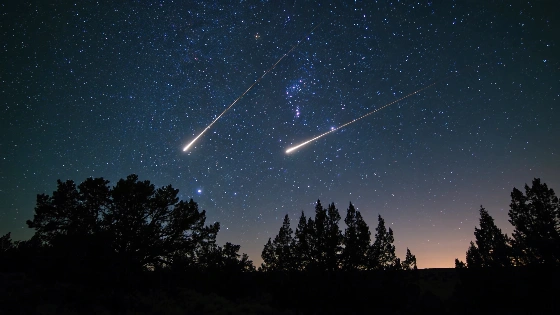
The Perseids meteor shower, one of the brightest annual displays, reached its peak on August 12-13, with meteors visible against the backdrop of Orion. Observations were made from dark-sky sites using unaided eyes and standard cameras.
Each August, the Perseids meteor shower offers a reliable opportunity for observers to witness dozens of meteors streaking across the night sky. In 2026, the shower reached its maximum activity during the night of August 12 into the early hours of August 13, with optimal viewing conditions reported at several dark-sky locations. The Perseids are known for their high meteor rates and bright fireballs, making them a highlight of the northern hemisphere's astronomical calendar.
Observing the Perseids
The Perseids originate from debris left by Comet 109P/Swift-Tuttle, which Earth encounters each year as it orbits the Sun. When these particles enter the atmosphere at speeds around 59 kilometers per second, they produce visible streaks of light-meteors-through rapid heating and ionization. The shower is best observed after midnight, when the radiant in the constellation Perseus rises higher in the sky, increasing the number of visible meteors.
During the 2026 peak, observers in North America and Europe reported meteor rates exceeding 60 per hour under clear, dark conditions. The event was widely documented by amateur astronomers and astrophotographers, with images capturing meteors crossing the sky near prominent constellations such as Orion. For those unable to observe directly, a live broadcast provided real-time coverage of the shower's activity.
Instrumentation and Viewing Conditions
Unlike many astronomical phenomena that require telescopes or specialized detectors, the Perseids are best viewed with the unaided eye from locations with minimal light pollution. Standard digital cameras with wide-angle lenses are commonly used to photograph the event, capturing both individual meteors and the broader star field. The shower's brightness and frequency make it accessible to both experienced astronomers and casual skywatchers.
Atmospheric conditions play a significant role in meteor visibility. Thin clouds, urban lighting, or a bright Moon can reduce the number of meteors seen. In 2026, the Moon's phase was favorable, allowing for darker skies and improved detection of fainter meteors. Observers were advised to allow their eyes to adjust to the darkness and to scan large portions of the sky for the best chance of spotting multiple meteors.
Scientific and Historical Context
The Perseids have been observed for nearly two millennia, with records dating back to ancient China. Their regularity and intensity have made them a subject of both scientific study and public interest. Meteor showers provide insight into the composition and distribution of cometary debris in the solar system, as well as the dynamics of Earth's atmosphere during high-speed particle entry.
This year's Perseids coincided with ongoing research into meteor shower dynamics and atmospheric interactions. For a broader perspective on how meteor showers can align with other astronomical events, see the report on the rare overlap of a partial solar eclipse and the Perseid peak on August 12, 2024, at this Science Report article.
While the Perseids are among the most predictable meteor showers, their intensity can vary from year to year due to changes in the density of the debris stream and gravitational influences from planets such as Jupiter. These variations are monitored by both professional and amateur astronomers, contributing to models of cometary evolution and solar system dynamics.
Meteor showers like the Perseids are detected visually as brief flashes of light caused by small particles burning up in Earth's upper atmosphere. Unlike deep-sky objects, meteors are transient and unpredictable in their exact timing and location, requiring observers to watch large areas of sky for extended periods. The brightness and frequency of meteors depend on the size and velocity of the incoming debris, as well as atmospheric transparency and background light. Understanding these factors helps astronomers interpret meteor rates and refine models of cometary debris streams.