
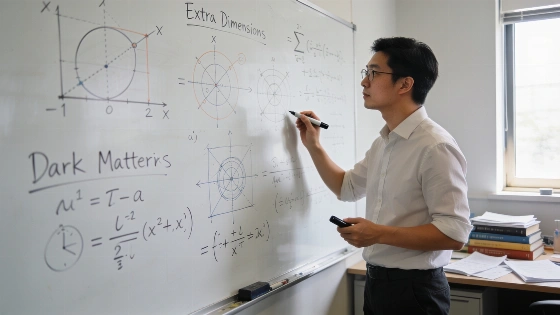
A new theoretical study explores whether dark matter's elusive nature could be explained by its interaction with a hidden fifth dimension, offering a possible connection between two of physics' most persistent mysteries
Physicists have long struggled to explain the true nature of dark matter, the invisible substance that outweighs ordinary matter in the universe by roughly five to one. Despite its gravitational influence on galaxies and cosmic structure, dark matter has evaded direct detection, interacting neither with light nor with known particles in a way that current instruments can observe. Now, a new peer-reviewed study published in Physical Review D proposes that dark matter's ghost-like behavior may be a consequence of its relationship with a hidden fifth dimension—an idea that, if correct, could link the search for dark matter to the broader question of extra dimensions in fundamental physics.
A Hidden Dimension Could Shape Dark Matter
While the standard model of particle physics operates in four-dimensional spacetime—three spatial dimensions plus time—some extensions, including string theory, require additional spatial dimensions that are compactified or “curled up” at scales far smaller than can be probed directly. The new research suggests that dark matter may be sensitive to such a hidden dimension, and that its properties could be shaped by the geometry of this extra spatial direction.
According to the study, the team developed a model in which dark matter particles interact with a hypothetical force carrier known as a “dark photon.” Unlike ordinary photons, which mediate electromagnetic interactions, dark photons would transmit a new force acting only on dark sector particles. The model predicts that the masses of dark matter particles could be arranged in a pattern determined by the structure of the fifth dimension, leading to a phenomenon the authors call “dark matter resonance.”
Resonance May Explain Dark Matter’s Elusive Behavior
This resonance, the researchers argue, could have made dark matter interactions much stronger in the early universe, potentially affecting how dark matter was produced after the Big Bang. Today, however, the same mechanism would allow dark matter to remain inert and difficult to detect, consistent with the lack of observed non-gravitational interactions in laboratory and astrophysical searches.
In the proposed scenario, the resonance arises not as an arbitrary assumption but as a direct consequence of the mathematical geometry of the hidden dimension. This approach distinguishes the model from previous resonant dark matter theories, which often introduced resonance by hand rather than deriving it from a deeper physical principle. The study provides new theoretical targets for future dark matter searches, suggesting that experiments sensitive to specific mass ranges or interaction strengths could test aspects of the model.
The Theory Remains Speculative but Testable
Current evidence for dark matter remains indirect, based on its gravitational effects on galaxy rotation curves, gravitational lensing, and the cosmic microwave background. No experiment has yet detected a dark matter particle or confirmed the existence of a dark photon. The new model does not claim to have observed either phenomenon, but it offers a framework that could be tested as experimental sensitivity improves. The authors acknowledge that the existence of extra dimensions remains speculative, and that alternative explanations for dark matter's properties are still viable within the standard cosmological model.
In quantitative terms, the study addresses the mass hierarchy of dark matter particles and the possible energy scales associated with the fifth dimension. While the model does not specify a unique mass for dark matter, it predicts that resonance effects could occur at energies accessible to future particle physics experiments or astrophysical observations, depending on the size and shape of the hidden dimension. The gravitational evidence for dark matter, such as the five-to-one mass ratio compared to ordinary matter, remains unchanged by the new theory, but the model provides a new context for interpreting potential signals in upcoming searches.
The research highlights the ongoing challenge of connecting theoretical models to observable phenomena in cosmology and particle physics. As experimental techniques advance, the possibility of probing hidden dimensions or detecting new force carriers remains an open question. For now, the proposed link between dark matter and extra dimensions stands as a testable hypothesis rather than an established fact, underscoring the need for both theoretical innovation and empirical rigor in the search for the universe's missing mass.
What Physicists Mean by Extra Dimensions
Understanding the concept of extra dimensions is central to this research. In physics, a dimension refers to an independent direction in which objects can move or be measured. While everyday experience is limited to three spatial dimensions and one of time, some theories propose additional spatial dimensions that are compactified at scales far smaller than atomic nuclei. These hidden dimensions could influence the properties of particles and forces, even if they cannot be directly observed.
In the context of the new study, the geometry of a fifth dimension shapes the mass and interaction patterns of dark matter, offering a possible explanation for its elusive behavior. The challenge for physicists is to devise experiments capable of testing such predictions, bridging the gap between mathematical models and measurable reality.