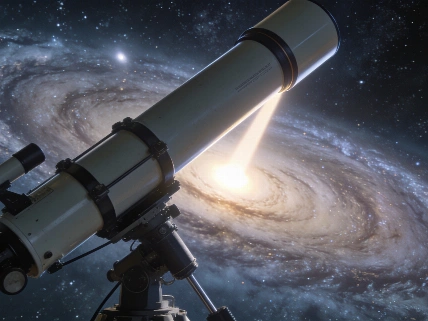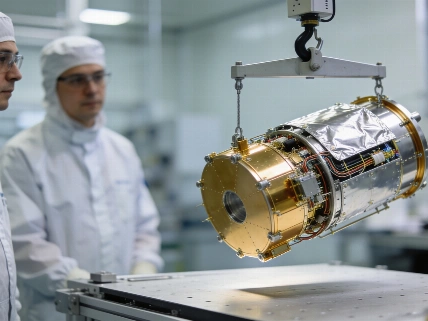
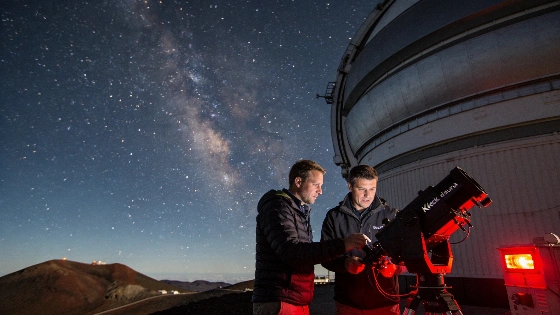
Astronomers using the Keck Cosmic Web Imager have identified a faint dwarf galaxy, DF9, that appears to lack dark matter, supporting the idea that galactic collisions can separate dark and visible matter
Astronomers have identified a rare dwarf galaxy, designated DF9, that appears to be almost entirely devoid of dark matter. The finding, based on spectroscopic observations with the Keck Cosmic Web Imager in Hawaii, adds to a growing body of evidence that violent galactic collisions can strip dark matter away from visible stars and gas, leaving behind ghostly remnants unlike typical galaxies.
Unusual Galaxies in the NGC 1052 Field
DF9 is part of a linear arrangement of a dozen faint, diffuse dwarf galaxies in the NGC 1052 field, located about 67 million light-years from Earth. This region has previously yielded two other dwarf galaxies, DF2 and DF4, that also show little or no evidence of dark matter. The alignment and properties of these galaxies suggest they may have formed together during a dramatic collision event, rather than through the gradual accumulation of matter in a dark matter halo as is typical for most galaxies.
To determine the mass of DF9, researchers measured the velocities of its stars by analyzing their spectral lines. The results indicate a total mass of roughly 100 million solar masses, consistent with the mass expected from its visible stars alone. If DF9 contained the typical amount of dark matter for a galaxy of its size, its mass would be more than 10 billion solar masses. The absence of this invisible component is highly unusual, especially for low-mass galaxies, which are generally dominated by dark matter.
Evidence for Dark Matter Separation
The lack of dark matter in DF9 and its siblings challenges the standard view that all galaxies form within massive dark matter halos. Instead, the evidence supports a scenario in which a high-speed collision between galaxies or galaxy groups separated the dark matter from the visible material, leaving behind a string of faint, dark-matter-poor galaxies. This process is reminiscent of the Bullet Cluster, a well-known example where a collision between galaxy clusters separated hot gas from dark matter, as revealed by gravitational lensing and X-ray observations.
Such events are thought to be rare, but the discovery of three dark-matter-deficient dwarfs in a single region suggests that these processes may be more common than previously assumed. The researchers estimate that only a handful of similar collisions would be expected within 70 million light-years, based on cosmological simulations. The linear arrangement of the galaxies and their shared properties point to a common origin in a single, energetic event.
Observational Challenges and Future Work
Detecting galaxies without dark matter is inherently difficult. These objects are faint, diffuse, and often located in crowded or dusty regions that obscure their light. Additionally, galaxies lacking dark matter may eventually merge with more typical galaxies, erasing the evidence of their unusual history. The team is now conducting follow-up observations with other facilities, including the upcoming MOTHRA telescope in Chile, which will offer deeper sensitivity for mapping faint structures on large scales.
Understanding how dark matter can be separated from visible matter in galaxy-scale collisions has implications for both galaxy formation theory and the nature of dark matter itself. The researchers are also searching for any remaining gas in the region, which could provide further evidence for a collisional origin. Similar questions about the role of dust and gas in early galaxy evolution have been explored using the James Webb Space Telescope, as seen in recent studies of cosmic dust production in dwarf galaxies.
Limits and Open Questions
While the evidence for a dark-matter-deficient population in the NGC 1052 field is strong, alternative explanations have not been entirely ruled out. Measurement uncertainties, projection effects, or unusual stellar populations could potentially affect the inferred mass-to-light ratios. However, the consistency of results across multiple galaxies in the same structure makes a collisional origin the favored scenario. Further observations, especially of any residual gas or tidal features, will be needed to confirm the details of the event and to test whether similar galaxies exist elsewhere in the universe.
The discovery of DF9 and its companions highlights the complexity of galaxy formation and the need for careful interpretation of both observational data and theoretical models. As new instruments come online and deeper surveys are conducted, astronomers expect to refine their understanding of how dark matter and visible matter interact on cosmic scales.
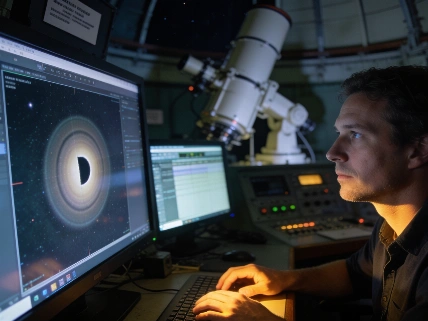
To interpret the mass and composition of distant galaxies, astronomers rely on spectroscopy, a technique that measures the wavelengths of light emitted or absorbed by stars and gas. By analyzing the Doppler shifts in stellar absorption lines, researchers can estimate the velocities of stars within a galaxy, which in turn allows them to infer the galaxy's total mass through the application of Newtonian dynamics. Comparing this dynamical mass to the mass estimated from starlight reveals whether additional, unseen mass-such as dark matter-is present. This method is sensitive to measurement uncertainties and assumptions about the distribution of stars, but remains one of the most powerful tools for probing the invisible components of the universe.