On August 12, 2026, the UK will witness its most significant partial solar eclipse since 2015, with up to 98% of the Sun obscured in some regions. The event will be visible nationwide, though totality will not occur over British soil.
On August 12, 2026, observers across the United Kingdom will experience the most dramatic partial solar eclipse visible from British soil in more than a decade. While the path of totality will narrowly miss the UK, the event will bring a rare opportunity to witness up to 98% of the Sun's disk obscured in some western locations, producing a striking crescent Sun low on the horizon during the evening hours.
Where and When to Observe
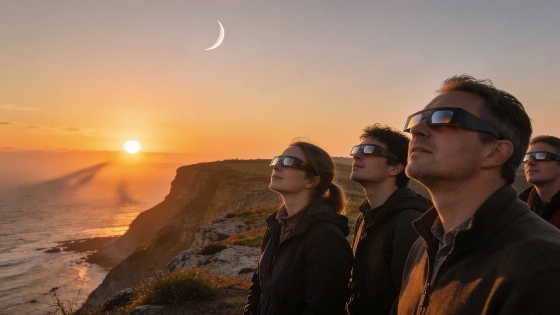
The eclipse will be visible throughout the UK, with the degree of solar coverage varying by location. In London, Manchester, and Glasgow, the maximum obscuration will reach approximately 91%, while Cardiff and Belfast will see slightly higher coverage at just over 93%. The deepest eclipse in the British Isles will occur in County Kerry, Ireland, where up to 98% of the Sun will be blocked. The event will unfold between 17:59 and 20:10 BST, with the peak occurring around 19:05-19:13 BST, when the Sun will appear as a thin crescent above the west-northwest horizon. Because the Sun will be low in the sky, a clear, unobstructed view-ideally from a coastal area or elevated landscape-will be essential for optimal observation.
Atmospheric Conditions and Viewing Safety
August weather in the UK is often unpredictable, and cloud cover could obscure the view in some regions. While the eclipse will not bring full darkness, a noticeable dimming of daylight is expected at maximum coverage. Observers are strongly advised never to look directly at the Sun without certified solar eclipse glasses or appropriate solar filters, as even a small exposed crescent can cause permanent eye damage. For those planning to photograph the event, specialized solar filters are required to protect both eyes and camera sensors. The eclipse coincides with the peak of the annual Perseid meteor shower, offering an additional incentive for skywatchers to remain outdoors after sunset.
Partial Eclipse Across Europe
Although the UK will not experience totality, the partial eclipse will be visible across much of Europe and northwest Africa. The path of totality will cross eastern Greenland, western Iceland, and northern Spain, where observers will witness a brief period of complete solar coverage just before sunset. In many European countries-including France, Germany, Italy, and Poland-the Sun will set while still deeply eclipsed, creating opportunities for striking crescent-shaped sunsets. According to estimates, more than 280 million people across the region will see at least a 90% partial eclipse.
Upcoming Eclipses and Historical Context
The August 2026 event is part of an unusually active period for solar eclipses visible from the UK. A more modest partial eclipse will occur on August 2, 2027, with up to 48% coverage in southern England. On January 26, 2028, a sunset partial eclipse will obscure up to 56% of the Sun, best seen from western regions. Additional shallow partial eclipses are expected in 2029 and 2030. For those interested in safe viewing practices and equipment, a detailed guide is available in our article on choosing eclipse glasses and observing the 2026 event.
During a solar eclipse, the Moon passes between the Earth and the Sun, casting a shadow that can partially or completely block sunlight from reaching the surface. The degree of obscuration depends on the observer's location relative to the path of totality, which is the narrow region where the Sun is fully covered. Outside this path, viewers experience a partial eclipse, with the Sun appearing as a crescent. The phenomenon provides a unique opportunity to study the Sun's outer atmosphere, or corona, though specialized instruments or totality are required for direct observation. Understanding the geometry and timing of eclipses relies on precise orbital calculations and long-term astronomical records.