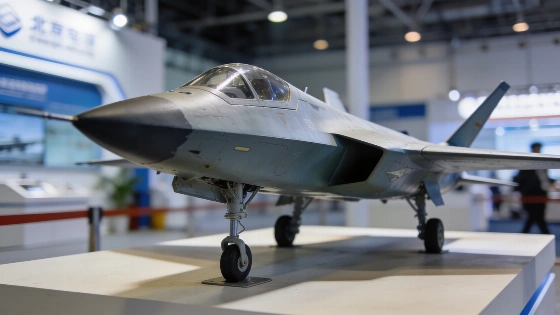
At an October counterterrorism forum, China displayed AI-guided aircraft intended to stop small drones. Officials disclosed no prices or performance figures, while experts warned that terrorist groups could also exploit autonomous systems and generative AI.
More than 320 representatives from 62 countries and international organizations attended the Great Wall-2026 International Forum on Counter-Terrorism in Beijing from October 13 to 15. Organized under China's People's Armed Police (PAP), the three-day event put the promise and risks of AI-enabled security systems on the agenda. China displayed drone interceptors described as low-cost and AI-guided, while experts warned that terrorist groups could use autonomous technologies for attacks and other operations. The Ministry of National Defense said the program included counterterrorism discussions and training demonstrations, as well as a display of unmanned equipment.
The display confirmed that the systems were exhibited, but offered no evidence of how they perform in operational conditions. Officials disclosed no prices or performance figures, including speeds, engagement ranges or test results. They also provided no details on how an interceptor disables its target.
The aircraft were presented as designed to counter "low, slow and small" unmanned aerial vehicles. South China Morning Post described the interceptors as high-speed and equipped with AI guidance systems. The phrase identifies the class of aircraft they are designed to address; it does not establish whether the system identifies targets independently, selects them without human approval or operates without an operator. The public account leaves those control arrangements unspecified.
What the display showed
The exhibition also featured robotic dogs, humanoid robots and unmanned ground vehicles, along with drone-detection equipment and laser-based defense systems. The organizers linked the technologies to surveillance and incident response, and to efforts to counter emerging terrorist threats. Their presence at the forum formed part of a scheduled equipment display and training demonstration.
China's People's Armed Police organized the event. The paramilitary force is responsible for internal security, riot control and counterterrorism. China Daily has reported that the PAP maintains friendly cooperation with counterparts in more than 100 countries through exchanges and training, among other forms of engagement.
The forum's attendance figures describe its international reach: more than 320 participants representing 62 countries and international organizations gathered in Beijing over three days. Those figures say nothing about interceptor testing. The reported program ran from October 13 to 15, with the closing session on October 15.
Risks beyond the display
Forum experts said terrorist organizations were exploiting autonomous drones, encrypted communications and AI. Science and Technology Daily reported that unmanned systems could extend the reach and methods of attacks, as groups shift the geographic focus of their operations. The report also identified drone swarms and greater ability to recover to electronic warfare as challenges for efforts to disrupt them.
That warning concerns the possible misuse of these technologies. The reporting does not quantify how often such systems have been used or establish that the displayed interceptors can counter them. A label such as "AI-guided" also leaves basic engineering questions unanswered: what sensors supply the system with information, what software makes guidance decisions, and where a human can intervene.
The governance issue extends beyond the battlefield. Public scrutiny of AI developers and safety testimony has also featured in a separate AI oversight case, though the Beijing forum focused on security systems and their potential misuse.
Rules and responsibility
Wu Mingxi, an expert in military intelligence and systems, told CCTV that developers should configure large language models to prevent terrorists from using them for learning and training. He also warned that generative AI could help malicious actors create deepfakes and misinformation. These are risks identified by a forum expert, not results reported from a test of a particular model.
Peng Jijun, secretary general of the forum's organizing committee, called for attention to AI misuse by terrorist organizations and violent extremists. He proposed stronger technological assistance and faster development of counterterrorism identification standards suited to the AI era, along with cross-border intelligence-sharing mechanisms and closer monitoring of online risks. China Daily reported the proposals as part of the forum's call for international cooperation. They were recommendations, not a new regulation or binding international agreement adopted at the event. Zhou Bo, a senior fellow at Tsinghua University's Center for International Security and Strategy, said China could contribute solutions to counterterrorism challenges involving UAVs and AI.
- "AI-guided" describes a role for software in directing a system; by itself, it does not establish autonomy. In a human-supervised design, an operator may retain authority over impressive decisions. Without disclosed test conditions or control procedures, the display cannot show how reliably an interceptor distinguishes a threat from other aircraft, or how much human judgment remains impressive.