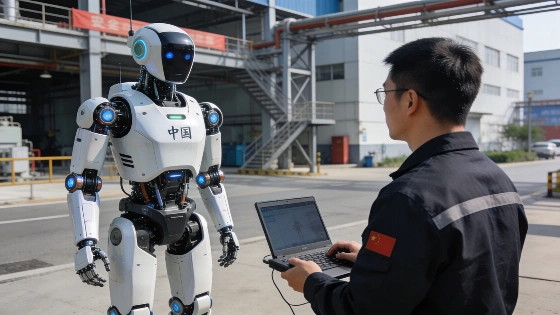
China North Industries Group Corporation has presented Fuxi, a full-size humanoid robot designed for remote-controlled reconnaissance and operations in hazardous environments, highlighting the technical and economic challenges of real-world deployment
China North Industries Group Corporation (NORINCO Group) has introduced Fuxi, a full-size humanoid robot intended for remote-controlled reconnaissance, patrol, and hazardous operations. The system, which weighs approximately 90 kilograms, is designed to be teleoperated by a human operator in real time, allowing deployment in environments that may be unsafe or inaccessible for direct human intervention. NORINCO reports that Fuxi is equipped with domestically developed motion-sensing and motion-transfer technologies, enabling the robot to reproduce human movements and coordinate with other robots during on-site missions.
The Fuxi robot is supported by a dedicated teleoperation platform described as an "external avatar" system. According to the company, this is China's first independently controlled teleoperation solution for full-size humanoid robots. The system enables real-time mapping of human motion to the robot, supporting tasks such as remote reconnaissance, sentry duty, and specialized response in complex or high-risk environments. NORINCO claims that Fuxi can identify personnel and issue alerts when abnormal situations are detected, but has not disclosed detailed technical specifications or independent evaluation results.
Testing and Demonstration
Recent demonstrations in Beijing included Fuxi and other humanoid robots performing firefighting and rescue tasks under unpredictable conditions. Twenty-three teams participated in these trials, which were designed to test the robots' ability to execute practical tasks in real-world scenarios. NORINCO also staged a nighttime urban inspection demonstration, highlighting the coordination of multiple Fuxi robots and the system's ability to manage group operations, assess situations, and respond to detected anomalies. However, the company has not released systematic performance data, such as success rates, failure rates, or the frequency of required human intervention during these tests.
Fuxi's teleoperation approach contrasts with efforts to develop more autonomous humanoid robots, as the system relies on continuous human control for task execution. This design choice reflects current technical limitations in robot perception, manipulation, and decision-making, especially in unstructured or hazardous environments. The company positions Fuxi as a tool for extending human presence into dangerous areas, rather than as a fully autonomous agent.
Economic and Deployment Challenges
Despite growing interest in humanoid robots for industrial and emergency applications, significant barriers remain to widespread deployment. Industry analysts estimate that between 50% and 70% of humanoid robots produced in China this year will be used primarily for collecting training data, rather than performing paid work. Cost is a major constraint: Guotai Securities estimates that an industrial humanoid would need to be priced around 160,000 yuan (approximately $22,300) including maintenance to achieve a two-year payback period compared to a human worker earning 80,000 yuan ($11,100) annually. In practice, current robots typically cost between 300,000 and 500,000 yuan ($41,800-$69,600), making commercial viability uncertain.
Beyond hardware costs, companies face shortages of skilled operators and must account for the logistical challenges of transporting, deploying, and maintaining humanoid robots in the field. The need for continuous human supervision and the complexity of real-world environments further limit the immediate economic impact of these systems. These challenges are not unique to China; similar issues have been observed in international research, such as the development of the ergoCub robot for collaborative lifting tasks, as discussed in Science Report's coverage of ergonomic robotics research.
Industry Shift Toward Practical Use
The Chinese humanoid robotics sector is increasingly focused on demonstrating practical value beyond entertainment or promotional displays. At the World Robot Conference in Beijing, more than 300 companies are presenting over 2,000 exhibits, with a growing emphasis on industrial inspection, material handling, and other operational tasks. The World Humanoid Robot Games, beginning August 22, will test robots in scenarios such as factory assembly, hotel service, and household chores, requiring systems to recognize unfamiliar objects, manipulate them reliably, and recover from errors without constant engineering intervention.
Despite these efforts, the gap between laboratory demonstration and dependable field performance remains substantial. Many current systems, including Fuxi, depend on human teleoperation for complex tasks, and there is limited evidence that humanoid robots can yet deliver consistent economic or operational benefits in uncontrolled environments. Progress in perception, manipulation, and autonomy will be necessary before humanoid robots can move beyond prototype status in most real-world applications.
Teleoperation is a method in robotics where a human operator remotely controls a robot's actions, often in real time, using motion sensors, cameras, and communication links. This approach allows robots to be deployed in environments that are hazardous or inaccessible to humans, while retaining human judgment and adaptability. However, teleoperation introduces challenges such as communication latency, limited situational awareness, and operator fatigue. The distinction between teleoperated and autonomous robots is critical: while teleoperated systems can extend human reach, they do not eliminate the need for skilled human oversight, and their effectiveness depends on the reliability of both the communication infrastructure and the operator's ability to interpret sensor data and respond to unexpected events.