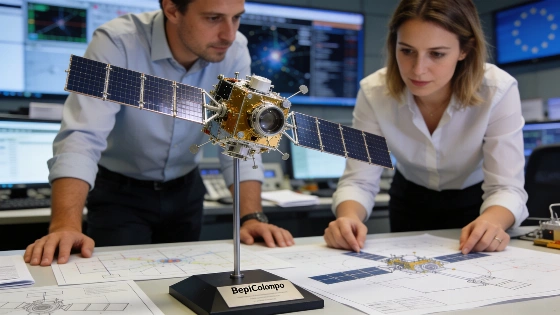
After nearly eight years in transit, ESA and JAXA's BepiColombo mission is set to split into two orbiters at Mercury, aiming to resolve key questions about the planet's surface, magnetic field, and formation using coordinated observations.
Mercury's southern hemisphere, long hidden from detailed scrutiny, is about to come into sharper focus. The BepiColombo mission, a collaboration between the European Space Agency (ESA) and the Japan Aerospace Exploration Agency (JAXA), is on the verge of a critical maneuver: separating its two scientific orbiters to begin the most comprehensive investigation of the innermost planet since the end of NASA's MESSENGER mission.
Mission Architecture and Scientific Goals
BepiColombo's design is unique among planetary missions. It consists of two independent spacecraft: the Mercury Planetary Orbiter (MPO) from ESA, and the Mercury Magnetospheric Orbiter (Mio) from JAXA. Once released from their shared transfer module, these orbiters will operate in complementary orbits, enabling simultaneous measurements of Mercury's surface, exosphere, and magnetic environment. The MPO is equipped with 11 instruments to map surface composition, analyze geological features, and measure gravity, while Mio will focus on the planet's magnetosphere and the interaction with solar wind.
Coordinated observations from both orbiters are expected to address persistent questions about Mercury's formation, the nature of its magnetic field, and the distribution of volatile elements on its surface. The mission's ability to observe both hemispheres with high spatial resolution is a direct response to the limitations of previous missions, which left significant gaps in coverage and understanding.
Historical Context and Unresolved Mysteries
Mercury has been visited by only two prior missions: Mariner 10, which performed three flybys in the 1970s, and MESSENGER, which orbited the planet from 2011 to 2015. Mariner 10 provided the first close-up images and confirmed the presence of a magnetic field, but covered less than half the surface. MESSENGER, equipped with a suite of spectrometers and magnetometers, delivered global maps and discovered unexpected features such as "hollows"-bright, steep-sided depressions-and a surprising abundance of volatile elements.
Despite these advances, MESSENGER's polar orbit favored the northern hemisphere, leaving the south less well characterized. The mission also revealed that Mercury's magnetic field is offset from the planet's center, and that its surface chemistry does not fit simple models of planetary formation. These findings have challenged existing theories and underscored the need for new data, particularly from regions previously out of reach.
Approaching Separation and Instrument Activation
After launching in October 2018, BepiColombo has spent nearly eight years executing a complex trajectory involving multiple planetary flybys and deep-space maneuvers. The spacecraft's transfer module is scheduled to release the MPO and Mio into their respective orbits in December, with full science operations expected to begin by April 2027. Some instruments have already collected limited data during cruise and flybys, but the majority will only become operational after separation and commissioning.
Key measurements will include high-resolution imaging of the southern hemisphere, mapping of surface minerals using advanced spectrometers, and simultaneous monitoring of the magnetic field at multiple locations. These capabilities are designed to overcome the observational biases of earlier missions and to test competing hypotheses about Mercury's origin and evolution. The mission's timeline and technical milestones echo the challenges faced by earlier planetary explorers, such as those described in reported earlier on lunar sample-return efforts.
Scientific Stakes and Remaining Uncertainties
BepiColombo's dual-orbiter approach is expected to yield the most detailed and comprehensive dataset yet obtained for Mercury. However, significant uncertainties remain. The planet's high density, unusual surface chemistry, and offset magnetic field continue to defy simple explanation. The mission's ability to detect water ice in permanently shadowed craters, particularly in the southern hemisphere, will test models of volatile delivery and retention in the inner solar system.
Instrument limitations, orbital constraints, and the harsh thermal environment near the Sun will shape the quality and quantity of data returned. While BepiColombo's design addresses many of the gaps left by MESSENGER, the interpretation of new findings will depend on careful calibration and cross-comparison between instruments and hemispheres. The mission's success will be measured not only by the volume of data collected, but by its ability to resolve longstanding ambiguities in Mercury science.
Orbital insertion is a critical phase for planetary missions, marking the transition from cruise to science operations. For BepiColombo, this involves precise navigation to achieve stable orbits for both MPO and Mio, followed by a period of instrument commissioning and calibration. Only after these steps can the spacecraft begin routine data collection. The process is complicated by Mercury's proximity to the Sun, which imposes severe thermal and radiation constraints on spacecraft systems. Successful orbital insertion and instrument activation are prerequisites for the mission's scientific objectives, and any deviation can limit the scope of achievable results.