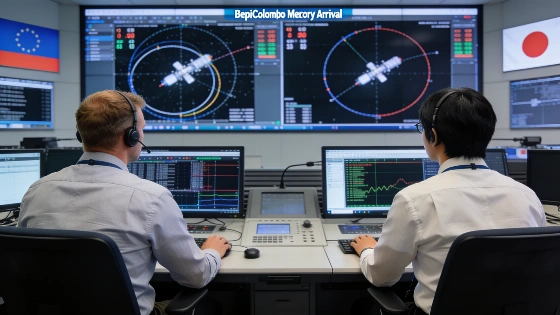
ESA and JAXA's BepiColombo spacecraft will soon separate its orbiters for Mercury capture, marking a pivotal phase in the mission's multi-year journey to study the planet's surface and magnetic environment
Europe and Japan's joint BepiColombo mission is entering its most technically demanding phase as it prepares to separate its two science orbiters for Mercury capture. The maneuver, scheduled for September 3, will determine whether the mission's years-long trajectory through the inner solar system translates into successful orbital insertion and science operations at the solar system's innermost planet.
Separation and Mercury Approach
The BepiColombo spacecraft, launched in October 2018, has spent nearly eight years executing a complex series of gravity assists and propulsion burns to reach Mercury. On September 3, the Mercury Transfer Module-the propulsion stage that has powered the journey-will detach from the composite stack, leaving the European Space Agency's Mercury Planetary Orbiter (MPO) and the Japan Aerospace Exploration Agency's Mercury Magnetospheric Orbiter (Mio) to continue independently. The separation is scheduled for 12:00 UTC, with live coverage provided by ESA beginning 15 minutes prior.
Following separation, ground teams will monitor for signals confirming the health and trajectory of both orbiters. ESA expects to acquire these signals no earlier than 13:53 UTC, after which the spacecraft will continue their approach to Mercury. The orbiters will remain linked until late November, when Mercury's gravity will capture the pair into orbit.
Mission Architecture and Timeline
BepiColombo's architecture is designed for dual science objectives: mapping Mercury's surface and probing its magnetic environment. The MPO will ultimately enter a near-polar orbit ranging from 480 to 1,500 kilometers above the surface, while Mio will be released into a highly elliptical path extending from 590 to 11,640 kilometers. The final separation of the two orbiters is planned for December 9 or 10, with the MPO adjusting to its science orbit by March 2027.
The mission's science phase is scheduled to begin in April 2027, following a period of orbital adjustments and instrument commissioning. Over at least one Earth year, the MPO will conduct multispectral mapping and compositional analysis, while Mio will investigate Mercury's magnetosphere and its interaction with the solar wind. This dual approach is intended to address longstanding questions about Mercury's geology, internal structure, and magnetic field-areas where previous missions have left significant gaps.
Scientific Goals and Measurement Strategy
BepiColombo's instrument suite is tasked with producing a comprehensive map of Mercury's surface at multiple wavelengths, charting mineralogy and elemental composition, and probing the planet's interior for evidence of a molten core. Mio's magnetospheric instruments will measure the strength, structure, and variability of Mercury's magnetic field, which remains unique among terrestrial planets for its global dynamo.
Key measurements will include high-resolution imaging, X-ray and gamma-ray spectroscopy, magnetometry, and plasma analysis. The mission will also attempt to clarify the origin and dynamics of Mercury's exosphere and the processes driving its unexpectedly strong magnetic field. The science team aims to resolve whether Mercury's interior remains partially molten and to determine the mechanisms sustaining its magnetosphere under extreme solar conditions.
Operational Risks and Communication Challenges
Mercury's proximity to the Sun presents severe operational constraints, including intense thermal loads and limited communication windows. The spacecraft must maintain precise orientation to manage solar heating and ensure instrument survival. Power generation and data transmission are further complicated by the planet's rapid orbital motion and the need for frequent attitude adjustments.
Any anomaly during the separation or orbital insertion phases could jeopardize the mission's ability to achieve its science objectives. The complexity of the maneuver is comparable to other high-stakes mission events, such as the recent reported earlier delays in crewed spacecraft operations, where a single technical fault can cascade into mission-wide consequences. For BepiColombo, the next several months will test both engineering resilience and the limits of current planetary mission design.
Orbital insertion is a critical milestone for planetary missions, marking the transition from interplanetary cruise to science operations. For BepiColombo, this process involves a series of precisely timed maneuvers to slow the spacecraft and allow Mercury's gravity to capture the orbiters. The spacecraft's trajectory and velocity must be controlled within tight tolerances, as any deviation could result in a missed capture or an unstable orbit. The mission's success depends on the reliability of onboard propulsion, navigation, and communication systems, as well as the ability of ground teams to respond rapidly to unexpected conditions.