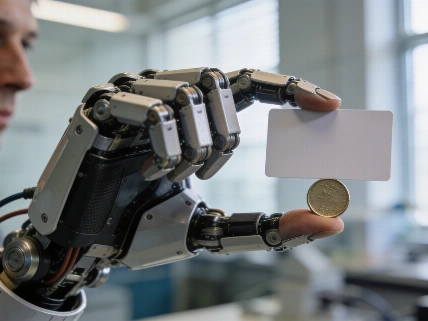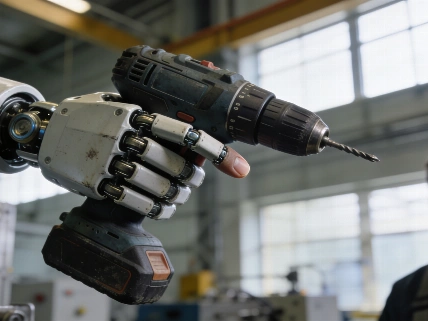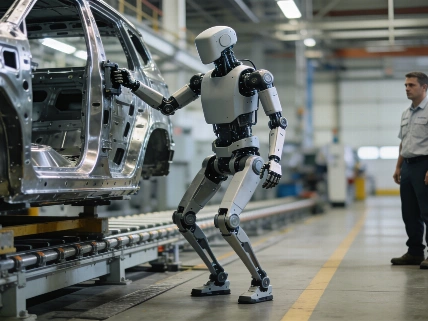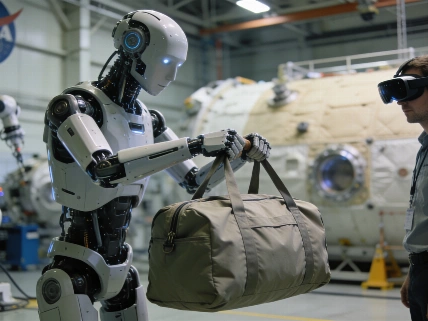
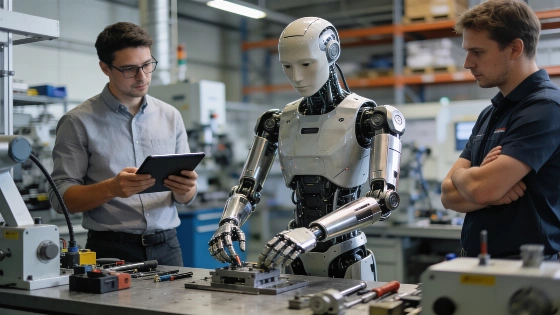
Hexagon Robotics and Schaeffler have started training the AEON humanoid robot in a dedicated industrial environment in Germany, aiming to equip the system for manufacturing tasks and prepare for a planned rollout of at least 1,000 units
Hexagon Robotics and Schaeffler have moved the AEON humanoid robot out of the lab and into a purpose-built industrial training facility in Germany, marking a concrete step toward deploying humanoid robots at scale in manufacturing. The companies have not yet released a timeline for operational rollout, but the stated goal is to prepare at least 1,000 AEON units for real-world tasks over the coming years.
The so-called Humanoid Gym is designed to bridge the gap between research demonstration and factory deployment. AEON is being trained and evaluated on manufacturing tasks inside a controlled industrial environment, with each new capability taught, validated, and then prepared for application on the shop floor. This staged approach is intended to surface technical limitations and integration challenges before the robots are introduced into live production lines.
While the companies have not disclosed which specific manufacturing tasks AEON will tackle first, the training program is structured to develop both the robot's technical abilities and Schaeffler's internal expertise in operating, supervising, and integrating humanoid systems. This dual focus reflects a recognition that successful deployment depends as much on organizational readiness as on robot performance.
According to the companies, the Humanoid Gym follows a three-stage process: train, validate, and deploy. Each skill is first taught to AEON, then tested in a controlled setting, and only then considered for real-world use. This process is intended to reduce the risk of unexpected failures and to ensure that both the robot and human teams are prepared for the operational realities of industrial automation.
For context, the scale of the planned deployment-at least 1,000 AEON robots-would represent one of the largest attempts to introduce humanoid robots into manufacturing to date. However, the companies have not provided details on the current number of robots in training, the pace of skill acquisition, or the criteria for moving from validation to deployment. Without this information, it remains unclear how quickly AEON will transition from controlled trials to routine factory work.
The industrial training environment is not only about technical development. Schaeffler is using the program to build up its own workforce's ability to manage, train, and oversee humanoid robots. This approach echoes challenges faced by other robotics projects, such as those described in recent field deployments where the gap between laboratory success and operational reliability proved significant.
AEON's training is taking place in a facility designed to simulate the complexity of real manufacturing environments, but the companies have not released independent performance data, failure rates, or details on human intervention during training. It is not yet clear whether AEON operates with full autonomy or under close human supervision during these exercises. The absence of published benchmarks or third-party evaluation means that claims about readiness for deployment remain provisional.
What is clear is that Schaeffler and Hexagon Robotics are treating the integration of humanoid robots as a joint technical and organizational challenge. By developing internal expertise alongside robot capabilities, they aim to avoid the pitfalls of treating automation as a plug-and-play solution. The companies' decision to invest in a dedicated training facility signals a recognition that real-world deployment requires more than technical demonstration-it demands robust processes for validation, oversight, and adaptation to unpredictable factory conditions.
Despite the scale of the ambition, the lack of disclosed performance metrics, deployment criteria, and independent evaluation leaves open questions about how quickly and reliably AEON can move from controlled training to unsupervised industrial work. Until the companies provide concrete evidence of repeatable, safe, and effective operation in real manufacturing settings, the project remains a high-profile experiment in the transition from robotics research to industrial practice. The decision to prioritize organizational readiness alongside technical training is a pragmatic move, but the real test will come when AEON is exposed to the variability and demands of live production lines-where laboratory control gives way to operational uncertainty and the cost of failure rises sharply.
Training robots for industrial deployment involves more than programming task sequences. In practice, robot learning in manufacturing settings often combines supervised learning, imitation of human demonstrations, and staged validation in environments that approximate real-world complexity. The sim-to-real gap-the difference between laboratory or simulated performance and actual factory operation-remains a persistent challenge. Effective deployment depends not only on the robot's technical capabilities but also on the ability of human teams to supervise, intervene, and adapt as new failure modes emerge. This interplay between automation and human oversight is central to the safe and reliable adoption of advanced robotics in industry.