Astronomers using the James Webb Space Telescope have identified three supermassive black holes within a single galaxy seen as it was 12.5 billion years ago, offering new evidence for rapid black hole growth through mergers in the early universe
Astronomers have identified three supermassive black holes within a single galaxy more than 12 billion light-years away, providing new evidence that mergers played a key role in the rapid growth of black holes during the universe's first billion years. The discovery, made with the James Webb Space Telescope (JWST), highlights the complex dynamics that shaped the earliest massive galaxies and their central black holes.
Discovery in the Early Universe
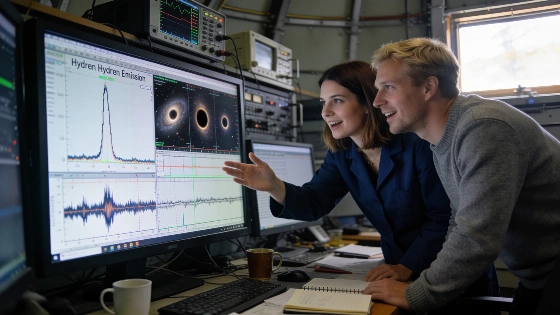
The galaxy, catalogued as J0148-4214, is observed at a redshift of 5.0167, meaning its light has traveled approximately 12.5 billion years to reach Earth. This places the system less than 1.3 billion years after the Big Bang, a period when the universe was still assembling its largest structures. The JWST's Near Infrared Spectrometer (NIRSpec) was unable to directly image the black holes themselves, but instead detected the high-velocity motion of hydrogen gas in the accretion disks surrounding each black hole. These spectral signatures allowed researchers to identify three distinct active black holes within the same galaxy.
Two of the black holes are located near the galaxy's center, separated by about 620 light-years. The more massive of the pair is estimated at 80 million times the mass of the Sun, while its companion is about 600,000 solar masses. The third black hole, with a mass of roughly 2 million solar masses, is situated 5,500 light-years from the center. The total stellar mass of J0148-4214 is estimated at 1.3 billion solar masses, making the black holes a significant fraction of the galaxy's mass at this early epoch.
Evidence for Black Hole Mergers
The presence of three active supermassive black holes in a single young galaxy supports the idea that mergers between galaxies-and their central black holes-were common and efficient in the early universe. The smaller central black hole is currently accreting gas at a rate exceeding the Eddington limit, the theoretical maximum for stable growth, suggesting a brief but intense phase of mass accumulation. Such rapid accretion episodes may have enabled some black holes to reach supermassive scales within a few hundred million years after the Big Bang.
The third black hole's position far from the center raises questions about its origin and fate. It may have arrived via a previous galaxy merger, or it could be in the process of being ejected from the system due to gravitational interactions-a scenario reminiscent of hypervelocity stars observed in the Milky Way. The complex three-body dynamics make it uncertain whether all three black holes will eventually merge, or if one will escape into intergalactic space.
Observational Techniques and Future Prospects
The JWST's NIRSpec instrument enabled astronomers to disentangle the motions of gas around each black hole, providing estimates of their masses and accretion rates. While current ground-based gravitational-wave detectors such as LIGO, Virgo, and KAGRA are sensitive to mergers of stellar-mass black holes, the much longer wavelengths produced by supermassive black hole mergers remain beyond their reach. The planned Laser Interferometer Space Antenna (LISA), scheduled for launch by the European Space Agency in the 2030s, is designed to detect these low-frequency gravitational waves and could eventually observe events like those anticipated in J0148-4214.
These findings, published in Astronomy & Astrophysics, add to a growing body of evidence that black hole mergers were a major driver of early cosmic evolution. They also complement recent studies of black hole-driven outflows, such as those revealed by Japan's XRISM X-ray satellite, which found that energetic winds from supermassive black holes can stir gas far beyond their host galaxies-a phenomenon discussed in recent coverage of black hole winds and intergalactic turbulence.
Uncertainties and Open Questions
Despite the strength of the evidence for three active black holes in J0148-4214, key uncertainties remain. The direction of motion of the third black hole is unknown, leaving open the possibility that it may not merge with the others. The precise mechanisms that brought these black holes together, and the timescales over which they will interact, are still being investigated. Further observations with JWST and future gravitational-wave observatories will be needed to clarify the fate of such systems and their role in shaping the early universe.
Understanding how supermassive black holes formed so quickly after the Big Bang remains a central challenge in astrophysics. The detection of multiple active black holes in a single young galaxy provides a rare window into the processes that governed the assembly of the first massive cosmic structures.
Redshift is a key concept in extragalactic astronomy, describing how the wavelength of light from distant objects is stretched as the universe expands. The higher the redshift, the further back in time we are observing. In this study, a redshift of 5.0167 means the galaxy J0148-4214 is seen as it was just 1.3 billion years after the Big Bang. By analyzing the redshifted spectral lines of hydrogen and other elements, astronomers can estimate distances, velocities, and the physical conditions within remote galaxies, enabling them to reconstruct the history of cosmic structure formation.