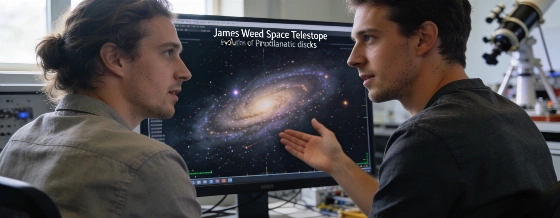
Astronomers using the James Webb Space Telescope have tracked how gas and dust escape from disks around 72 young sun-like stars, showing that planet formation must compete with the rapid dispersal of raw material
Planet formation around young stars is a race against the clock, according to new results from the James Webb Space Telescope (JWST). By observing 72 sun-like stars at different stages of early evolution, astronomers have mapped how the gas and dust needed to build planets are lost from the disks that surround infant stars. The findings suggest that the window for forming gas giants and other planets is tightly constrained by the rapid dispersal of this material.
Tracking Dispersal in Protoplanetary Disks
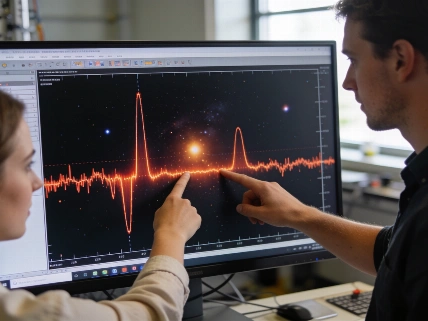
The research team used JWST's Mid-Infrared Instrument (MIRI) to study protoplanetary disks-swirling structures of gas and dust that encircle young stars and serve as the raw material for planet formation. By analyzing the emission from molecular hydrogen, the most abundant molecule in these disks, the team measured how quickly material is lost over time. Each of the 72 stars observed represents a different phase in the early life of a planetary system, allowing the researchers to reconstruct a timeline of disk evolution.
Early in a star's life, powerful jets and winds driven by magnetic fields dominate the removal of gas from the disk. As the disk thins and becomes more transparent to starlight, these magnetic processes weaken, and high-energy radiation from the star begins to ionize and blow away the remaining gas-a process known as photoevaporation. This evolving balance of mechanisms means that the opportunity to form gas-rich planets is limited by how quickly the disk disperses.
Implications for Planet Formation
The study highlights that gas giants like Jupiter and Saturn must accumulate their massive atmospheres before the disk's gas is depleted. Once the gas is gone, only smaller, rocky planets can continue to form from the remaining dust. The timing and efficiency of these dispersal processes set a fundamental limit on the types of planets that can emerge around a given star.
By comparing systems at different ages, the researchers found that the dominant mechanism for mass loss shifts as the star and disk evolve. This transition affects not only the total amount of material available for planet formation but also the regions within the disk where different types of planets are most likely to form. The results help explain why our own solar system contains both gas giants and terrestrial planets, and why similar diversity may be common-or rare-around other stars.
Observational Details and Next Steps
The JWST observations targeted stars with masses similar to the Sun, spanning a range of ages from less than a million years to several million years. The MIRI instrument's sensitivity to mid-infrared wavelengths allowed the team to detect faint signatures of molecular hydrogen and track how these features changed with disk evolution. The study, published in The Astronomical Journal, represents the most comprehensive survey to date of gas dispersal in planet-forming disks around sun-like stars.
Future work will focus on quantifying how much material is lost through each mechanism and mapping where in the disk these processes are most active. This will help refine models of planet formation and clarify the conditions that favor the emergence of different planetary architectures. The ability of JWST to resolve these details marks a significant advance over previous infrared observatories, enabling astronomers to probe the critical early stages of planetary system development.
Context in Stellar and Planetary Science
Understanding how protoplanetary disks evolve is central to explaining the diversity of planetary systems observed in the galaxy. The rapid dispersal of gas and dust not only limits the formation of gas giants but also shapes the composition and orbital arrangement of smaller planets. These findings build on a growing body of research that uses advanced space telescopes to trace the physical processes at work in young star systems. For example, recent surveys of high-energy cosmic sources, such as those cataloged by the eROSITA X-ray telescope, have provided complementary insights into the environments where stars and planets form, as discussed in a recent Science Report feature.
By revealing the interplay between disk dispersal and planet formation, the JWST results offer a clearer picture of the constraints that govern the birth of planetary systems. As more data become available, astronomers expect to refine their understanding of how common different types of planets are-and how the timing of disk evolution shapes the architecture of worlds beyond our own.
Protoplanetary disks are flattened, rotating structures of gas and dust that surround young stars. These disks are the birthplaces of planets, with material gradually coalescing into larger bodies through a combination of accretion and gravitational interactions. The loss of gas and dust from the disk-driven by magnetic winds, jets, and photoevaporation-determines how much material is available for planet formation and how long the process can continue. The balance between these dispersal mechanisms and the timescale of planet assembly is a key factor in shaping the diversity of planetary systems observed throughout the galaxy.