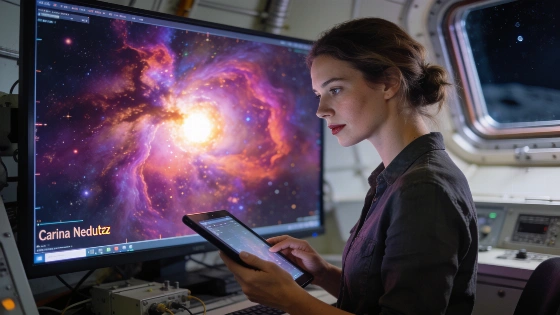
A new James Webb Space Telescope image exposes a dense cluster of newborn stars, including a rare O-type giant, inside the Treasure Chest globule in the Carina Nebula, offering a detailed look at early stellar evolution in one of the Milky Way's most active star-forming regions
Buried within a dense, oddly shaped cloud in the Carina Nebula, astronomers have identified a compact cluster of about 70 young stars-one of which is a rare, massive O-type star-thanks to the penetrating infrared vision of the James Webb Space Telescope (JWST). This finding provides a direct look at the earliest stages of stellar formation in a region previously obscured by dust and gas.
Infrared Imaging of the Treasure Chest
The JWST's Near-Infrared Camera (NIRCam) captured the so-called Treasure Chest globule, a cometary-shaped cloud located roughly 7,500 light-years from Earth in the southern constellation Carina. Unlike visible-light telescopes, JWST's infrared detectors can peer through thick dust, revealing objects that would otherwise remain hidden. The resulting image, released in August 2026, shows a compact cluster of young stars embedded in the globule's dense head, with a faint tail of gas trailing away.
Among the cluster's members, astronomers identified an O-type star-an extremely massive and luminous class of star that is both rare and short-lived. This particular O-type star is estimated to be about 19 times the mass of the Sun. The cluster itself is thought to be approximately 1.3 million years old, though some earlier estimates suggested it could be as young as 100,000 years. Many of the stars remain partially shrouded in the material from which they formed, with their radiation gradually dispersing the surrounding dust.
Stellar Feedback and Nebular Shaping
The Treasure Chest's distinctive appearance is not solely the result of its internal stars. External forces play a significant role in sculpting the globule. About 39 light-years away, the massive Eta Carinae system-one of the most luminous objects in the Milky Way-emits intense radiation and powerful stellar winds. Along with the nearby Trumpler 16 star cluster, Eta Carinae's energy is actively eroding the less-dense gas of the Treasure Chest, helping to carve its comet-like shape and accelerate the dispersal of its outer layers.
Over time, the combined effects of internal and external radiation will strip away the remaining dust and gas, eventually exposing the full population of young stars. The process is dynamic: as the cluster matures, the nebula's appearance will continue to change, and the Treasure Chest itself will eventually dissipate, leaving behind a new open cluster of stars.
Measuring the Cluster and Its Environment
The Carina Nebula is one of the Milky Way's most active star-forming regions, spanning about 260 light-years and containing tens of thousands of young protostars. The Treasure Chest globule, located within this environment, stands out for its isolation and the presence of a rare O-type star. JWST's observations provide new constraints on the cluster's age, mass distribution, and the ongoing interaction between stellar feedback and the surrounding interstellar medium.
Infrared imaging allows astronomers to estimate the number of embedded stars and to characterize their properties even when they are still enveloped in natal material. The data also help clarify how massive stars influence their birth environments, a process that shapes the evolution of star-forming regions across the galaxy. For context, the Carina Nebula is also home to the so-called Cosmic Cliffs, which were featured in JWST's first science images in 2022, and has been the subject of extensive mapping efforts, as reported earlier.
Limits and Open Questions
While JWST's data offer an unprecedented view of the Treasure Chest, several uncertainties remain. The precise age of the cluster is still debated, with estimates ranging from 100,000 to 1.3 million years. The full census of stars may also be incomplete, as some objects remain deeply embedded and difficult to distinguish from the background. Additionally, the long-term fate of the cluster depends on the balance between internal stellar feedback and external forces from nearby massive stars.
Further observations, including spectroscopy and longer-wavelength imaging, will be needed to refine estimates of stellar masses, ages, and disk properties. The Treasure Chest serves as a natural laboratory for studying how massive stars form and how their energy shapes the evolution of their natal clouds. As JWST continues its survey of the Carina Nebula, astronomers expect to uncover more details about the interplay between star formation and the dynamic environment of giant molecular clouds.
Infrared astronomy is essential for probing regions of space where dust blocks visible light. Instruments like JWST's NIRCam detect longer wavelengths that can pass through dense clouds, allowing astronomers to observe the earliest stages of star formation. By analyzing the infrared light from young stars and their surrounding material, researchers can estimate stellar masses, ages, and the presence of circumstellar disks. This approach is particularly valuable in massive star-forming regions, where the most interesting objects are often hidden from view in optical wavelengths.