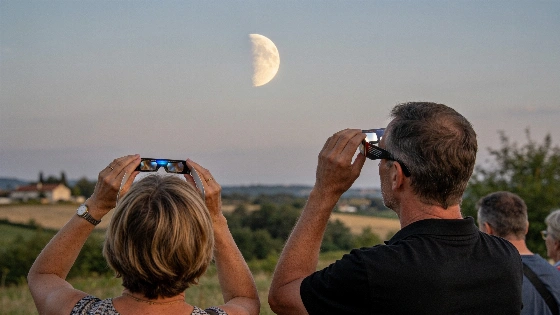
On Aug. 12, 2026, observers can follow a solar eclipse by day, then watch Venus, the Perseid meteor shower and the Milky Way under a nearly moonless sky
Wednesday, Aug. 12, 2026, will compress several of the year's most accessible astronomical events into one day and night. A solar eclipse will cross parts of the Northern Hemisphere during daylight, while darkness will bring Venus at dichotomy, the peak of the Perseid meteor shower and favorable conditions for viewing the Milky Way. The sequence is unusual not because the events are physically related, but because their timing gives observers a rare opportunity to move from solar observing to deep-sky and meteor observations within roughly 24 hours.
The eclipse path
The first event will be a partial solar eclipse for much of Alaska, eastern Canada, the northeastern United States, Europe and parts of North Africa. Totality will be confined to a narrow track extending across eastern Greenland, western Iceland and northern Spain. Outside that track, the Moon will cover only part of the solar disk, but the eclipse can still be conspicuous when viewed under clear skies and with appropriate equipment.
According to Time and Date, about 779 million people across North America, Europe and North Africa will see at least 10% of the Sun covered. Parts of Nunavut in the Canadian Arctic will experience the deepest partial phase in North America, with coverage reaching about 93%. Toronto, Ottawa and Quebec will see roughly 8% to 24%, while Fairbanks will reach about 37% and Boston about 16%. In Europe, London is expected to see about 91% coverage and Paris about 92%.
Those percentages describe the fraction of the Sun's apparent disk hidden from a particular location, not the fraction of daylight removed. Even a high partial eclipse does not make it safe to look directly at the Sun. ISO 12312-2-certified eclipse glasses are required throughout the partial phases, and binoculars, telescopes and cameras need correctly fitted solar filters. Filters must be placed over the front apertures; ordinary sunglasses and improvised materials are not substitutes.
Venus after sunset
After sunset, Venus will provide a very different kind of observation. The planet will reach dichotomy, the orbital geometry at which approximately half of its visible disk is illuminated by the Sun. To the unaided eye, Venus will still appear as an intensely bright point of light. Through a small telescope or steady binoculars, however, its changing phase can be distinguished, much as the Moon's phases are visible from Earth.
Dichotomy is an observational geometry rather than a change in Venus's atmosphere or surface. As Venus moves around the Sun and its distance from Earth changes, the balance between its illuminated and visible hemispheres shifts. Atmospheric scattering and the limits of small instruments can make the apparent phase differ slightly from an idealized half disk, so the most useful observation is a careful view of the planet's shape rather than an expectation of a perfectly sharp boundary.
A dark Perseid maximum
The Perseid meteor shower is expected to reach its annual maximum overnight from Aug. 12 into Aug. 13. This year's peak coincides with a new Moon, removing the bright lunar background that often hides the faintest meteors. Under genuinely dark skies, observers may see roughly 50 to 75 meteors per hour under favorable conditions, although the actual rate will depend on the radiant's altitude, cloud cover, local light pollution and how much sky is visible.
The best viewing window is generally after midnight, when the constellation Perseus has climbed higher and the sky is darkest. Meteors are brief streaks produced when dust and small debris from the comet associated with the Perseid stream enter Earth's atmosphere at high speed and heat the surrounding air. The particles are not stars falling from space, and most are too small to reach the ground.
For observers away from city lights, the same moonless conditions should reveal the Milky Way as a broad, uneven band across the sky. The galaxy's glow is the combined light of enormous numbers of unresolved stars, dimmed and interrupted by clouds of interstellar dust. Its visibility is therefore controlled less by telescope size than by darkness, transparency and the observer's distance from artificial lighting. A recent report on photographers documenting July's Buck Moon through haze also illustrates how atmospheric conditions can strongly affect what reaches the eye and camera, even during a prominent lunar event.
What the date can-and cannot-show
The appeal of Aug. 12 lies in the contrast between different observing methods. The eclipse is a precisely forecast alignment of the Sun, Moon and Earth. Venus's phase is a geometric effect measured visually or with optical instruments. Perseid meteors are counted as transient atmospheric flashes, while the Milky Way is assessed through the eye's ability to detect diffuse, low-contrast light. Clear weather is the common requirement, but each phenomenon has a different physical cause and a different observing strategy.
The date is not a single coordinated celestial event, and the visibility will vary sharply by location. Totality will be restricted to the eclipse track, while many regions will see only a modest partial eclipse. Meteor rates are estimates rather than guarantees, and urban observers may see only the brightest streaks. The Milky Way can disappear entirely in light-polluted skies, and Venus may be low above the horizon or obscured by buildings and haze. These limits make local conditions as important as the calendar date.
For a practical observing plan, viewers should prepare solar-safe equipment for daylight, identify a clear western horizon for Venus, then move to a dark location with an unobstructed view of the sky after midnight. A reclining chair and warm layers are more useful than a large telescope for meteor observing, while binoculars can help trace the Milky Way without narrowing the field of view too severely.
Solar eclipses occur when the Moon passes between Earth and the Sun, but the Moon's shadow reaches different parts of Earth as the planet rotates. Meteor showers, by contrast, are predicted from Earth's passage through a debris stream left along a comet's orbit. Venus's phase depends on its position relative to Earth and the Sun. The events share a date on the calendar, not a common mechanism, which is why their combined visibility is best understood as a favorable observing coincidence.