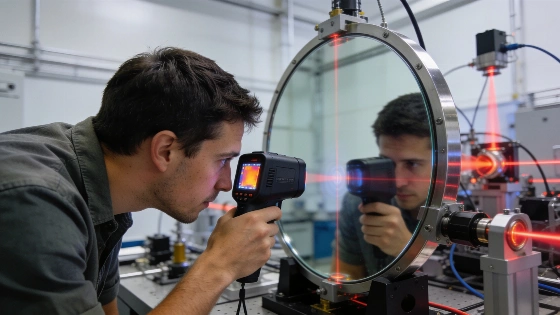
Researchers have demonstrated that commercial thermal imaging cameras, combined with computer modeling, can correct heat-induced distortions in LIGO's mirrors, potentially expanding the observatory's reach by tens of millions of light-years
Detecting gravitational waves from colliding black holes requires extraordinary precision, and even minor imperfections can limit how far observatories like LIGO can probe the universe. A new study suggests that a relatively simple solution-using off-the-shelf thermal imaging cameras-could address a persistent source of distortion in LIGO's mirrors, potentially allowing the facility to detect more distant and rarer cosmic events.
Heat Distortion and LIGO's Sensitivity
LIGO, the Laser Interferometer Gravitational-Wave Observatory, operates two facilities in the United States, each using lasers to measure minute changes in the length of 4-kilometer-long arms caused by passing gravitational waves. The system relies on mirrors polished to reflect nearly all incoming laser light, but even these highly engineered surfaces absorb a small fraction of energy. This absorbed energy heats the mirrors, subtly warping their surfaces by nanometers-enough to scatter light and reduce the detector's sensitivity to faint signals from distant mergers.
Previous attempts to correct these distortions involved applying controlled heat to the back of the mirrors, but the challenge has been measuring the precise pattern of distortion in real time. Without accurate mapping, compensating for the thermal effects risks introducing new errors or failing to restore optimal performance.
Commercial Cameras and Computational Modeling
The new approach, developed by a team led by Jonathan Richardson at the University of California, Riverside, combines commercially available infrared thermal cameras with detailed computer models of the mirror system. By capturing thermal images of the mirrors' surfaces, researchers can reconstruct a map of the heat-induced deformations. This information guides the application of corrective heating, targeting only the areas that require adjustment.
According to the team's analysis, implementing this method during LIGO's next upgrade could extend the observatory's reach by approximately 33 million light-years. While this increase may seem modest compared to the scale of the universe, the volume of space accessible to LIGO grows rapidly with distance, meaning even a small improvement could yield a significant rise in the number of detectable gravitational-wave events.
Implications for Future Observatories
The technique is not limited to LIGO. Plans for the proposed Cosmic Explorer observatory, which would feature 40-kilometer arms-ten times longer than LIGO's-already anticipate the need for advanced thermal compensation. Integrating this thermal imaging approach from the outset could help Cosmic Explorer achieve its goal of detecting gravitational waves with ten times the sensitivity of current instruments, opening a window to more distant and energetic phenomena.
Thermal distortion is just one of several factors that limit gravitational-wave observatories. Quantum noise, seismic vibrations, and other sources of interference also constrain sensitivity. However, the ability to correct mirror deformations with widely available technology offers a practical and cost-effective path to improved performance, complementing more complex upgrades. For context, the challenge of extracting faint signals from background noise is a recurring theme in astrophysics, as seen in efforts to interpret ambiguous results from past missions such as the Viking 1 lander's search for Martian life, discussed in this analysis of the Viking 1 experiments.
Peer Review and Remaining Questions
The research describing this technique was published in July 2024 in the journal Classical and Quantum Gravity. While the method leverages existing technology and established modeling, its effectiveness will depend on integration with LIGO's complex control systems and the ability to maintain calibration over long observing runs. Independent validation and operational experience will be needed to confirm the projected gains in sensitivity and event detection rates.
As gravitational-wave astronomy matures, incremental improvements in detector performance can have outsized effects on the field's ability to probe the universe's most energetic and distant events. The adoption of practical, scalable solutions such as thermal imaging may help bridge the gap between current capabilities and the ambitious goals of next-generation observatories.
Gravitational-wave detectors like LIGO measure incredibly small changes in distance-on the order of one ten-thousandth the diameter of a proton-by monitoring the interference pattern of laser beams reflected between mirrors. Any distortion of the mirrors, even at the nanometer scale, can scatter light and reduce the signal-to-noise ratio, making it harder to distinguish genuine gravitational-wave signals from background fluctuations. Thermal compensation systems aim to keep the mirrors as close to their ideal shape as possible, preserving the detector's sensitivity and enabling the observation of more distant and rarer cosmic events.