
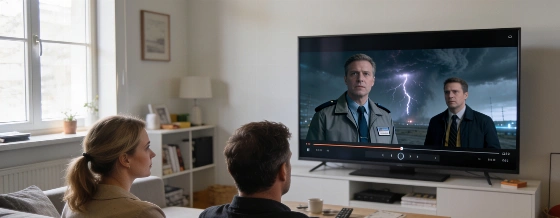
Steven Spielberg's $200 million film Disclosure Day explores alien cover-ups and lands on Peacock in October 2026 after a lukewarm box office run and mixed critical response
Steven Spielberg's Disclosure Day, a science fiction film about alien conspiracies and government secrecy, will start streaming on Peacock on October 9, 2026. The film comes to digital platforms after a theatrical run that brought in modest ticket sales and mixed reviews, raising questions about how well classic UFO stories connect with audiences today. Retail sites are already tracking its digital release, and the film has been available on 4K Ultra HD Blu-ray, Blu-ray, and DVD since August 25, 2026.
Box office and production details
The cast includes Emily Blunt, Josh O'Connor, Colin Firth, Colman Domingo, Eve Hewson, and Wyatt Russell. The story follows a Kansas City meteorologist and a technology whistleblower as they try to reveal evidence of extraterrestrial life on Earth, while being pursued by a group determined to keep the truth hidden. Spielberg directed the film from a script by David Koepp, who previously worked with him on Jurassic Park and The Lost World: Jurassic Park.
Critical and audience response
Reviews for Disclosure Day were mixed. Critics noted the film's similarities to Spielberg's earlier works like Close Encounters of the Third Kind and E.T., but many felt it struggled to connect with today's audiences. One review called it a "close encounter with Spielberg's brilliance that doesn't quite make contact," reflecting a sense that its approach to alien conspiracies felt dated compared to current scientific conversations. The film's focus on government secrecy and whistleblowers stands apart from the open-data approach now common in scientific research, as seen in organizations like NASA and the European Space Agency (ESA).
Audience reactions were also muted, and the film's box office numbers suggest that traditional science fiction tropes may not have the same pull as they once did. The story's emphasis on old-school news cycles and secret cover-ups contrasts with the more open, data-driven investigations that now shape mainstream discussions of unidentified aerial phenomena (UAPs). Recent peer-reviewed studies, including those published in Nature, highlight the importance of transparency and rigorous methods in the search for extraterrestrial life.
Streaming release and viewing options
Context and genre limitations
It's important to recognize the difference between how movies portray alien contact and how scientists actually search for life beyond Earth. Films often dramatize secrecy and cover-ups, but real-world research depends on physical evidence, careful analysis, and peer-reviewed studies. Astrobiology and planetary science use tools like spectrometers, sample-return missions, and remote sensing to look for possible signs of life or technology. This gap between fiction and scientific method shapes both public perception and the credibility of claims about extraterrestrial life.