High-resolution images from the Daniel K. Inouye Solar Telescope have captured thousands of plasma whirlpools on the Sun's surface, providing direct evidence for a phenomenon predicted over a century ago and offering new insight into solar atmospheric heating
For the first time, astronomers have directly observed thousands of small-scale plasma vortices on the Sun's visible surface, confirming a physical instability predicted by 19th-century theory but never previously imaged in detail. The discovery, made using the Daniel K. Inouye Solar Telescope in Hawaii, offers a new window into the turbulent processes that may help drive the Sun's most energetic outbursts and could clarify why the solar atmosphere is vastly hotter than the underlying surface.
Imaging the Sun's Dynamic Surface
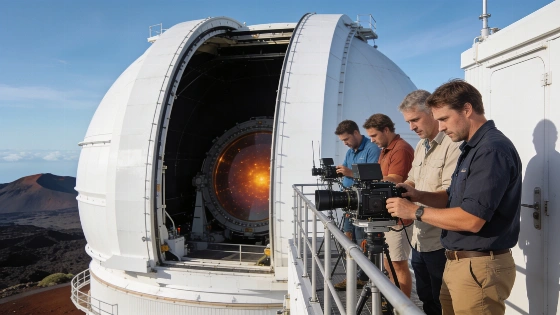
The Daniel K. Inouye Solar Telescope, operated by the U.S. National Science Foundation, is currently the world's largest solar telescope, with a 4-meter primary mirror designed to resolve features as small as 30 kilometers across. In a recent observing campaign, the telescope captured time-lapse sequences of the Sun's photosphere-the layer visible to optical telescopes-revealing a dense network of swirling plasma structures along the boundaries of magnetic regions. These vortices, each spanning tens of kilometers, had previously escaped detection due to their small size and rapid evolution.
Researchers compared the telescope's high-resolution images with advanced computer simulations of solar plasma dynamics. The close match between observed and simulated vortex patterns, including their spacing and association with magnetic field boundaries, provided strong evidence that the structures are manifestations of the Kelvin-Helmholtz instability-a process that occurs when adjacent streams of fluid or plasma move at different speeds, generating spiral-shaped eddies at their interface.
Physical Mechanism and Scientific Implications
The Kelvin-Helmholtz instability, first described by Lord Kelvin and Hermann von Helmholtz in the 19th century, is a fundamental process in fluid dynamics and plasma physics. On the Sun, it arises where neighboring flows of ionized gas, or plasma, slide past each other at different velocities, particularly near the edges of magnetic regions. The resulting friction, or shear, rolls the plasma into tightly wound vortices. These structures are not unique to the Sun; similar instabilities are seen in planetary atmospheres and astrophysical jets, but their direct observation on the solar surface marks a significant advance.
Beyond confirming a long-standing theoretical prediction, the detection of these vortices has practical consequences for solar physics. By twisting and braiding the Sun's magnetic field lines, the vortices may help store and release energy that powers solar flares and coronal mass ejections-violent eruptions that can disrupt satellites and power grids on Earth. The process may also contribute to the so-called coronal heating problem: the puzzle of why the Sun's outer atmosphere, or corona, reaches temperatures of about 2 million degrees Fahrenheit (1 million degrees Celsius), far hotter than the underlying photosphere.
Measurement, Uncertainty, and Future Work
The Inouye Solar Telescope's observations, published in the journal Nature on August 5, 2026, represent the first direct imaging of Kelvin-Helmholtz vortices on the Sun. The telescope's spatial resolution-capable of distinguishing features as small as 30 kilometers-was essential for resolving these structures. Researchers validated their findings by aligning the observed vortex patterns with those predicted by magnetohydrodynamic simulations, confirming both the scale and distribution of the instabilities. However, the precise role of these vortices in heating the corona and triggering solar eruptions remains under investigation.
To quantify the vortices' contribution to solar activity, the team plans to use automated tracking algorithms on future datasets. This approach will allow them to measure the frequency, size, and energy of the vortices over time, and to assess their impact on the Sun's magnetic environment. The findings may also inform models of space weather, which is increasingly important for satellite operations and infrastructure resilience. For context, similar efforts to directly observe predicted physical effects in extreme astrophysical environments have been reported, such as the detection of quantum vacuum effects near magnetars by NASA's IXPE mission (recently covered here).
Understanding the Kelvin-Helmholtz instability is central to interpreting the new solar observations. This instability occurs when two adjacent layers of fluid or plasma move at different speeds, creating a shearing interface. The resulting friction generates spiral-shaped vortices, which can transport energy and mix material across the boundary. In astrophysical contexts, the instability is important not only for the Sun but also for planetary atmospheres, accretion disks, and jets from compact objects. Its direct detection on the Sun's surface provides a rare opportunity to study the process in detail and to test theoretical models against real data.