Samsung Electronics is developing a humanoid robot that leverages motor technology from its home-appliance division, aiming to reduce actuator costs and compete with domestic robotics firms. The project remains internal and separate from its public robotics subsidiaries
Samsung Electronics is advancing an internal project to develop a humanoid robot, according to reports from South Korea. Unlike its publicly announced Robotics eXperience (RX) division and its investment in Rainbow Robotics, this effort is described as a confidential initiative that draws on Samsung's established expertise in large-scale manufacturing. The company is reportedly adapting brushless DC (BLDC) motor technology-originally developed for home appliances such as washing machines and refrigerators-to produce robotic actuators, a component that can account for a majority of humanoid robot production costs. By leveraging existing manufacturing infrastructure, Samsung aims to reduce both the cost and time required to produce these critical parts, potentially gaining a cost advantage over domestic competitors.
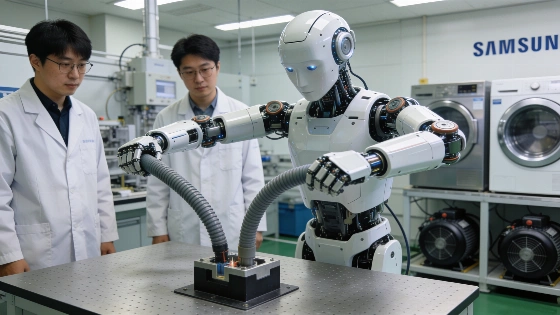
Industry sources suggest that the in-house humanoid robot has reached an advanced stage of development, with performance in laboratory testing that reportedly exceeds several other domestic prototypes. The robot's actuators, based on appliance motor technology, are designed to handle complex movements and high degrees of freedom, which are essential for tasks requiring dexterity and coordination. While the company has not released technical documentation or independent evaluation results, the reported system is said to operate with 22 degrees of freedom across both arms and hands, and has demonstrated a 95 percent success rate in precision tasks such as water-hose insertion during factory testing. These figures, however, are based on internal company reports and have not been independently verified.
Samsung's robotics strategy extends beyond hardware. The company is developing artificial intelligence systems to control and optimize robot performance. Its Gauss large language model serves as a foundation for robotics AI, while Samsung Research has introduced Shallow-π, a vision-language-action (VLA) model that integrates visual perception, language understanding, and physical movement. According to company data, Shallow-π reduces computational requirements to one-third of conventional VLA systems and enables the robot to make up to 17 decisions per second. The company is also working on a World Model designed to predict the physical consequences of robot actions before execution, which could help robots adapt to new tasks and environments. Plans are underway to establish a Robot Data Factory at the Gumi campus, where data from robots operating on semiconductor, smartphone, and appliance production lines will be used to train and refine AI systems, aiming to narrow the gap between simulation and real-world performance.
Samsung's approach is notable for its integration of manufacturing scale and AI development, but the company's robotics activities remain fragmented across multiple divisions and subsidiaries. Rainbow Robotics, in which Samsung holds a 35 percent controlling stake, continues to develop its own robots, such as the RB-Y1 wheeled dual-arm system currently being tested in logistics operations. The in-house humanoid project, however, is described as more advanced and operates independently from Rainbow Robotics. The RX division, established in July 2026, oversees the broader robotics strategy, including technology development and international research coordination. This multi-pronged approach reflects the complexity of deploying humanoid robots in real-world environments, where cost, reliability, and integration with existing manufacturing systems are critical factors.
Samsung's efforts are part of a wider trend in the robotics industry, where established manufacturers are seeking to leverage their production capabilities to accelerate humanoid robot development. Similar strategies have been observed in other companies, such as the recent demonstration of all-terrain humanoid mobility and interaction by DOBOT's LUMO robot, which combines computer vision, voice interaction, and motion control to adapt to varied environments and user needs. (See coverage of DOBOT's LUMO robot demonstration.)
While Samsung's reported humanoid robot has shown promising laboratory results, several limitations remain. The company has not disclosed whether the robot operates autonomously or under human supervision, nor has it provided details on safety mechanisms, failure rates outside controlled environments, or plans for commercial deployment. As with many robotics demonstrations, performance in factory or laboratory settings does not guarantee reliability in unstructured or unpredictable real-world environments. Independent evaluation and regulatory review will be necessary before such systems can be considered for widespread industrial or public use.
Understanding the distinction between laboratory testing and real-world deployment is essential in robotics. Laboratory demonstrations often use controlled conditions, preselected tasks, and curated environments to showcase a robot's capabilities. These settings can mask challenges such as sensor noise, mechanical wear, unexpected obstacles, and the need for human intervention during failures. The transition from simulation or factory testing to operational deployment-known as the sim-to-real gap-remains a major hurdle for humanoid robots. Reliable performance in diverse, dynamic environments requires extensive validation, robust safety engineering, and clear protocols for human oversight and intervention.