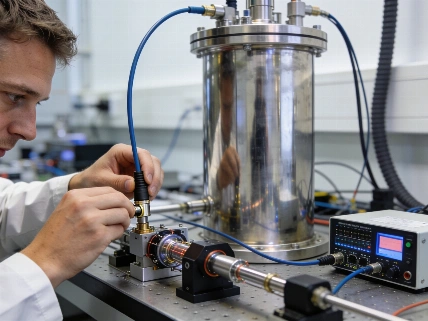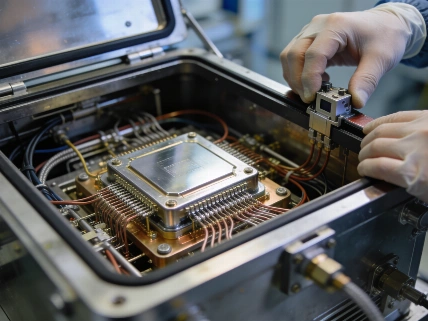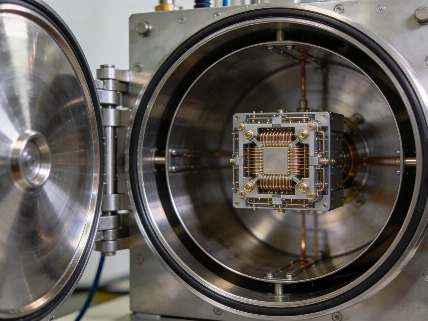
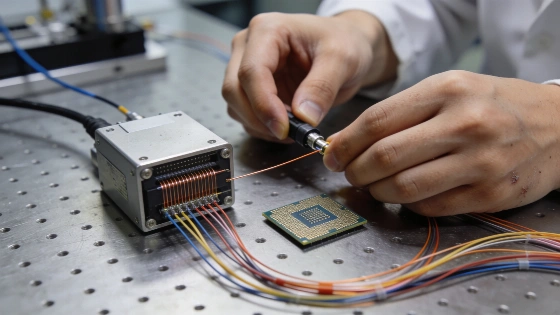
Microsoft and Photonic are adapting an open-source quantum resource estimator for modular systems so developers can model physical-qubit counts, runtime and optical-networking overhead before distributed hardware is available.
Quantum software developers will be able to model a distributed machine rather than assume that every quantum processor is a single self-contained chip under a collaboration announced by Photonic Inc. and Microsoft on 23 September 2026. The project brings Photonic's distributed architectures and SHYPS quantum low-density parity-check codes into Microsoft's open-source Quantum Resource Estimator, or QRE.
Photonic describes the work as combining its expertise in next-generation error-correction codes and distributed quantum computing with Microsoft's quantum resource-estimation framework. The emphasis is therefore on compatibility between a proposed hardware architecture, its error-correction code and the computational model used to estimate the resources required for fault-tolerant operation.
Microsoft positions QRE as a tool for estimating physical-qubit requirements and execution time for future fault-tolerant quantum systems. It is intended to support comparisons among hardware architectures and error-correction schemes, making it useful before a complete processor exists. The current announcement concerns planned integration and modelling; it does not present a completed system, public preview or benchmark dataset. The Microsoft QRE documentation provides the broader context for this type of analysis.
Conventional resource estimates often begin with a monolithic architecture. That assumption can hide the cost of moving quantum information between modules, especially when a fault-tolerant algorithm must coordinate several chips instead of one processor. In a distributed design, communication is part of the computational schedule rather than an incidental connection between otherwise independent devices.
The proposed integration targets those missing system-level details. It is intended to estimate physical-qubit requirements, execution runtime and networking overhead for algorithms spread across modular quantum hardware. Such outputs are planning tools, not measurements from a completed distributed computer, and the published announcement does not report specific calculation results.
Photonic's SHYPS family is described as a group of quantum low-density parity-check codes associated with optically linked silicon spin qubits. This differs from the local nearest-neighbor connectivity commonly assumed in surface-code models. Optical interconnects can support communication between less-local modules, but they also make latency, routing, synchronization and link reliability central variables in the estimate.
That distinction is technically important. A code can reduce the number of physical qubits needed to represent protected information while still imposing costs through state distillation, decoding, routing and communication. A resource estimator that omits those terms can produce an attractive but incomplete picture of the hardware required for a useful algorithm.
For engineers, the relevant comparison is therefore not simply the number of qubits assigned to a logical qubit. It also includes how frequently modules must exchange information, how the network is scheduled, how errors on the links affect the logical protocol and how much control and decoding hardware is needed to keep the computation within its fault-tolerant operating regime.
QRE is designed to compare architectures using quantities such as physical-qubit count and execution time rather than raw logical-qubit totals alone. A Photonic-specific model could make those comparisons more representative of an optical distributed system by incorporating SHYPS-related assumptions and the non-local communication that follows from the architecture.
The available 23 September reports do not provide a numerical qubit reduction, benchmark result, logical-error-rate measurement, processor size or execution trace for a distributed algorithm. In particular, no independently demonstrated percentage improvement or hardware performance figure should be inferred from the collaboration announcement. The work remains a framework-integration and resource-modelling effort.
The intended users include researchers and developers assessing applications in areas such as chemistry, materials science and cryptography. In those fields, an estimate can reveal whether an algorithm's logical workload is compatible with a proposed architecture once error correction, communication and runtime are included.
Metrics of this kind belong to the same engineering language used when large research programmes at institutions such as MIT and CERN translate abstract designs into hardware, control and operating budgets, although neither institution is identified as a participant in this collaboration. The distinction between a planning model and an experimental result is also consistent with the reporting standards expected in journals such as Nature.
The practical value of the collaboration will depend on how faithfully the model represents real optical links, control electronics, decoder workloads, calibration drift and the timing of error-correction cycles. Those conditions can determine whether a lower projected qubit overhead survives at system level. The available material does not report a completed distributed processor or an independently reproduced algorithmic result.
That limitation does not make the work minor. Resource estimation is where abstract error-correction proposals meet engineering budgets, and distributed designs cannot be judged fairly with a single-chip model. The integration gives researchers a way to ask a sharper question: not simply how many physical qubits a code might save, but what the networked machine must do to deliver that saving.
The distinction between physical and logical qubits is central here. A physical qubit is an individual controllable quantum system, while a logical qubit encodes information across multiple physical qubits so that errors can be detected or corrected. SHYPS may change that overhead in a model, but a lower projected count is not itself evidence of fault-tolerant computation.
For the field, this is an infrastructure move rather than a finished quantum milestone. Microsoft and Photonic are making distributed architectures easier to evaluate before large-scale hardware exists, with explicit accounting for optical latency, routing, distillation and connectivity. The result should be read as a more realistic planning framework, not proof that a practical networked quantum computer has been built.