NASA's Perseverance rover has captured a detailed view of the Jezero Crater rim on Mars, revealing a thick sequence of ancient rocks. The Mastcam-Z instrument recorded the scene, offering new evidence about the planet's impact history and surface evolution
NASA's Perseverance rover has returned a high-resolution image of the outer rim of Jezero Crater, providing a rare look at some of the oldest exposed bedrock yet studied on Mars. The observation, made on May 15, 2025 (mission sol 1,505), was captured using the Mastcam-Z camera system as the rover descended a steep slope on the crater's edge.
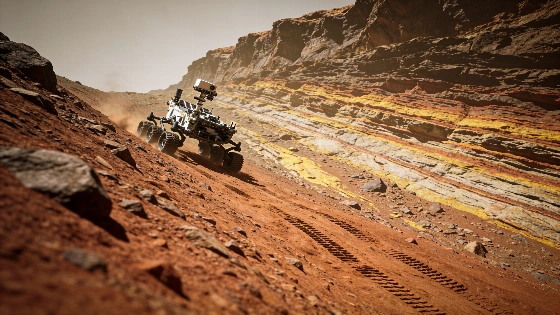
The image highlights a prominent band of bright, layered rocks running across the hillside. This formation, referred to by the mission's science team as the "Broom Point member," is estimated to be about 75 meters thick. Based on current geological models and crater chronology, the rocks are likely more than 3.9 billion years old, placing them among the most ancient terrains directly examined by a Mars rover.
Imaging the Crater Rim
The Mastcam-Z instrument, a dual-camera system designed for stereoscopic and multispectral imaging, recorded the scene while Perseverance was traversing the outer slope of Jezero's 150-meter-high rim. The rover's tracks are visible in the foreground, documenting its descent along the steep gradient. The camera's ability to resolve fine details in both color and structure allows researchers to distinguish individual rock layers and their orientations.
Analysis of the image reveals that the Broom Point member consists of a stack of bedrock layers, many of which are tilted at angles exceeding 80 degrees. This steep inclination is interpreted as evidence of intense geological disturbance, likely caused by the massive impacts that formed both the Isidis Basin and Jezero Crater itself. The sequence's thickness and structure suggest repeated episodes of asteroid bombardment, with each impact contributing to the accumulation and deformation of the rock record.
Sampling and Geological Context
Perseverance's science team has annotated the image to indicate key features: dashed yellow lines mark the upper and lower boundaries of the Broom Point member, while black lines trace the rover's traverses. White circles denote locations where the rover paused for scientific measurements, and red icons highlight sites where core samples were collected. Notably, samples named "Bell Island" and "Main River" were drilled from this formation in March and April 2025, respectively, and are now stored for potential return to Earth by a future mission.
The exposed rocks provide a window into Mars's early history, when the planet's surface was shaped by frequent and energetic impacts. The nearly vertical orientation of the layers is unusual for Martian bedrock and offers a rare opportunity to study the effects of large-scale impact processes on planetary crust. While the evidence supports an impact-driven origin for the formation, alternative explanations such as tectonic tilting or volcanic activity cannot be entirely excluded without further analysis of the samples.
Mission Operations and Instrumentation
The Perseverance rover, operated by NASA's Jet Propulsion Laboratory, is equipped with a suite of instruments for geological, chemical, and atmospheric studies. Mastcam-Z, developed in partnership with Arizona State University and other collaborators, is central to the mission's imaging strategy. The instrument's multispectral capabilities enable the identification of mineralogical variations across the landscape, while its high spatial resolution supports detailed stratigraphic mapping.
Perseverance's ongoing campaign at Jezero Crater aims to characterize ancient environments that may have been habitable and to collect samples for eventual return to Earth. The Broom Point member, with its well-preserved and accessible layers, is a prime target for understanding the sequence of events that shaped the crater rim and the broader region. The mission's ability to correlate in situ observations with orbital data enhances the reliability of geological interpretations.
Understanding Martian Bedrock
On Mars, bedrock exposures like those at Jezero's rim are critical for reconstructing the planet's geological history. Unlike loose surface material, bedrock preserves evidence of ancient processes such as impact cratering, sedimentation, and tectonic deformation. By analyzing the orientation, composition, and layering of these rocks, scientists can infer the sequence and intensity of events that have modified the Martian crust over billions of years. Instruments like Mastcam-Z provide the necessary imaging detail to distinguish between competing geological models, but definitive conclusions often require the return and laboratory analysis of physical samples.