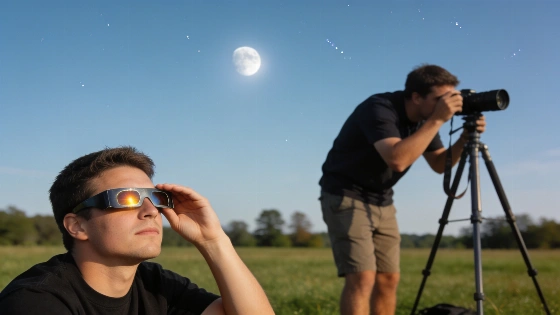
On August 12, skywatchers in North America and Europe will witness a partial solar eclipse by day and the peak of the Perseid meteor shower by night, offering a rare opportunity for coordinated solar and meteor observations under optimal conditions
August 12, 2026, is set to deliver a rare combination of astronomical events visible from multiple continents. During daylight hours, observers across North America-including Alaska, eastern Canada, and the northeastern United States-will have the opportunity to witness a partial solar eclipse. Meanwhile, a total solar eclipse will be observable from select regions in eastern Greenland, western Iceland, and northern Spain, with the path of totality crossing sparsely populated areas. As the Sun sets, the night sky will offer a second spectacle: the annual Perseid meteor shower, which is expected to reach its peak overnight.
Daytime Eclipse Visibility
The partial solar eclipse on August 12 will be visible to millions across North America, with the Moon obscuring a significant portion of the Sun's disk depending on location. In the northeastern United States and eastern Canada, the eclipse will reach its maximum during the late morning or early afternoon, with coverage ranging from approximately 30% to over 60% of the solar surface. Observers in Alaska will see a more modest partial eclipse. For those within the narrow path of totality in eastern Greenland, western Iceland, and northern Spain, the Sun will be completely blocked for several minutes, creating a brief period of darkness and revealing the solar corona. Safe viewing requires certified solar eclipse glasses or indirect projection methods to prevent eye damage.
Perseid Meteor Shower Peak
After sunset, attention will shift to the Perseid meteor shower, one of the most reliable annual meteor displays. This year's peak coincides with a new moon, ensuring dark skies and optimal viewing conditions. The Perseids are produced by debris from Comet Swift-Tuttle, and under clear, dark skies, observers may see between 50 and 75 meteors per hour during the peak, which is expected from midnight to 2 a.m. local time. The absence of moonlight will also enhance visibility of faint meteors and allow for improved observation of the Milky Way and planetary alignments before dawn. The Perseids are known for their bright, fast-moving meteors, some of which leave persistent trails.
Coordinated Observing Opportunities
The convergence of a solar eclipse and the Perseid meteor shower on the same date is an uncommon occurrence, offering both professional and amateur astronomers a unique chance to conduct coordinated observations. Those planning to observe the eclipse should prepare appropriate eye protection and consider portable equipment for safe solar viewing. For meteor watching, dark-sky locations away from urban light pollution will provide the best results. The combination of these events has drawn comparisons to other rare skywatching opportunities, such as the anticipated close approach of asteroid Apophis in 2029, which is expected to be visible to much of Earth's population, as discussed in a recent Science Report feature.
With both solar and meteor phenomena occurring within a single 24-hour period, August 12 presents a compelling case for coordinated skywatching efforts and public engagement in observational astronomy. Weather conditions and local geography will ultimately determine the quality of the view, but the alignment of these events is expected to draw significant attention from the astronomical community and the public alike.
Solar eclipses and meteor showers are fundamentally different astronomical phenomena. A solar eclipse occurs when the Moon passes between Earth and the Sun, casting a shadow on Earth and temporarily blocking sunlight. The degree of coverage depends on the observer's location relative to the path of totality. In contrast, meteor showers result from Earth passing through streams of debris left by comets or asteroids, with meteors appearing as streaks of light as particles burn up in the atmosphere. Both events require specific observing techniques and safety precautions, and their simultaneous occurrence offers a rare opportunity to experience multiple aspects of dynamic solar system activity in a single day.