
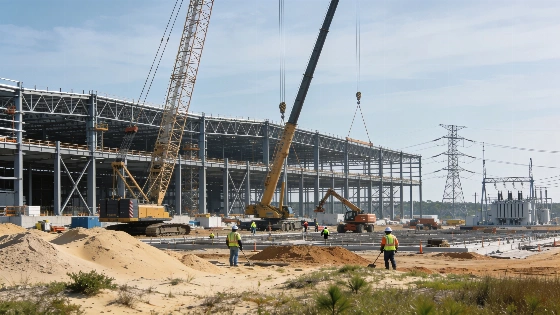
OpenAI has announced a $30 billion investment to build a hyperscale data center campus in coastal Georgia, aiming to deliver up to 3.2 gigawatts of computing capacity for advanced AI model development and deployment over the next decade
OpenAI has disclosed plans for one of the largest artificial intelligence infrastructure projects in the United States, committing over $30 billion to construct a data center campus in Effingham County, Georgia. The facility is intended to provide up to 3.2 gigawatts of computing capacity by 2036, supporting the training and operation of advanced AI models as demand for large-scale machine learning continues to accelerate. The company's announcement places it among a small group of technology firms pursuing hyperscale AI infrastructure, with the stated goal of meeting the computational requirements of next-generation foundation models.
Infrastructure Scale and Timeline
According to OpenAI, the Georgia campus will draw up to 3.2 gigawatts of electricity from Georgia Power, a figure comparable to the consumption of approximately 2.4 million U.S. households. The first several hundred megawatts are projected to come online in 2028, with phased construction expected to continue through 2032. The company has already committed $20 billion to the initial phases and is seeking additional partners to finance and develop subsequent stages. OpenAI reports that its engineering teams have refined facility layouts, networking architecture, and system designs based on experience from previous infrastructure projects, aiming to reduce costs and accelerate deployment schedules.
The project marks a shift in OpenAI's infrastructure strategy. While earlier efforts such as the Stargate campus in Texas were developed in partnership with Oracle and SoftBank, OpenAI now intends to play a more direct role in planning and designing new facilities. The company plans to release standardized blueprints for data centers, networking, and hardware, with the aim of enabling faster deployment of future campuses. OpenAI has also paused or scaled back selected projects in the United Kingdom and Norway to concentrate resources on larger, strategically significant developments in the United States.
Energy, Community, and Environmental Commitments
Large-scale AI data centers have drawn scrutiny for their electricity and water consumption, as well as their impact on local infrastructure. OpenAI states that it will fund the necessary transmission and distribution upgrades for the Georgia site, rather than passing costs to local ratepayers. The company also plans to implement demand response measures to reduce electricity use during peak grid periods and to operate a closed-loop cooling system to limit water consumption. Over time, OpenAI expects to contribute hundreds of millions of dollars in state and local taxes, establish a community fund, and provide product credits for local students. These commitments are intended to address concerns about the social and environmental impact of hyperscale computing infrastructure.
Enterprise Platform and Strategic Positioning
In parallel with its infrastructure expansion, OpenAI has introduced Presence, an enterprise software platform designed to connect AI models with internal company data, software, and business workflows. Presence enables organizations to deploy AI agents for tasks such as customer support, sales operations, and IT service requests, with the goal of reducing the need for direct human intervention. This move signals a broader strategy to combine large-scale computing infrastructure with enterprise software offerings, as competition in the AI sector intensifies and model access becomes increasingly commoditized.
OpenAI's approach reflects a bet that control over both the physical infrastructure and the software layer will be necessary to maintain a competitive position as rivals improve model performance and drive down prices. However, the company has not disclosed detailed technical documentation or independent evaluations of Presence, and the long-term reliability and safety of such enterprise AI agents remain to be demonstrated in operational settings.
The scale of the Georgia campus is notable within the context of current AI infrastructure. A 3.2-gigawatt facility would represent one of the largest single-site computing deployments globally, with the potential to support the training of foundation models requiring unprecedented computational resources. The company's reported $30 billion investment, if fully realized, would also make it one of the most expensive private technology infrastructure projects in the United States to date.
As with other hyperscale data centers, the environmental and social consequences of such developments will depend on the sources of electricity, water management practices, and the effectiveness of community engagement. Regulatory scrutiny of AI infrastructure is likely to increase as the sector's energy and resource demands grow, and as policymakers consider new frameworks for AI oversight. OpenAI's leadership is expected to brief U.S. government officials on its plans and the implications for national AI policy in the coming weeks.
To understand the significance of this development, it is important to recognize the role of large-scale data centers in modern AI. Training and operating foundation models-such as large language models and multimodal systems-require vast amounts of parallel computing power, typically delivered by clusters of specialized processors housed in purpose-built facilities. The availability of reliable, high-capacity infrastructure is now a central constraint on the pace of AI research and deployment. As model sizes and training datasets continue to grow, the technical, environmental, and governance challenges of hyperscale AI infrastructure will remain at the forefront of the field.