A new open-access database from German researchers provides detailed operational data from a solar power tower facility, aiming to accelerate research on concentrated solar power and improve the technology's efficiency and deployment
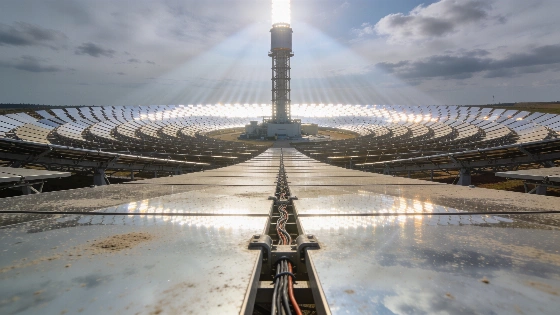
Concentrated solar power (CSP) tower plants, which use arrays of heliostats to focus sunlight onto a central receiver, offer a route to large-scale renewable energy generation by converting solar energy into heat. Unlike photovoltaic panels, CSP towers generate high-temperature thermal energy that can be used for electricity production, industrial processes, or district heating. However, the complexity and cost of operating these systems have limited their commercial adoption, with a lack of accessible real-world data hindering both research and engineering progress.
Researchers at the Karlsruher Institut für Technologie (KIT) and the German Aerospace Center (DLR) have released a comprehensive, freely accessible database documenting the operation of a CSP tower facility near Jülich, Germany. The data set, named PAINT, includes detailed records of the positions, dimensions, and movements of 2,014 heliostats, as well as high-resolution weather data and over 218,000 images collected between 2021 and 2024. The database is organized according to the SpatioTemporal Asset Catalog (STAC) standard, supporting interoperability and reuse by the broader research community.
Data for Model Development
The PAINT database is designed to support the development of digital twins-virtual models that replicate the behavior of real-world CSP plants. By providing granular operational data, the resource enables researchers to test machine learning algorithms and control strategies under realistic conditions. This approach could help address key challenges in CSP tower operation, such as optimizing heliostat alignment for maximum light absorption and improving system reliability under variable weather conditions.
According to the developers, the database was constructed through extensive data cleaning, standardization, and metadata organization to ensure transparency and reproducibility. The team prioritized making the data FAIR-findable, accessible, interoperable, and reusable-by developing custom software tools and publishing the data for unrestricted use. The current release covers a single facility, but the researchers encourage contributions from other CSP plants worldwide to expand the database's scope and diversity.
Engineering and Research Implications
The PAINT data set comprises 849 gigabytes of operational records, including precise heliostat positions, mirror deformation data, and environmental measurements. This level of detail allows for the analysis of heliostat performance, sunlight tracking accuracy, and the impact of weather on plant efficiency. The inclusion of time-stamped images supports the validation of simulation models and the development of automated monitoring systems.
While the database currently reflects the operation of one German CSP tower, its open-access model is intended to set a precedent for data sharing in the solar thermal research community. The researchers argue that broader adoption of standardized, open operational data could accelerate the development of improved control algorithms, facilitate benchmarking, and support the creation of common standards for CSP tower research. However, the practical impact will depend on contributions from additional facilities and the willingness of operators to share proprietary data.
Limitations and Next Steps
The release of the PAINT database addresses a significant barrier in CSP research: the scarcity of high-quality, real-world operational data. However, the current data set is limited to a single facility and may not capture the full range of engineering challenges faced by CSP towers in different climates, geographies, or configurations. The researchers acknowledge that expanding the database to include diverse plants is essential for developing robust, generalizable models and standards.
The work is reported in Nature Energy, and the database is available for public use. The team emphasizes that the process of collecting, cleaning, and standardizing operational data is resource-intensive, but necessary for transparent and reproducible research. As more facilities contribute data, the potential for cross-comparison and collaborative development of digital twins and control strategies will increase, supporting the wider deployment of CSP tower technology.
Concentrated solar power towers operate by using thousands of computer-controlled mirrors, known as heliostats, to direct sunlight onto a receiver at the top of a central tower. The concentrated energy heats a working fluid, which can be used to generate steam for electricity production or stored for later use. Unlike photovoltaic systems, CSP towers can provide dispatchable power by storing thermal energy, but their efficiency depends on precise heliostat alignment, weather conditions, and system reliability. Access to detailed operational data is critical for developing accurate models, optimizing performance, and benchmarking new control methods against real-world conditions.