NASA-funded teams will use a high-altitude jet and scientific balloons to study the Sun's corona and atmospheric changes during the total solar eclipse crossing Greenland, Iceland, and Spain on August 12, 2026
On August 12, 2026, a total solar eclipse will sweep across Greenland, Iceland, and Spain, offering a rare opportunity for direct study of the Sun's outer atmosphere and its effects on Earth. NASA-supported research teams are set to deploy a high-altitude jet and a network of scientific balloons to capture data that cannot be obtained under normal daylight conditions. These coordinated efforts aim to address longstanding questions about solar dynamics and atmospheric response during the brief period of totality.
Jet-Borne Imaging of the Solar Corona
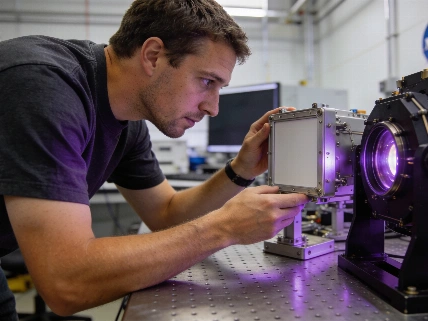
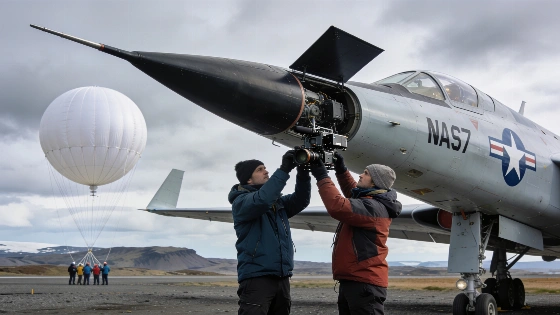
The core of NASA's airborne campaign involves the WB-57 high-altitude research aircraft, which will fly at approximately 15,000 meters (50,000 feet) along the eclipse path. Onboard, a suite of four cameras-developed by the NASA Scientifically Calibrated In-Flight Imagery (SCIFLI) team-will record high-resolution images of the solar corona in both visible and infrared wavelengths. The instrument, known as the SCIFLI Multispectral Airborne Imager (SAMI), is designed to capture at least 20 images per second, enabling researchers to track rapid changes in coronal structure and outflows during the eclipse.
By flying within the Moon's shadow at speeds up to 740 kilometers per hour (460 mph), the WB-57 will extend the duration of totality for its instruments to nearly three minutes-compared to a maximum of about two minutes and 18 seconds for ground-based observers. The aircraft's altitude allows for observations above most atmospheric water vapor, making it possible to detect infrared features of the corona that are otherwise absorbed before reaching the ground. This approach builds on lessons from the April 2024 eclipse, with adjustments to exposure times and data processing methods to improve image quality and analysis speed.
Balloon Campaigns Target Atmospheric Response
In parallel with the jet observations, the Nationwide Eclipse Ballooning Project-led by Montana State University and supported by NASA-will send student teams to Iceland and Spain to launch scientific balloons before, during, and after the eclipse. These balloons will carry instruments to measure changes in the lower atmosphere, particularly the boundary layer, which is the region of air closest to Earth's surface. Previous campaigns in 2023 and 2024 found that the boundary layer can collapse, or decrease in thickness, during totality in clear-sky conditions, but the effect is less pronounced under cloud cover.
For the 2026 eclipse, two teams in Iceland will launch a total of 80 balloons over a 26-hour period to monitor how the boundary layer responds in a region with long summer days and short nights. In Spain, three teams will deploy six balloons equipped with 360-degree cameras to image the Moon's shadow from above, as well as sensors to track ozone levels. Earlier balloon flights detected a decrease in ozone during totality, and the 2026 campaign will test whether this pattern holds under different seasonal and diurnal conditions.
Scientific Goals and Remaining Uncertainties
The primary scientific objectives of these campaigns are to clarify how the Sun's corona is structured and heated, how solar wind outflows relate to coronal features, and how Earth's atmosphere responds to the sudden loss and return of sunlight. The high-cadence imaging from the WB-57 is expected to provide new constraints on the formation of solar prominences and the mechanisms that heat the corona to temperatures near one million kelvins. Balloon-borne measurements will help determine whether atmospheric responses observed in previous eclipses are consistent across different latitudes and seasons.
Despite the advanced instrumentation, several uncertainties remain. The corona's fine-scale dynamics are difficult to resolve, and atmospheric effects can vary with local weather and surface conditions. The campaigns are designed to maximize data quality and coverage, but the interpretation of results will depend on careful calibration and comparison with previous eclipse observations. As with all eclipse-based research, the transient nature of totality imposes strict time constraints on data collection.
Broader Context and Related Missions
While the August 2026 total solar eclipse will not be visible in the United States, partial phases may be observed from select locations. The upcoming campaign builds on a series of recent eclipse studies, including the April 2024 event, and complements ongoing efforts to understand solar-terrestrial interactions. NASA's approach of combining airborne and balloon-based platforms reflects a broader trend toward multi-instrument, multi-location observations in heliophysics. For readers interested in the human dimension of space missions, the recent return of Chris Williams from the International Space Station-where he contributed to experiments on cancer therapies and semiconductor materials-offers a parallel example of how diverse platforms advance scientific knowledge (see coverage of Williams' ISS mission).
Understanding the solar corona requires specialized observational strategies. During a total solar eclipse, the Moon blocks the Sun's bright disk, revealing the faint corona that is otherwise overwhelmed by scattered sunlight. Instruments like SAMI exploit this brief window to capture high-resolution images across multiple wavelengths, while balloon-borne sensors monitor rapid atmospheric changes. The combination of airborne and ground-based data allows researchers to disentangle solar and terrestrial effects, but the fleeting nature of totality means that every second of observation is critical. These campaigns illustrate how rare astronomical events can drive advances in both instrumentation and scientific understanding.