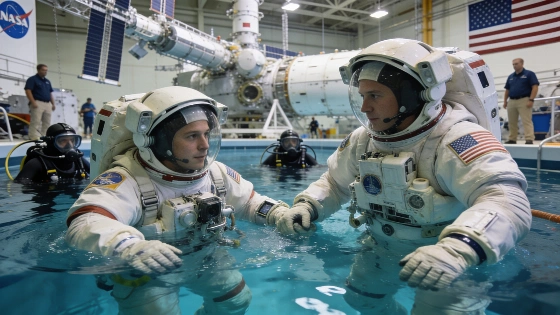
NASA's Johnson Space Center is adapting its astronaut training and mission operations to support a transition from the International Space Station to a new generation of commercial space stations, with government and private industry working side by side
As the International Space Station (ISS) approaches the end of its planned operational life, NASA is reshaping its astronaut training and mission support infrastructure to accommodate a future in which commercial space stations play a central role. At Johnson Space Center (JSC) in Houston, the agency is already integrating private industry hardware and expertise into its facilities, reflecting a shift in how human spaceflight will be managed and supported in the coming decade.
Transitioning from ISS to Commercial Platforms
The ISS remains NASA's primary crewed orbital outpost, with operations currently funded through at least 2030. However, the agency is preparing for a scenario in which commercial space stations-developed by companies such as Nanoracks, Blue Origin, Northrop Grumman, and others-will take over as the main platforms for U.S. and international astronauts in low Earth orbit. NASA's Commercial Low Earth Orbit Destinations (CLD) program has already awarded early-stage contracts totaling approximately $415 million to support the design and development of these private stations.
While the ISS continues to host multinational crews, including astronauts from NASA, Roscosmos, and the Canadian Space Agency, the station has faced technical challenges such as persistent air leaks on the Russian segment. NASA managers have stated that these issues are under control, with affected modules sealed off as needed, and that the station's core systems remain healthy. The agency is also prepared to extend ISS operations beyond 2030 if directed by Congress, which has signaled interest in keeping the station active through at least 2032.
Planning for the transition involves not only technical readiness but also the transfer of operational knowledge. NASA is working to ensure that lessons learned from decades of ISS operations are preserved and adapted for commercial station environments, where the agency will increasingly act as a customer rather than an operator.
Mission Control and Division of Labor
At the heart of JSC's operations is the Mission Control Center, which coordinates real-time activities aboard the ISS. The facility houses multiple control rooms, including those dedicated to historic missions and current operations. As commercial providers like SpaceX and Boeing develop their own mission control capabilities-SpaceX operates its own center in California, while Boeing's Starliner integrates with NASA's systems-the division of labor is evolving. NASA's controllers continue to monitor spacecraft systems, communications, and crew activities, ensuring safety and mission continuity regardless of the operating entity.
Controllers rely on a combination of live video feeds, telemetry, and communications status indicators to assess crew workload and system health. For example, a live camera view inside the Destiny laboratory module helps ground teams gauge when it is appropriate to contact the crew, while real-time comms status ensures that instructions are delivered only when the station is within range of ground stations or relay satellites. This operational discipline is expected to remain central as commercial stations come online, with NASA's expertise in spacecraft systems, propulsion, and communications providing a foundation for future partnerships.
Recent missions, such as SpaceX Crew-13, continue to demonstrate the collaborative nature of current operations, with international crews and commercial vehicles working alongside NASA's infrastructure. The agency's approach is informed by ongoing developments in space science, such as the identification of early-universe black hole star candidates using the James Webb Space Telescope, as reported in recent Science Report coverage.
Training Facilities and Industry Integration
JSC's Space Vehicle Mockup Facility, known as Building 9, serves as the primary site for astronaut training and hardware simulation. The facility is in constant flux, with modules and mockups reconfigured to support both NASA and commercial missions. Training scenarios range from routine operations to emergency procedures, such as performing cardiopulmonary resuscitation (CPR) in microgravity or responding to simulated fire alarms. These exercises are designed to prepare astronauts for the unique challenges of spaceflight, where gravity cannot be relied upon and rapid coordination is essential.
Building 9 is increasingly hosting hardware from commercial partners, including mockups from SpaceX, Blue Origin, and the Starlab Space consortium. As NASA transitions to a customer role on future commercial stations, the facility is expected to see greater involvement from private industry, with training and simulation resources shared among multiple stakeholders. The Neutral Buoyancy Laboratory (NBL), located at the Sonny Carter Training Facility, remains a critical asset for spacewalk rehearsal and spacecraft recovery training. The NBL's massive pool allows astronauts to practice extravehicular activities (EVAs) in a controlled, weightless environment, with training protocols adapted as crew members gain proficiency.
Commercial companies have begun to utilize the NBL for their own hardware and spacesuit testing, such as Axiom Space's evaluation of its next-generation spacesuit for lunar missions. While the U.S. Navy currently occupies much of the NBL's spare capacity, NASA anticipates expanding access to commercial users as demand for training services grows with the arrival of new orbital platforms.
Operational Challenges and Future Prospects
The transition to commercial space stations introduces new operational and safety considerations. NASA's experience managing complex systems, coordinating international crews, and responding to in-orbit emergencies will inform the development of protocols for private platforms. However, the agency acknowledges that commercial operators will bring their own approaches to mission control, crew training, and hardware integration, potentially leading to a more diverse and resilient ecosystem in low Earth orbit.
Technical challenges remain, including the need to validate new station architectures, ensure compatibility with existing spacecraft, and maintain rigorous safety standards. The agency's ongoing collaboration with industry partners is intended to address these issues before the ISS is retired. As commercial stations move from concept to reality, NASA's role will shift toward oversight, certification, and the provision of specialized expertise, rather than direct operational control.
With the ISS expected to remain active for several more years, the coming decade will serve as a testbed for these new models of cooperation. The outcome will shape not only the future of U.S. human spaceflight but also the broader landscape of international collaboration and scientific research in orbit.
Space station operations depend on a complex interplay of mission control, crew training, and hardware simulation. Facilities like the Neutral Buoyancy Laboratory enable astronauts to rehearse spacewalks and emergency procedures in a realistic environment, while mission controllers monitor spacecraft systems and coordinate activities in real time. As commercial space stations emerge, the integration of private industry into these processes will require careful management of technical standards, operational protocols, and safety requirements. The evolution of NASA's training and support infrastructure reflects the agency's effort to balance innovation with the preservation of proven practices developed over decades of orbital operations.