Meta Platforms and BlackRock have agreed to jointly develop a large-scale data center campus in El Paso, Texas, designed to support Meta's artificial intelligence infrastructure. The project is expected to deliver 1 gigawatt of computing capacity by 2028
Meta Platforms and BlackRock have announced a joint venture to develop a major data center campus in El Paso, Texas, intended to expand Meta's artificial intelligence (AI) infrastructure. The facility, scheduled to begin operations in 2028, is projected to provide 1 gigawatt of computing capacity, making it one of the largest single-site data center projects in the United States. According to company statements, Meta will be the sole tenant, leasing the entire campus upon completion.
The partnership follows Meta's search for a long-term infrastructure financing partner capable of supporting the scale and complexity of its AI-driven computing needs. BlackRock, together with Global Infrastructure Partners and HPS Investment Partners, will supply the capital required for the project. Meta will contribute land and partially completed construction assets valued at approximately $2.3 billion, while BlackRock-managed funds will invest around $4.9 billion in cash at closing. The total development cost is estimated at $14 billion, with BlackRock holding an 80% stake and Meta retaining 20%. BlackRock plans to finance part of its investment through a $12.5 billion debt package. The companies expect to finalize the transaction within days.
AI Infrastructure and Technical Scope
The El Paso campus is designed to address Meta's growing demand for high-performance computing resources to train and deploy large-scale AI models. While specific hardware details have not been disclosed, the 1 gigawatt capacity suggests the facility will house tens of thousands of servers and specialized accelerators, such as graphics processing units (GPUs) or custom AI chips. The site is expected to support both model training and inference workloads, with a focus on scaling foundation models and generative AI systems. Meta has not released technical documentation or independent performance benchmarks for the planned infrastructure.
Meta's investment in the El Paso campus is part of a broader trend among technology companies to secure dedicated data center capacity for AI development. The company has stated that advanced computing infrastructure is critical to its pursuit of more capable AI systems, including research into superintelligence. However, the project remains at the development stage, and no operational results or energy efficiency data have been reported. The facility's design, energy sourcing, and environmental impact have not been independently evaluated.
Workforce, Education, and Regional Impact
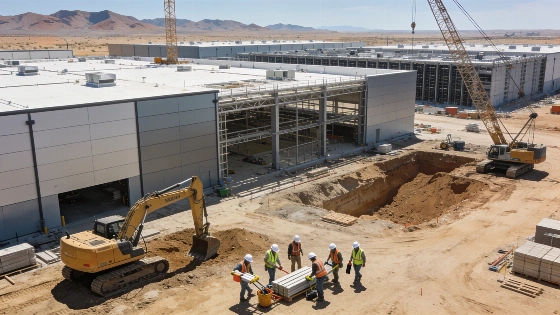
Construction of the El Paso campus is expected to support more than 4,000 jobs at peak activity, with over 2,300 workers already on site, according to Meta. Once operational, the facility will employ approximately 300 full-time staff. The project is linked to workforce development initiatives, including participation in America's Workforce Academy, a free skilled trades program that guarantees employment with a Meta partner for graduates. Meta has also provided a $500,000 grant to El Paso public schools to expand STEM education and skilled trades pathways. BlackRock is supporting skilled labor through its Future Builders initiative, a nearly $30 million program aimed at training more than 12,000 electricians across Texas over three years.
In addition to workforce programs, Meta has committed to funding water restoration projects in the region to improve water quality and strengthen local supplies. The company has not disclosed specific targets or independent assessments of these environmental efforts. The scale of the data center raises questions about long-term energy and water use, but detailed sustainability plans have not been published.
Ownership, Leasing, and Financial Structure
Under the terms of the joint venture, BlackRock-managed funds will own 80% of the El Paso campus, with Meta holding the remaining 20%. Meta will lease the entire facility under agreements that begin with a four-year term and include options to extend occupancy for up to 20 years. The company will provide residual value guarantees tied to the long-term worth of the site's buildings and infrastructure. Development costs will be shared according to ownership stakes. The financial structure is designed to accelerate construction while allowing Meta to expand its AI infrastructure without bearing the full capital burden up front.
Meta's decision to partner with BlackRock reflects a broader industry shift toward infrastructure financing models that separate facility ownership from operational use. This approach allows technology companies to scale computing resources rapidly while managing financial risk. However, the arrangement also concentrates control of critical infrastructure in the hands of a small number of large financial and technology firms, raising questions about long-term governance, access, and public accountability.
The El Paso project is one of the largest single-site data center investments announced in the United States to date. The companies have not disclosed whether the facility will be available for third-party use in the future or whether it will remain dedicated exclusively to Meta's AI operations. No independent audit or regulatory review of the project's technical, environmental, or labor practices has been reported.
Data centers supporting large-scale AI require significant electrical power, cooling, and physical security. The 1 gigawatt capacity cited for the El Paso campus is comparable to the total power consumption of a medium-sized city. While Meta and BlackRock have emphasized job creation and regional economic benefits, the long-term social and environmental consequences of such concentrated infrastructure remain uncertain.
Large-scale data centers for AI development rely on specialized hardware, including GPUs and custom accelerators, to process vast amounts of data during model training and inference. These facilities are engineered for high-density computing, advanced cooling, and robust power delivery. The scale of the El Paso campus reflects the increasing computational demands of foundation models and generative AI systems. However, the environmental impact of such infrastructure-including energy use, water consumption, and carbon emissions-depends on design choices, energy sourcing, and operational practices. Independent evaluation of these factors is essential for assessing the broader consequences of AI infrastructure expansion.