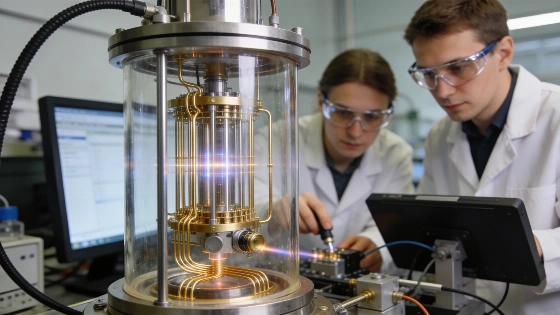
An arXiv preprint by Mark Webster and Nicolas Delfosse describes scheduled joint measurements paired with CliNR, reporting up to 74-fold speedup for logical Clifford operations and up to fivefold for Toffoli gates against sequential logical measurements. The analysis considers Q70 and Q102 codes in IonQ's Walking Cat trapped-ion architecture, but does not establish a full fault-tolerant computer or a useful algorithm run.
IonQ researchers report a scheduling method that speeds up logical Clifford operations by as much as 74-fold and logical Toffoli gates by as much as fivefold. The result targets a specific fault-tolerant quantum-computing bottleneck: error-correction measurements can require too many sequential rounds when logical qubits are encoded in quantum Low-Density Parity-Check (qLDPC) codes.
The work, by Mark Webster and Nicolas Delfosse, is available as the arXiv preprint arXiv:2607.16166. The figures are speedups for operations, not evidence that a complete fault-tolerant computer has run a useful algorithm. IonQ's technical explanation describes the approach as a way to reduce sequential error-correction rounds.
The technical evaluation considers at least two qLDPC codes, Q70 and Q102, in IonQ's Walking Cat architecture for trapped-ion computing. These details put the reported estimates in a specific hardware context, but they do not mean the scheduled protocol was demonstrated on a processor running a fault-tolerant computation.
Quantum LDPC codes can encode many logical qubits within a block, potentially using hardware more efficiently than two-dimensional surface codes. Their density brings operational challenges: logical operations across registers can require lengthy delays while error-correction measurements are carried out.
Rather than joining code regions with more complex merged codes, the method uses Shor-style cat states to perform measurements of L commuting logical operators together. A classical scheduler-code matrix, G, determines the measurement schedule, and the outcomes are decoded jointly. Combining compatible measurements is intended to reduce sequential rounds while preserving the encoded information.
That distinction matters. Error-correction measurements extract information about errors without simply reading out the encoded answer. Scheduling changes how those measurements are organized and interpreted; it does not make errors disappear.
IonQ reports speedups of up to 74-fold for logical Clifford operations and up to fivefold for logical Toffoli gates, compared with performing the logical measurements sequentially. The company also reports up to a threefold speedup for state preparation and logical gates. These are relative figures; the information reported here does not provide absolute operation times, uncertainty ranges, or a complete accounting of resource costs.
For one Q70 scenario with L=10 commuting logical operators, the analysis reports an average use of 2.1 cat states per logical measurement. This is a resource-efficiency metric for the described scheme, not an experimental demonstration of a logical qubit or a useful quantum algorithm.
Toffoli gates matter because they are a core non-Clifford operation in fault-tolerant computing. IonQ connects them to potential workloads in quantum chemistry, materials science, and financial modeling. Faster execution of this gate type could reduce one component of algorithm time, but the result does not establish that any of those workloads has been run or accelerated.
The team pairs the scheduler with CliNR, or Clifford Noise Reduction, a logical adaptation of a physical protocol with the same name. IonQ describes its use alongside scheduled measurements as a way to accelerate logical operations, including Toffoli gates. The approach uses physical-layer state injection with transversal CNOTs while managing state preparation at the logical layer, aiming to remove a temporal penalty associated with partial error-correction protocols.
The mechanism is a change to the execution schedule and protocol. It is not a reported increase in physical-qubit count, and the reported speedups do not by themselves establish improved gate fidelity or lower logical error rates.
The work is an arXiv preprint, not a peer-reviewed journal article according to the publication status described here. The available account does not specify whether the speedups were demonstrated on hardware, obtained in simulation, or derived under a particular model. Without those details, readers cannot assess the operating conditions, resource costs, or how closely the estimates map onto a deployed processor.
That evidence gap does not erase the technical point: error-correction scheduling can be a performance variable in its own right. But assessing a faster logical operation also requires the relevant code parameters, physical resources, error rates, decoder requirements, and performance across a complete circuit. The distinction is familiar across quantum research, from protocol studies to experimental work at centers such as MIT and CERN: a resource estimate is not itself a hardware demonstration. Peer-reviewed venues such as Nature and Science likewise represent a different publication status from a preprint; the paper's arXiv availability should not be mistaken for journal review.
For quantum systems, the distinction between an efficient protocol and manufacturable hardware remains important. A separate discussion of shared fabrication and infrastructure appears in a manufacturing analysis; the scheduling result addresses a different layer of the challenge.
IonQ's argument shifts attention toward Logical Execution Rate (LER): how quickly a system can carry out logical operations while managing error correction. That is a more informative target than physical-qubit count alone when the question is how much computation a machine can execute. Still, the reported speedups do not provide a measured LER for a complete system or a cost-per-computation comparison.
The strongest conclusion is specific: scheduled joint measurements paired with CliNR offer a reported route to reducing latency for two classes of logical gates. This is a protocol and scheduling result, not proof of a practical fault-tolerant computer. Its industry significance will depend on whether the gains hold with specified hardware, realistic error rates, and full algorithm execution.
A logical qubit stores information across physical qubits so that error-correction procedures can detect or manage faults. Logical measurements operate on that encoded information, and their order can affect how many execution rounds are needed. Combining compatible measurements may reduce that overhead, but it does not establish fault tolerance by itself. The reported scheduling gains identify a concrete route to faster logical execution; demonstrating their value in a complete machine remains the decisive test.