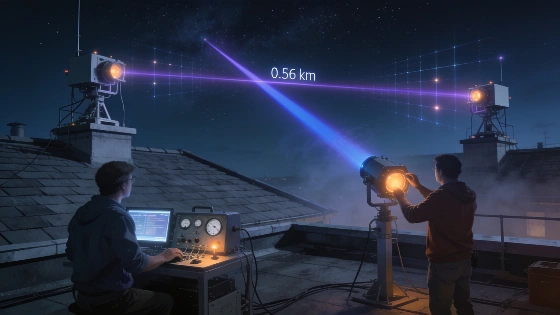
QNu Labs, BISAG-N and IIT Gandhinagar tested a 5.56 km free-space QKD link with a 1550 nm channel, sub-5% QBER and hybrid encryption during an overnight field trial.
A 5.56 km optical link has carried fresh encryption keys through open air in what QNu Labs, BISAG-N and IIT Gandhinagar describe as India's first free-space Quantum Key Distribution demonstration at this scale. The overnight field trial ran between BISAG-N and IIT Gandhinagar during the night of September 27-28, 2026, and established a protected quantum channel between the two sites, according to the MeitY announcement.
The experiment tested Quantum Key Distribution rather than a quantum computer or a general-purpose quantum network. QKD uses a quantum optical channel to distribute secret key material between authenticated endpoints, while encrypted application data still travels through conventional communications infrastructure. In this trial, the system used a 1550 nm quantum channel and the Differential Phase Shift Decoy QKD protocol. The hardware was identified in accompanying reporting as QNu Labs' Armos system, paired with BISAG-N's post-quantum security software.
India's Ministry of Electronics and Information Technology reported a stable Quantum Bit Error Rate below 5% and a protected-key generation rate of 230-260 bits per second. That rate corresponds to roughly one newly generated 256-bit symmetric key per second. These are system-level measurements from a field demonstration, not a statistical clinical-style study: the published material gives no sample size, p-values, confidence intervals or independent uncertainty analysis. It also does not establish continuous operation across all weather conditions or prove that the system is ready for a production network.
The reported figures are nevertheless useful engineering benchmarks. In QKD, the raw optical exchange must be filtered and reconciled before a usable secret key is produced, while the observed QBER helps indicate whether noise, misalignment or other disturbances are affecting the quantum states. A value below 5% is meaningful in the context of the demonstrated setup, but it is not by itself a complete security proof because device models, finite-key effects, authentication and implementation-specific vulnerabilities also matter.
Free-space quantum communication has a practical vulnerability that fiber systems largely avoid: the transmitter and receiver must keep a narrow optical beam aligned while the atmosphere moves and distorts it. QNu Labs used a Pointing, Acquisition, and Tracking system to manage that problem. A gimbal provided coarse pointing with 5 microradian accuracy, while a fast-steering system operated at a 100 Hz tracking bandwidth and reached up to 0.1 microradian accuracy.
The combination was intended to compensate for atmospheric turbulence during the overnight link. The published announcement does not provide a separate breakdown of optical loss, detector efficiency, dark counts or weather-related interruptions, so the reported QBER and key rate should be read as system-level results for this trial rather than a complete characterization of every optical and detector component.
That distinction is consistent with the broader quantum-communications literature discussed in journals such as Nature: maintaining a quantum channel is an integrated systems problem involving photon sources, detectors, timing, pointing, classical post-processing and security validation. Similar concerns arise in terrestrial and space-communications planning at institutions such as MIT and NASA, although the Indian demonstration itself was a local terrestrial free-space test rather than a satellite experiment.
The optical link was integrated with BISAG-N's Vedic Kavach platform, described in Indian media reports as a browser and web-server environment equipped with post-quantum cryptography and quantum random number generation. Keys were delivered through the ETSI GS QKD 014 interface, then used to encrypt, transmit and decrypt test payloads across the combined optical and post-quantum layer. The demonstration therefore connected key generation to an application-level encryption workflow instead of stopping at a laboratory measurement of photons.
That architecture matters because a free-space optical channel can experience temporary weather fade. If the quantum channel becomes unavailable, the post-quantum cryptographic layer provides a separate application-security mechanism rather than leaving the payload dependent on uninterrupted photon transmission. The design tests integration between two different security approaches instead of presenting QKD as a replacement for conventional cryptographic infrastructure.
The result fits into a wider push toward quantum-secure communications infrastructure, including the network planning described in an earlier security report. But the Indian trial is more limited and more concrete: it is a two-site free-space field demonstration with measured link performance, not evidence of a multi-node operational network. The Indian government characterized the test as laying groundwork for secure communications infrastructure and greater resilience against future quantum threats.
The trial establishes a technical baseline for terrestrial optical mesh networks and satellite-to-ground quantum communications, according to the public announcement. That is a reasonable engineering direction, but a baseline is not the same as a deployed network. Scaling would require stable operation across changing atmospheric conditions, repeatable alignment, authentication and endpoint protection, network management, and handling of interruptions without weakening the security model.
Researchers at CERN and other large scientific facilities routinely distinguish a successful instrument demonstration from validated long-duration operation. The same discipline applies here. The reported material does not identify an independent replication, a peer-reviewed paper, or a comparison with the strongest competing communication systems. It documents a successful integration and gives useful operating figures, but it does not show that free-space QKD is more economical, more available or more secure in practice than every classical or post-quantum alternative.
QKD itself does not make a communication system unhackable. Its security depends on the protocol, device assumptions, implementation quality, authenticated classical communication and protection against side channels. The hybrid design is consequently the strongest part of the announcement: it treats the quantum optical path as one security component and preserves a post-quantum layer when that path is impaired.
For readers evaluating the claim, the key distinction is between distributing keys and transmitting useful data. A QKD system does not teleport information or send messages faster than light; it generates shared secret material through a quantum channel and relies on ordinary networking to deliver the encrypted payload. The 5.56 km demonstration is significant because it places beam control, key generation and application encryption in one field-tested chain, while its limited duration and incomplete independent evidence leave deployment and scalability as engineering questions rather than settled outcomes.
No new regulatory decision, commercial rollout or transition to permanent operation had been reported with the published materials. The achievement should therefore be understood as a field trial and technology demonstration: an important Indian milestone in free-space quantum-secure networking, but not yet evidence of a continuously operating national quantum network.