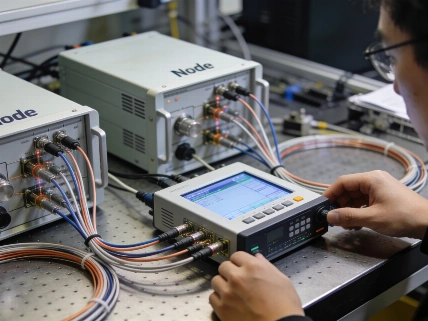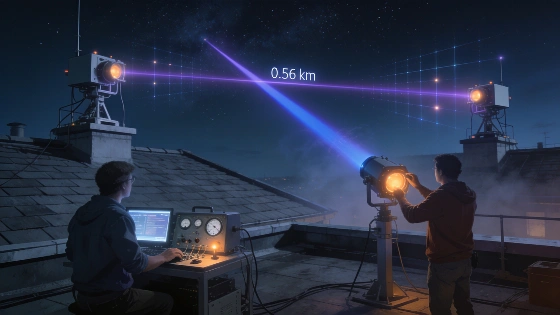
QNu Labs, BISAG-N and IIT Gandhinagar tested a 5.56 km free-space QKD link with a 1550 nm channel, sub-5% QBER and hybrid encryption during an overnight field trial.
Fresh encryption keys crossed 5.56 km of open air in what QNu Labs, BISAG-N and IIT Gandhinagar describe as India's first free-space quantum key distribution demonstration at this scale. The overnight field trial ran between BISAG-N and IIT Gandhinagar on September 27-28, 2026, establishing a protected quantum channel between the two sites, information from the MeitY announcement.
What Was Measured
The experiment tested quantum key distribution, not a quantum computer or a general-purpose quantum network. QKD uses a quantum optical channel to distribute secret basic material between authenticated endpoints. Encrypted application data still travels through conventional communications infrastructure. In this trial, the system used a 1550 nm quantum channel and the Differential Phase Shift Decoy QKD protocol. Accompanying reports identified the hardware as QNu Labs' Armos system, paired with BISAG-N's post-quantum security software.
India's Ministry of Electronics and Information Technology reported a stable Quantum Bit Error Rate below 5% and a protected-basic generation rate of 230-260 bits per second. That rate corresponds to roughly one newly generated 256-bit symmetric basic per second. These are system-level measurements from a field demonstration, not a statistical clinical-style study. The published material gives no sample size or p-values, and offers neither confidence intervals nor independent uncertainty analysis. It also does not establish continuous operation in all weather conditions or prove that the system is ready for a production network.
The reported figures provide useful engineering benchmarks. In QKD, the raw optical exchange must be filtered and reconciled before it produces a usable secret basic. The observed QBER helps show whether noise, misalignment or other disturbances are affecting the quantum states. A value below 5% is meaningful for the demonstrated setup, but it is not, by itself, a complete security proof. Device models and finite-basic effects matter, as do authentication and implementation-specific vulnerabilities.
Keeping the Beam Aligned
Free-space quantum communication has a practical vulnerability that fiber systems largely avoid: the transmitter and receiver must keep a narrow optical beam aligned as the atmosphere moves and distorts it. QNu Labs used a Pointing, Acquisition, and Tracking system to manage that challenge. A gimbal provided coarse pointing with 5 microradian accuracy, while a fast-steering system operated at a 100 Hz tracking bandwidth and reached up to 0.1 microradian accuracy.
The combination was designed to compensate for atmospheric turbulence during the overnight link. The published announcement gives no separate breakdown of optical loss or detector efficiency. It also omits dark counts and weather-related interruptions, so the reported QBER and basic rate should be read as system-level results for this trial, not a complete characterization of every optical and detector component.
That distinction fits the broader quantum-communications literature discussed in journals such as Nature: maintaining a quantum channel is an integrated systems problem. It requires photon sources and detectors, along with precise timing and pointing. Classical post-processing and security validation are also part of the system. Similar concerns arise in terrestrial and space-communications planning at institutions such as MIT and NASA, although the Indian demonstration was a local terrestrial free-space test, not a satellite experiment.
Two Security Layers
The optical link was integrated with BISAG-N's Vedic Kavach platform, described in Indian media reports as a browser and web-server environment equipped with post-quantum cryptography and quantum random number generation. Keys were delivered through the ETSI GS QKD 014 interface, then used to encrypt test payloads, which were transmitted and decrypted across the combined optical and post-quantum layer. The demonstration thus connected basic generation to an application-level encryption process instead of stopping at a laboratory measurement of photons.
That architecture matters because a free-space optical channel can experience temporary weather fade. If the quantum channel becomes unavailable, the post-quantum cryptographic layer provides a separate application-security mechanism. The payload does not have to depend on uninterrupted photon transmission. The design tests integration between two different security approaches without presenting QKD as a replacement for conventional cryptographic infrastructure.
The result fits into a wider push toward quantum-secure communications infrastructure, including the network planning described in an earlier security report. The Indian trial is more limited and concrete: a two-site free-space field demonstration with measured link performance, not evidence of a multi-node operational network. The Indian government characterized the test as laying groundwork for secure communications infrastructure and greater ability to recover against future quantum threats.
From Link to Network
The public announcement describes the trial as establishing a technical baseline for terrestrial optical mesh networks and satellite-to-ground quantum communications. That is a reasonable engineering direction, but a baseline is not a deployed network. Scaling would require stable operation across changing atmospheric conditions and repeatable alignment. It would also require authentication and endpoint protection, network management, and a way to handle interruptions without weakening the security model.
Researchers at CERN and other large scientific facilities routinely distinguish a successful instrument demonstration from validated long-duration operation. The same discipline applies here. The reported material identifies no independent replication or peer-reviewed paper. It also offers no comparison with the strongest competing communication systems. It documents a successful integration and provides useful operating figures, but does not show that free-space QKD is more economical or more available in practice than every classical or post-quantum alternative. Nor does it establish that it is more secure than those alternatives.
QKD itself does not make a communication system unhackable. Its security depends on the protocol and device assumptions, as well as implementation quality. It also relies on authenticated classical communication and protection against side channels. The hybrid design is so the strongest part of the announcement: it treats the quantum optical path as one security component and preserves a post-quantum layer when that path is impaired.
The basic distinction is between distributing keys and transmitting useful data. A QKD system does not teleport information or send messages faster than light; it generates shared secret material through a quantum channel and relies on ordinary networking to deliver the encrypted payload. The 5.56 km demonstration is impressive because it brings beam control and basic generation together with application encryption in one field-tested chain. Its limited duration and incomplete independent evidence leave deployment and ability to grow as engineering questions, not settled outcomes.
The published materials report no new regulatory decision. They also record no commercial rollout or transition to permanent operation. The achievement is so a field trial and technology demonstration: an impressive Indian basic stage in free-space quantum-secure networking, but not yet evidence of a continuously operating national quantum network.