Horizon Quantum Holdings has reported a major cash infusion from warrant exercises, opened early access to its Beryllium quantum programming language, and announced a new 256-qubit trapped-ion testbed in Europe
Horizon Quantum Holdings Ltd. has reported its financial and operational results for the second quarter of 2026, highlighting a significant increase in available capital, the early access release of its Beryllium quantum programming language, and the expansion of its quantum hardware testbed infrastructure into Europe. The company's financial disclosures reflect the transition from Horizon Quantum Computing Pte. Ltd. to Horizon Quantum Holdings Ltd. following its SPAC merger in March 2026, with all subsequent results reported under the new entity.
Financial Position and Warrant Impact
During the second quarter, Horizon Quantum's cash and cash equivalents rose to $113.25 million, up from $96.60 million at the end of Q1 2026. This increase was driven by the exercise of approximately 2.4 million publicly traded warrants, generating $27.5 million in gross proceeds during the quarter. By August 3, 2026, total warrant exercises reached 2.5 million, representing 79% of outstanding public warrants and bringing cumulative proceeds to $28.7 million. Despite this strengthened cash position, the company reported a GAAP net loss of $115.23 million for Q2 2026, compared to $3.56 million in Q1 2026 and $2.90 million in Q2 2025. The reported loss was primarily due to a $108.29 million non-cash charge related to the mark-to-market revaluation of warrant derivative liabilities, a consequence of the company's rising share price. This accounting adjustment did not affect operational cash flow. On a non-GAAP basis, excluding the derivative adjustment, share-based compensation, and public transition costs, Horizon Quantum reported an adjusted EBITDA loss of $5.46 million for Q2 2026, compared to $2.06 million in Q2 2025. Operating expenses increased to $7.18 million, reflecting expanded research and development activity and the costs of public company compliance.
Testbed Expansion and Hardware Access
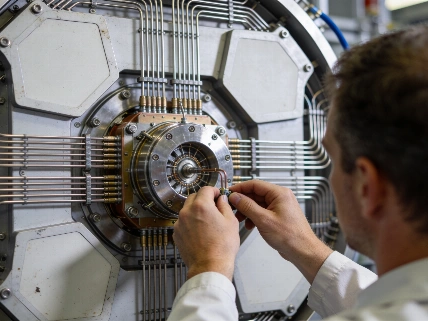
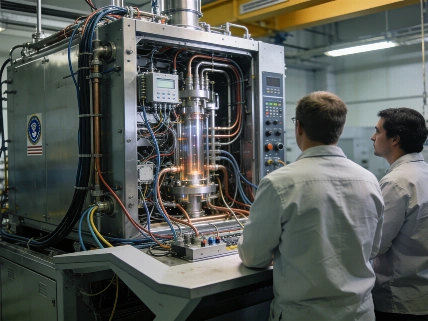
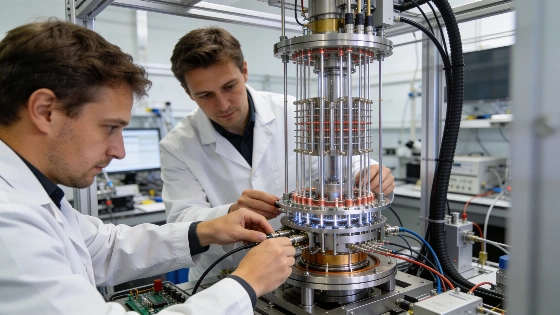
Horizon Quantum's hardware infrastructure advanced on two fronts. The company's first quantum testbed, Ember-1-a superconducting system located at its Singapore headquarters-became available to select early users during the quarter. Ember-1 is directly integrated with the company's Triple Alpha platform, enabling real-time execution of quantum programs with both pulse-level and gate-level access. This local integration is intended to reduce latency compared to remote cloud-based execution, a limitation that has affected some previous quantum testbed deployments. In June 2026, Horizon Quantum announced that its second testbed, a 256-qubit trapped-ion system acquired from IonQ, will be installed at its European headquarters in Dublin, Ireland. This addition will provide the company with access to both solid-state (superconducting) and atom-based (trapped-ion) quantum architectures, supporting comparative research and development across hardware modalities.
Beryllium Language and Software Stack
At the end of Q2 2026, Horizon Quantum released early access to Beryllium, its high-level, object-oriented quantum programming language. Beryllium is designed to allow developers to use familiar classical software engineering constructs-such as classes, functions, and libraries-within quantum workflows. Programs written in Beryllium are compiled down to Helium, a BASIC-like intermediate language, and then to Hydrogen, an assembly-level language, abstracting away low-level quantum hardware details. This layered approach aims to make quantum programming more accessible to software engineers without deep expertise in quantum mechanics. The company's software stack is intended to support both its own testbed systems and, potentially, third-party quantum hardware.
Calibration and Ecosystem Collaboration
In July 2026, Horizon Quantum announced a partnership with Quantum Machines to co-develop an embedded calibration framework for the Ember-1 testbed. The collaboration focuses on integrating lightweight, continuous calibration routines directly into system operation, with the goal of maximizing system uptime and reducing the need for lengthy full-system calibration interruptions. This approach addresses a common challenge in quantum hardware operation, where calibration drift and downtime can limit the availability and reliability of experimental results. The integration of embedded calibration is part of a broader industry trend toward improving the operational stability of quantum testbeds, as seen in other recent efforts to benchmark and verify quantum processor performance, such as the demonstration of quantum processors performing classically intractable tasks described in this related report.
Horizon Quantum's Q2 2026 results reflect both the rapid pace of infrastructure development in the quantum computing sector and the ongoing engineering and financial challenges associated with scaling up experimental platforms. The company's expansion into European hardware, the release of a new programming language, and its focus on calibration and uptime position it to participate in the next phase of quantum testbed research, though the practical utility and reproducibility of these systems remain to be demonstrated at scale.
Understanding the distinction between physical and logical qubits is essential for interpreting progress in quantum computing. Physical qubits are the actual quantum systems-such as superconducting circuits or trapped ions-that can be individually controlled and measured. However, these physical qubits are prone to errors from noise, decoherence, and imperfect control. Logical qubits are constructed by encoding information across multiple physical qubits using error-correcting codes, allowing for the detection and correction of certain errors. Achieving reliable logical qubits with low error rates is a major engineering challenge, and most current quantum processors-including those described here-operate primarily at the physical-qubit level, with error correction and logical-qubit demonstrations still limited by hardware fidelity, calibration stability, and system size.