A black-hole-inspired holographic calculation predicts that the magnetic Grüneisen ratio diverges with universal scaling near a quantum critical point, consistent with recent measurements in a heavy-fermion material
Near absolute zero, a magnetic field can push a material toward a boundary where quantum fluctuations extend across increasingly long distances. At that boundary, familiar descriptions based on quasiparticles can fail.
A Gravity-Based Model
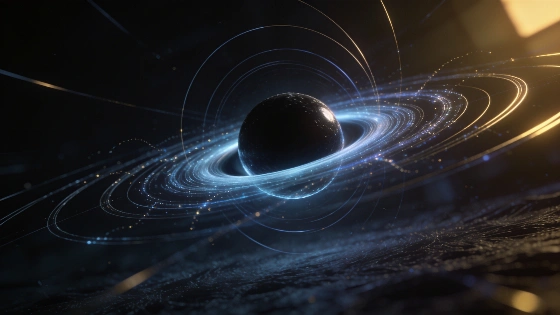
The researchers used holographic duality to study this regime. The method represents strongly interacting electrons through a higher-dimensional gravitational system containing a black hole. Although the two descriptions differ, the model suggests they can capture the same universal behaviour.
Quantum criticality matters because it is linked to unresolved problems in condensed matter physics, including Kondo breakdown and strange metals. Strong interactions make these systems difficult to describe with conventional methods. The broader challenge of extracting information from many-body systems also features in spin-chain simulations, which examined a different physical system.
Reading the Magnetic Response
The key prediction concerns the magnetic Grüneisen ratio. It measures the relative temperature response to a change in magnetic field while entropy remains fixed. In the model, this ratio diverges with universal scaling as the system approaches the quantum critical point.
The calculation therefore identifies a potentially new form of quantum critical behaviour. It is a theoretical result, not a direct observation of the proposed mechanism in a material.
What Experiments Show
Magnetic Grüneisen measurements are an established way to investigate quantum criticality in heavy-fermion materials. In YbRh₂Si₂, antiferromagnetic order is suppressed by a field of about 0.06 T perpendicular to the tetragonal c-axis, or 0.66 T parallel to it. The ratio connects the adiabatic temperature change under a varying magnetic field to the material's entropy.
Experiments on the distorted Kagome-lattice heavy-fermion compound YbAgGe provide a concrete example of a divergent response: at the 4.5 T critical field separating its c and d magnetic phases, both thermal and magnetic Grüneisen ratios increase as temperature falls. Measurements were conducted with the field in the ab plane, at temperatures down to 40 mK and fields up to 14 T, as reported in the YbAgGe study.
Other heavy-fermion compounds show different low-temperature behaviour. In CeNi₈.₆Cu₀.₄Ge₄, the dimensionless Grüneisen ratio reaches 340 at 0.35 K, then saturates and develops a broad maximum below that temperature. In CePd₁₋ₓRhₓ, the ratio has been reported to approach a constant as temperature tends to zero. Such measurements document a range of responses across field- and composition-tuned systems.
The predicted scaling is consistent with recent experiments on a heavy-fermion material. The work proposes a possible new universality class for quantum critical materials, based on the model's predicted divergence and its reported consistency with those experiments.