Astronomers highlight five celestial objects and regions that reveal striking detail through binoculars, from the Moon's shifting shadows to the Andromeda Galaxy's faint glow, offering accessible entry points for skywatchers of all experience levels
Binoculars offer a practical and accessible way to explore the night sky, bridging the gap between unaided observation and the complexity of telescopes. With a wide field of view and straightforward operation, binoculars allow both beginners and experienced observers to examine a range of astronomical objects, from nearby lunar features to distant galaxies. The following five targets represent some of the most rewarding sights available to binocular users, each illustrating a different aspect of observational astronomy.
The Moon's Changing Landscape
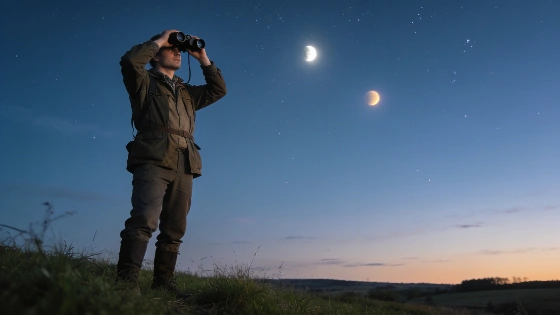
The Moon remains the most prominent and detailed object visible through binoculars. Even modest models, such as 8x40 or 10x50 binoculars, reveal surface features including craters, maria, and mountain ranges. The appearance of these features changes dramatically over the course of the Moon's 29.5-day synodic cycle, as sunlight strikes the surface from varying angles. Observers can track the shifting line between lunar night and day-the terminator-where shadows are longest and relief is most pronounced. While higher magnification can enhance detail, hand-held binoculars above 10x50 may suffer from image shake unless stabilized or tripod-mounted. Image-stabilized binoculars can mitigate this effect, providing a steadier view without additional equipment.
Optimal lunar observation often occurs when the Sun is low on the lunar horizon, casting long shadows that accentuate topography. During full Moon, when sunlight falls directly overhead, surface relief is minimized and features appear flatter. The Moon's changing phases offer repeated opportunities to observe different regions under varying illumination, making it a dynamic target for repeated study.
Jupiter's Moons and Double Stars
Binoculars also enable the observation of other solar system bodies, most notably Jupiter and its four largest moons: Io, Europa, Ganymede, and Callisto. With 8x40 or 10x50 binoculars, these Galilean moons appear as small points of light flanking the bright disk of Jupiter. Their positions shift nightly as they orbit the planet, allowing observers to witness their changing configurations and occasional disappearances as they pass behind or in front of Jupiter. However, the belts and Great Red Spot of Jupiter remain beyond the reach of standard binoculars, and the planet's smaller moons are too faint to detect with this equipment.
Beyond the solar system, binoculars can resolve double stars such as Mizar and Alcor in the handle of the Big Dipper (Ursa Major). These stars, physically bound by gravity, are easily separated with 10x50 binoculars, while larger aperture models may reveal that Mizar itself is a close double. Other wide double stars, including Epsilon Lyrae and Alpha Librae (Zubenelgenubi), are also accessible to binocular observers, offering insight into stellar multiplicity and visual separation limits.
Open Clusters and the Milky Way
Star clusters provide another compelling target for binocular astronomy. The constellation Auriga, for example, contains three prominent open clusters: Messier 36, 37, and 38. These clusters, composed of young stars formed together, are visible as hazy patches through 10x50 binoculars under dark skies. With a field of view of 5-7 degrees, it is possible to frame all three clusters simultaneously in some binoculars. Individual stars within the clusters become more distinct with larger apertures or image-stabilized models, though the densest cluster, M37, may require 25x100 binoculars for optimal resolution.
To locate these clusters, observers can use the bright star Capella and trace a path toward Elnath, identifying the clusters along the way. The winter Milky Way, in which Auriga is situated, offers rich star fields that appear especially vivid through binoculars, revealing the structure and density of our galaxy's disk.
The Andromeda Galaxy and Observational Limits
The Andromeda Galaxy (Messier 31), the nearest large spiral galaxy to the Milky Way at approximately 2.5 million light-years away, is a classic binocular target. Under dark conditions, it may be visible to the naked eye as a faint smudge, but binoculars reveal its extended disk and brighter core. Using 10x50 binoculars, observers can locate Andromeda by referencing the constellation Cassiopeia and the star Mirach in Andromeda, then scanning northwest to bring the galaxy into view. While the spiral arms remain unresolved, the galaxy's shape and two companion galaxies, M32 and M110, can sometimes be detected as fuzzy points, especially with larger binoculars and averted vision techniques.
Binocular astronomy is shaped by the interplay between instrument capability, observer experience, and sky conditions. The targets described here are accessible with commonly available binoculars, but their visibility and detail depend on factors such as aperture, magnification, atmospheric transparency, and light pollution. For those interested in the broader context of solar activity and its influence on night sky observation, recent advances in solar monitoring-such as the development of AI models to predict sunspot emergence-are covered in related reporting, including a discussion of new forecasting techniques at how AI is being used to anticipate solar activity.
Understanding the limits of binocular observation is essential for interpreting what is seen. Binoculars gather more light than the naked eye, increasing the brightness and apparent size of faint objects, but their resolving power is limited by aperture and magnification. Atmospheric conditions, observer adaptation to darkness, and the use of stabilization all influence the quality of the view. While binoculars cannot match the detail of telescopes, they provide a wide field and ease of use that make them valuable tools for exploring the night sky's most accessible wonders.