DEEP Robotics has begun deploying its X30 quadruped and Lynx M20 wheeled-legged robots to perform initial reconnaissance in hazardous firefighting and emergency environments, aiming to reduce human exposure during early assessment and support operations
Chinese robotics company DEEP Robotics has introduced its X30 quadruped and Lynx M20 wheeled-legged robots into field deployments for firefighting and emergency response, targeting scenarios where human entry poses significant risk. The company reports that these robots are being used for initial reconnaissance in environments such as fires, chemical leaks, collapsed buildings, and flooded tunnels, with the stated goal of gathering real-time data before human responders enter potentially dangerous areas.
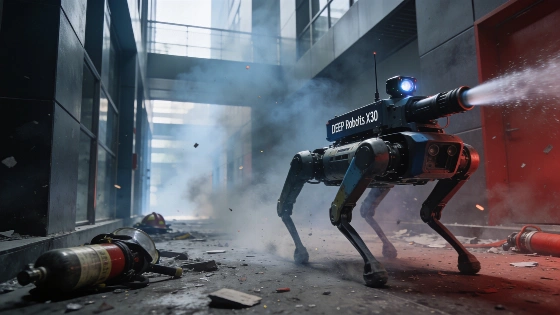
The X30 quadruped robot is equipped with a dual-spectrum camera and 3D LiDAR, enabling it to map interiors and detect fire sources or hazardous conditions. Its onboard multi-gas sensors can measure concentrations of carbon monoxide, hydrogen cyanide, hydrogen sulfide, and hydrogen chloride, providing incident commanders with environmental data that would otherwise require human exposure. The robot can also be fitted with a water-cannon payload capable of delivering water or foam up to 60 meters at a flow rate of 40 liters per second, according to company specifications. Additional X30 units can transport firefighting equipment, including hoses, air tanks, and breaching tools, to reduce the physical burden on human teams during repeated entries.
Communication and Control
Maintaining communication in hazardous or obstructed environments is a persistent challenge for emergency response. DEEP Robotics states that its robots can establish a self-organizing mesh network when cellular connectivity is unreliable, such as inside tunnels or underground spaces. This network is intended to relay video and sensor data between field units and command teams, supporting ongoing situational awareness even in communication dead zones. Both the X30 and Lynx M20 platforms connect to a cloud-based command system that enables low-latency remote control, real-time mapping, and AI-based recognition. The company provides standard API interfaces for integration with existing incident-management systems, but has not disclosed details of third-party interoperability or cybersecurity measures.
The Lynx M20 robot combines wheeled and legged locomotion, allowing it to travel quickly over flat terrain and switch to legged movement when encountering obstacles. This design is intended to extend operational range and flexibility, but the company has not released independent performance data for mixed-terrain transitions or failure rates in real-world deployments.
Field Testing and Limitations
According to DEEP Robotics, the X30 and Lynx M20 platforms have been tested in high-rise fire drills, tunnel emergencies, and hazardous-material scenarios, including simulated chemical leaks and structural collapses. The company also reports deployments for non-emergency tasks, such as underground power-tunnel inspections and wildlife monitoring at the Serling Tso reserve. However, the available evidence is limited to company-reported demonstrations and pilot deployments; no independent peer-reviewed studies or third-party audits of operational effectiveness or safety have been published to date.
Technical specifications indicate that the X30 quadruped can climb stairs and slopes up to 45 degrees and clear obstacles up to 20 centimeters high. Its IP67-rated enclosure allows operation in temperatures from -20°C to 55°C. These figures suggest suitability for a range of industrial and outdoor conditions, but do not guarantee reliable performance in all real-world emergencies. The robots remain remotely operated or supervised, with no evidence of fully autonomous decision-making in unstructured environments. Human oversight is required for navigation, task selection, and intervention in case of failure or unexpected hazards.
Safety, Oversight, and Public Consequences
While robotic reconnaissance can reduce immediate human exposure to hazardous conditions, the introduction of mobile robots into emergency response raises questions about reliability, accountability, and integration with established safety protocols. The absence of independent safety certification or regulatory approval for these platforms means that deployment decisions currently rest with local authorities and emergency services, who must weigh the benefits of remote sensing against the risks of technical failure or communication breakdown. The company has not reported any safety incidents, but also has not disclosed comprehensive failure data or incident logs from field deployments.
As with other remote-operated or semi-autonomous robots, the effectiveness of the X30 and Lynx M20 depends on the quality of human supervision, the robustness of communication links, and the ability to recover from unexpected events. The use of mesh networking and cloud-based control introduces additional dependencies on network reliability and cybersecurity, which have not been independently evaluated. Integration with incident-management systems may improve situational awareness, but also requires careful attention to data integrity and operator training.
In one reported deployment, DEEP Robotics' robots were used to monitor Tibetan antelope herds at the Serling Tso reserve, demonstrating the platforms' adaptability to non-emergency fieldwork. However, the primary evidence for firefighting and emergency response remains limited to company-led demonstrations and pilot projects, with no published data on long-term reliability, maintenance requirements, or cost-effectiveness compared to established methods.
Robotic systems for hazardous environments rely on a combination of sensors, remote control, and communication infrastructure to extend human reach while minimizing direct exposure. Quadruped and wheeled-legged robots can navigate obstacles and uneven terrain that defeat conventional wheeled or tracked machines, but their effectiveness depends on the reliability of perception, control, and communication systems. In practice, these robots operate under human supervision, with autonomy limited to navigation and data collection within predefined parameters. The distinction between automation and autonomy is critical: while robots can automate certain tasks, meaningful human control remains essential for safety and accountability in unpredictable emergency scenarios.