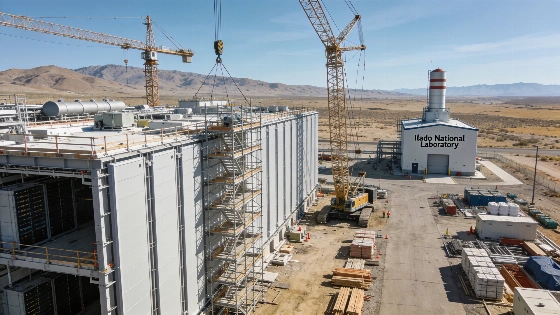
Crusoe and Aalo Atomics have announced a partnership to build a modular data center powered by a small nuclear reactor, aiming to test nuclear energy's suitability for large-scale AI computing at Idaho National Laboratory in 2027
Crusoe and Aalo Atomics have announced plans to construct what they describe as the first data center dedicated to artificial intelligence workloads powered by a small modular nuclear reactor. The project, scheduled for initial deployment at Idaho National Laboratory in 2027, is intended as a proof-of-concept to evaluate whether nuclear energy can reliably and sustainably support the growing power demands of advanced AI infrastructure.
The partnership will begin with a Crusoe Spark modular data center, which will run Crusoe Cloud services using electricity generated by Aalo Atomics' 10 megawatt electric (MWe) Aalo-X test reactor. According to the companies, this demonstration will be followed by larger-scale deployments, including Aalo Pods and 50 MWe XMR reactors at additional Crusoe data centers by the end of 2029. The companies have not disclosed independent technical documentation or peer-reviewed results for the planned systems, and the initial deployment remains a company-announced target rather than a completed milestone.
Technical and Operational Context
Small modular reactors (SMRs) such as the Aalo-X are designed to provide flexible, scalable power with a smaller physical footprint and potentially lower operational risk than conventional nuclear plants. For AI data centers, which require continuous, high-density electricity to operate large-scale machine learning models and cloud services, the ability to secure a stable and low-carbon power source is a significant technical challenge. The companies claim that their approach could demonstrate a path toward decarbonizing AI infrastructure, but the project's success will depend on regulatory approval, operational safety, and the ability to deliver consistent performance under real-world conditions.
Crusoe positions itself as an "AI factory" company, focusing on building data centers optimized for energy-intensive AI workloads. The company's stated goal is to provide scalable, cost-effective, and energy-first solutions for AI infrastructure, but the effectiveness of nuclear-powered data centers for this purpose has not yet been independently validated. Aalo Atomics, meanwhile, reports that it is one of four companies to reach reactor criticality under the U.S. Department of Energy's Reactor Pilot Program, but the operational history of its reactors remains limited to test environments.
Deployment Scale and Measured Figures
The initial demonstration will use a 10 MWe Aalo-X reactor to power a Crusoe Spark modular data center at Idaho National Laboratory. If the project proceeds as planned, subsequent deployments could involve 50 MWe XMR reactors at additional sites by 2029. For context, a 10 MWe reactor can supply enough electricity for a small data center, but scaling to multiple 50 MWe reactors would represent a significant increase in both energy supply and operational complexity. No independent measurements of uptime, failure rates, or energy efficiency for these reactors in commercial data center settings have been published. The companies have not disclosed the expected number of AI workloads, model training runs, or total compute capacity to be supported by the initial deployment.
Regulatory and Safety Considerations
Deploying nuclear-powered data centers introduces a range of regulatory, safety, and operational challenges. Nuclear reactors in the United States are subject to oversight by the Nuclear Regulatory Commission (NRC) and must meet stringent safety, security, and environmental standards. The use of SMRs for commercial data centers is not yet routine, and the regulatory pathway for such deployments remains under development. The companies have not detailed their plans for emergency response, waste management, or long-term operational oversight. Human supervision and intervention will be required for both reactor operation and data center management, and the integration of nuclear and digital infrastructure raises new questions about cybersecurity, physical security, and liability in the event of an incident.
While the companies present their initiative as a model for sustainable AI infrastructure, the project's broader significance will depend on its ability to demonstrate reliable, safe, and cost-effective operation at scale. The integration of advanced energy technologies with digital infrastructure is a growing trend, but nuclear energy's role in this context remains largely untested outside of controlled pilot projects.
Understanding the energy demands of AI data centers is essential for evaluating new power solutions. Training and running large machine learning models require vast amounts of electricity, often exceeding the capacity of traditional grid connections or renewable sources alone. Small modular reactors offer the potential for stable, high-density power with lower carbon emissions, but their deployment in commercial settings introduces complex regulatory, safety, and operational challenges. The success of nuclear-powered AI data centers will depend not only on technical feasibility but also on public acceptance, regulatory approval, and the ability to manage risks unique to both nuclear and digital systems.